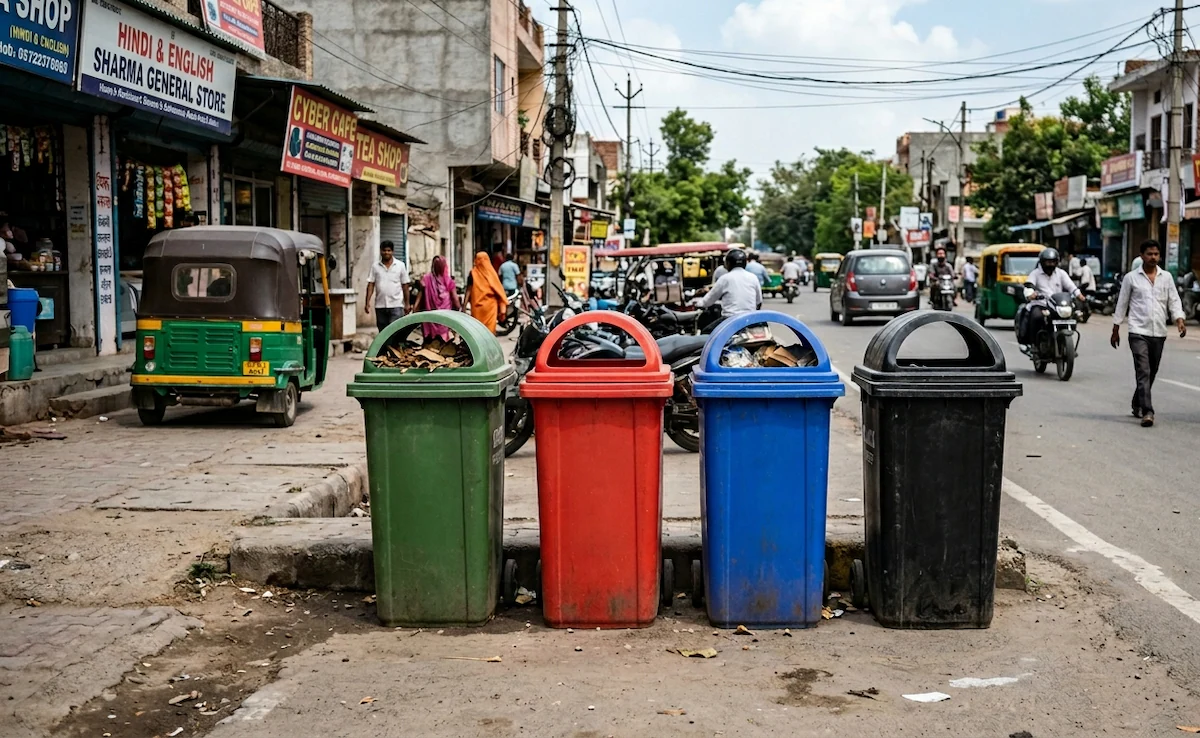
Indore Waste Management Model Strengthens Circular Urban Systems
India’s urban governance framework is entering a new phase of environmental accountability with the rollout of a mandatory four-bin waste segregation system across all urban local bodies from April 1. The reform, embedded in the revised Solid Waste Management Rules, marks a structural shift in how cities handle waste—moving from basic collection to scientifically managed segregation at source.
Under the new system, households and establishments are required to separate waste into four categories—wet, dry, sanitary, and hazardous—using colour-coded bins. This replaces the earlier two-bin model and is intended to streamline processing, reduce landfill dependency, and improve recycling efficiency across urban centres. The four bin waste system represents a critical intervention at a time when Indian cities are struggling with rising waste volumes driven by rapid urbanisation and consumption patterns. Municipal systems have historically relied on mixed waste collection, leading to inefficient sorting, environmental pollution, and overburdened landfill sites. By enforcing segregation at the source, authorities aim to reduce the load on downstream processing infrastructure and enable more efficient material recovery. Policy experts highlight that the reform aligns with broader circular economy principles, where waste is treated as a resource rather than a disposal challenge. Organic waste, for instance, can be composted or processed through bio-methanation, while recyclable materials are routed to dedicated recovery facilities. Hazardous and sanitary waste, often mixed with general garbage, will now require specialised handling to minimise public health risks. The rules also introduce accountability mechanisms, including penalties under the “polluter pays” principle for non-compliance. Sanitation workers are authorised to refuse collection of unsegregated waste, signalling a shift towards enforcement-led governance rather than voluntary compliance.
However, the transition presents significant operational challenges for urban local bodies. Cities will need to upgrade waste collection systems, including multi-compartment vehicles, decentralised processing facilities, and digital monitoring platforms to track waste flows. Public awareness campaigns and behavioural change initiatives will also be essential, as previous attempts at segregation—particularly under the two-bin model—have seen inconsistent adoption. Early signals from cities preparing for implementation suggest gaps between policy intent and ground readiness. Concerns range from inadequate infrastructure to limited citizen awareness, raising questions about how effectively the four bin waste system can be scaled across diverse urban contexts. From an urban planning perspective, the reform underscores the growing importance of environmental infrastructure alongside traditional sectors like transport and housing. Waste management systems are increasingly recognised as critical to city resilience, influencing air quality, public health, and land use patterns. The economic implications are equally significant. Efficient waste segregation can unlock value chains in recycling and composting industries, generate employment, and reduce municipal expenditure on landfill management.
For large waste generators—including institutions and commercial establishments—the rules mandate on-site processing, further decentralising waste handling responsibilities. As India’s cities continue to expand, the success of the four bin waste system will depend on execution at the local level. Coordinated planning, infrastructure investment, and citizen participation will determine whether the reform delivers cleaner, more sustainable urban environments—or remains another under-implemented policy ambition.