


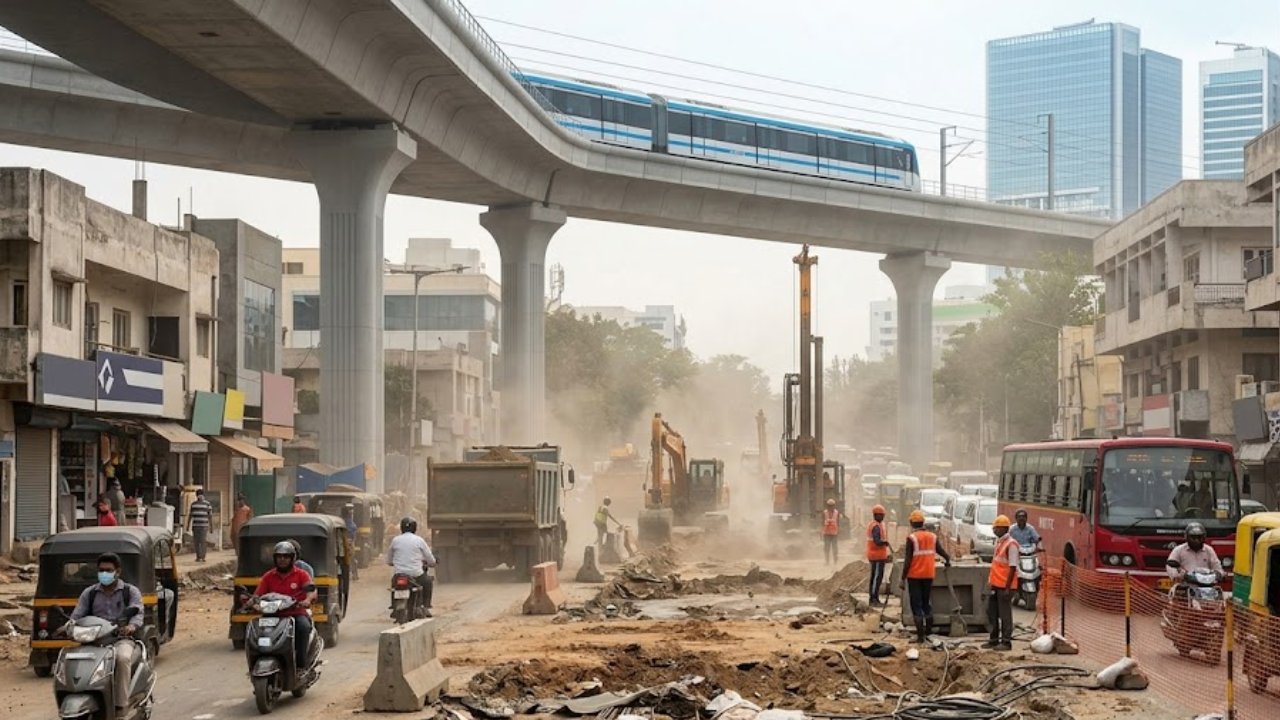
Commuters along Bengaluru’s Bannerghatta Road are facing prolonged travel delays as ongoing metro construction intensifies congestion on one of the city’s key arterial corridors.
The situation highlights the growing pains of infrastructure expansion in fast-growing urban centres, where development projects often intersect with already strained road networks.The disruptions, linked to elevated metro work, have narrowed carriageways and altered traffic flows, significantly affecting daily travel. The evolving conditions on Bengaluru Bannerghatta Road underscore the challenge of executing large-scale transit projects in densely populated areas without severely impacting mobility in the interim.Urban mobility experts point out that while metro expansion is critical for long-term congestion relief, the construction phase can create short-term inefficiencies. Reduced road capacity, combined with high vehicle volumes, has led to bottlenecks, longer commute times, and increased fuel consumption for motorists using Bengaluru Bannerghatta Road.Residents and commuters report that peak-hour traffic has become increasingly unpredictable, with delays spilling over into adjacent neighbourhoods. The lack of adequate diversion routes and limited real-time traffic management has compounded the issue, placing additional pressure on local streets not designed to handle heavy traffic loads.
From a planning perspective, the situation raises questions about construction-phase traffic management in rapidly expanding cities. Experts suggest that better coordination between project authorities, traffic police, and urban planners could help mitigate disruptions. Measures such as staggered construction schedules, improved signage, and digital traffic updates are often cited as essential tools for managing such transitions.The challenges on Bengaluru Bannerghatta Road also highlight the need for integrated transport planning. Expanding public transport infrastructure must be complemented by investments in last-mile connectivity, pedestrian infrastructure, and alternative routes to ensure that mobility remains functional during project execution.There are environmental implications as well. Prolonged congestion contributes to higher emissions and deteriorating air quality, particularly in high-density corridors. Experts emphasise that minimising construction delays and improving traffic flow during such phases is critical to reducing the environmental footprint of infrastructure projects.Despite the current disruptions, planners maintain that the metro expansion will provide long-term benefits by offering a high-capacity, efficient alternative to road-based travel. Once operational, the corridor is expected to ease congestion and improve connectivity across key parts of the city.
As Bengaluru continues to invest in mass transit, the experience of Bengaluru Bannerghatta Road serves as a reminder of the importance of balancing immediate commuter needs with future infrastructure gains. Managing this transition effectively will be key to ensuring that urban growth remains both sustainable and commuter-friendly.
Also Read:Bengaluru Vertical Housing Plan Adds 4000 Flats
