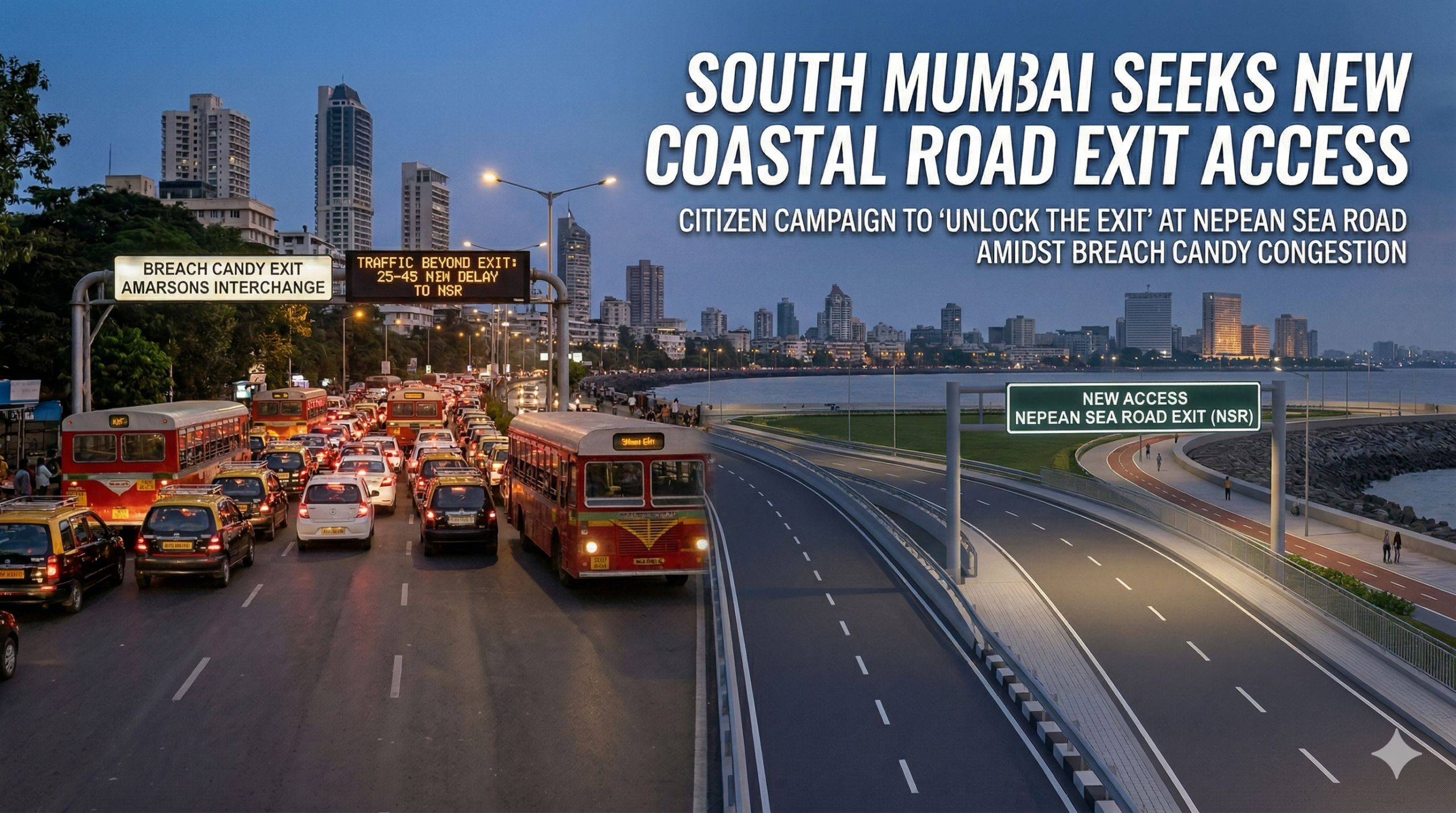
A growing section of South Mumbai residents is pressing for an additional exit along the Mumbai Coastal Road, as congestion at a key interchange continues to undermine the corridor’s time-saving promise. The demand centres on traffic bottlenecks near Breach Candy, where limited dispersal options are slowing vehicles despite otherwise seamless travel along the arterial stretch.
The Mumbai Coastal Road, conceived as a high-speed link between the city’s southern tip and its western suburbs, has significantly reduced commute durations across long distances. However, recent commuter feedback suggests that localised choke points—particularly at exit nodes—are offsetting these gains during peak hours. Urban mobility observers note that the current configuration funnels a substantial volume of northbound traffic through a narrow set of exit points. This concentration is creating delays in the final leg of journeys, especially for motorists heading towards Nepeansea Road and adjoining residential neighbourhoods. The absence of a direct dispersal route in this segment is forcing vehicles to rely on already burdened internal roads.
Residents and local stakeholders argue that the issue reflects a broader planning challenge often seen in dense urban corridors—where large-scale infrastructure improves corridor efficiency but falls short on last-mile integration. In this case, the missing Coastal Road exit is being viewed as a critical gap in the project’s overall traffic distribution strategy. Traffic spillover into surrounding streets has also raised concerns about neighbourhood-level impacts. Areas such as Bomanji Petit Road are witnessing increased vehicular load, with school traffic and kerbside parking further constraining movement. For residents, this has translated into longer travel times, reduced pedestrian safety, and a decline in local street liveability.
Planning experts suggest that adding a new Coastal Road exit could help redistribute traffic more evenly, easing pressure on existing interchanges. Preliminary discussions indicate that there may be technical options to introduce such an access point without disrupting the project’s coastal promenade or open space components. However, any intervention would require detailed feasibility assessments, environmental clearances, and coordination between multiple agencies. The situation underscores the importance of integrating micro-level mobility planning into mega infrastructure projects. While high-speed corridors are essential for reducing citywide congestion and emissions, their effectiveness depends on how well they connect with local road networks and support equitable access.
From a sustainability perspective, smoother traffic flow at exit points can also contribute to lower vehicular idling and emissions—an important consideration for a city grappling with air quality and climate resilience challenges. Authorities have yet to formally respond to the proposal, but the evolving discourse highlights how citizen-led inputs are increasingly shaping infrastructure conversations in Mumbai. Whether the Coastal Road exit demand translates into design revisions or operational tweaks will likely influence how future urban transport projects balance speed with accessibility and neighbourhood impact.
South Mumbai Seeks New Coastal Road Exit Access