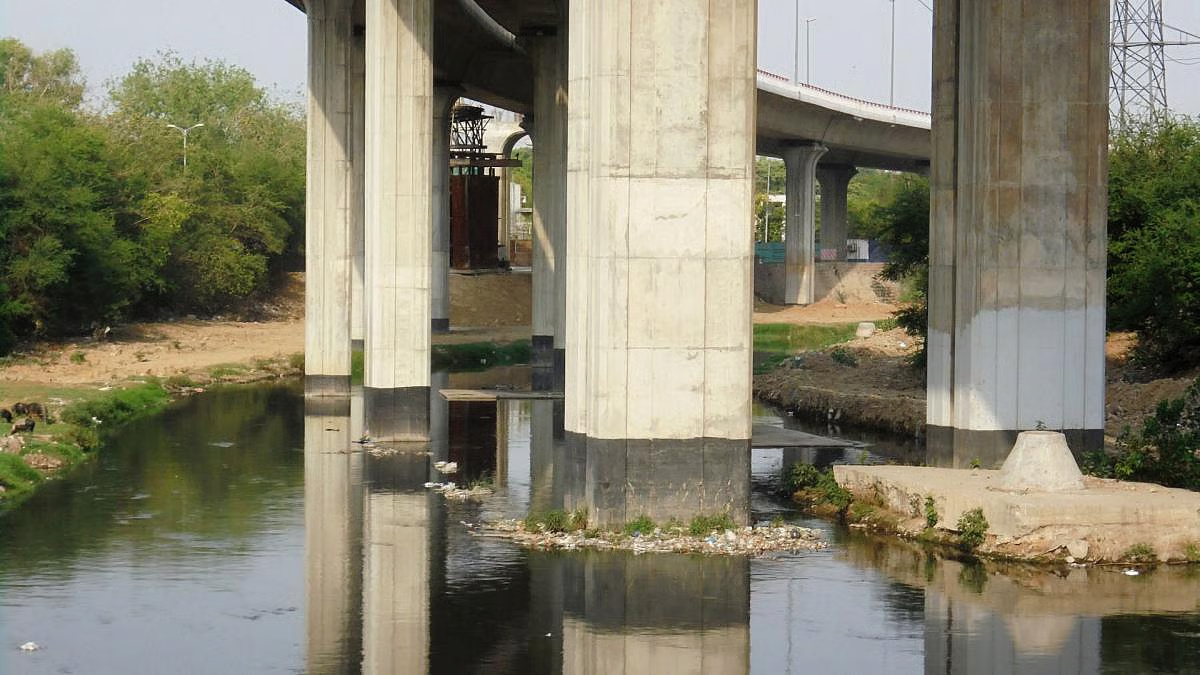
Delhi’s Barapullah drainage basin has become the centre of an administrative dispute after civic agencies presented conflicting claims before the environmental court regarding responsibility for sewer infrastructure gaps affecting the waterway. The development follows regulatory action taken after a government body failed to submit a required progress report on pollution mitigation measures linked to the drain network. In recent filings before the tribunal, the city’s shelter and rehabilitation agency stated that its responsibilities in informal settlements are limited to constructing and maintaining public sanitation facilities. According to officials familiar with the submission, the agency argued that the installation of sewer pipelines and the connection of toilets to the underground sewer network fall under the jurisdiction of the water utility.
The disagreement has intensified scrutiny of the Barapullah drain pollution issue, which has long been associated with untreated sewage flowing into subsidiary drains feeding the larger stormwater channel. Environmental authorities monitoring the matter indicated that incomplete coordination between civic departments has delayed the implementation of remedial measures. The tribunal had earlier imposed a financial penalty on the shelter agency for not submitting a comprehensive update on the condition of subsidiary drains in the Barapullah basin. The environmental body noted that the absence of a detailed report hindered the review of ongoing efforts to address contamination sources, particularly those linked to sewage discharge from dense informal settlements. Officials from the shelter authority stated that hundreds of public sanitation complexes operate across slum clusters in the capital, but the sewer lines that connect these facilities to the central system are developed and maintained by the water utility. As a result, they argued that delays in plugging sewage outlets into the formal drainage network cannot be attributed to their department alone. However, representatives of the water utility had earlier suggested that gaps in mapping sewage flows from informal settlements had slowed the process of connecting drains to treatment systems.
Urban governance experts say this institutional overlap often leads to delays in executing infrastructure upgrades in rapidly expanding cities. The Barapullah drain pollution problem has been raised repeatedly by residents of south Delhi neighbourhoods situated near the drainage corridor. Local communities report frequent waterlogging during the monsoon season, linking the flooding to blocked feeder drains and untreated wastewater entering the system. Urban planners note that the Barapullah drain is a critical part of Delhi’s stormwater infrastructure, designed to channel rainwater across several densely populated districts before it joins the Yamuna River. When sewage enters the network, it not only pollutes downstream water bodies but also reduces the drain’s capacity to manage heavy rainfall. Environmental analysts say the dispute highlights the need for integrated urban governance, particularly in managing wastewater and drainage systems that cut across multiple administrative jurisdictions. Without coordinated action between agencies responsible for sanitation, sewer networks and urban settlements, the capital may struggle to address long-standing water pollution challenges.
The tribunal is expected to review the latest submissions in the coming hearings and determine which institutions are accountable for addressing the infrastructure gaps contributing to Barapullah drain pollution, while also outlining steps needed to accelerate remediation efforts.