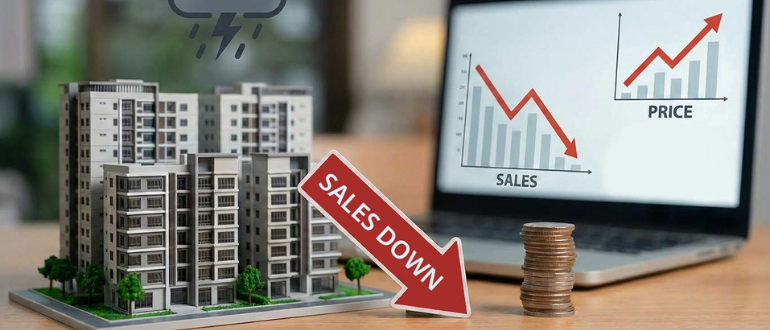
India’s residential property market has entered 2026 on a subdued note, with housing sales slipping below the one lakh threshold across the country’s top urban centres for the first time in over four years. The decline signals a shift in market momentum, raising questions about supply pipelines, affordability, and the pace of urban expansion in key metropolitan regions.
Latest market data indicates that total housing sales stood at 98,761 units in the January–March quarter, reflecting a double-digit annual contraction alongside a sequential dip. The downturn in India housing sales comes amid a parallel reduction in new project launches, pointing to a supply-side tightening rather than a sudden collapse in demand. Industry observers suggest developers are recalibrating their strategies, holding back inventory launches in response to elevated input costs, financing conditions, and cautious buyer sentiment. This has led to nearly 20% fewer units entering the market compared to the same period last year, constraining options for prospective homebuyers in several cities.
However, the slowdown has not been uniform. Bengaluru has emerged as a relative bright spot, reporting both quarterly and modest annual growth in sales volumes. The city’s strong employment base, particularly in technology and allied sectors, continues to support housing demand, reinforcing its position as a resilient urban growth engine. Delhi-NCR has also demonstrated stability, registering an annual uptick in transactions despite a marginal quarterly decline. Yet, experts note that a higher concentration of premium housing in the region has moderated absorption rates, as affordability pressures limit the pace at which such inventory is sold.In contrast, several traditionally high-volume markets including Mumbai, Pune, and Hyderabad have witnessed notable declines. These cities, often characterised by dense supply pipelines, are now experiencing the impact of delayed or deferred project launches. For urban planners, this trend raises concerns around uneven development and the risk of demand-supply mismatches in rapidly expanding peri-urban zones. The broader implications of falling India housing sales extend beyond market cycles.
A slowdown in residential activity can influence construction employment, urban infrastructure financing, and the pace of housing delivery in cities already grappling with population pressures. Reduced supply may also delay progress towards more inclusive and accessible housing, particularly in mid-income segments.At the same time, the current moderation could offer an opportunity for course correction. Experts point to the need for more balanced project portfolios, improved affordability through design efficiency, and greater alignment with sustainable urban planning principles. Cities that prioritise transit-linked development, energy-efficient housing, and mixed-use neighbourhoods may be better positioned to sustain long-term demand. As developers reassess pipeline strategies and buyers remain selective, the coming quarters will test the sector’s ability to stabilise. The trajectory of housing supply rather than demand alone may ultimately determine how India’s urban housing markets evolve through 2026.