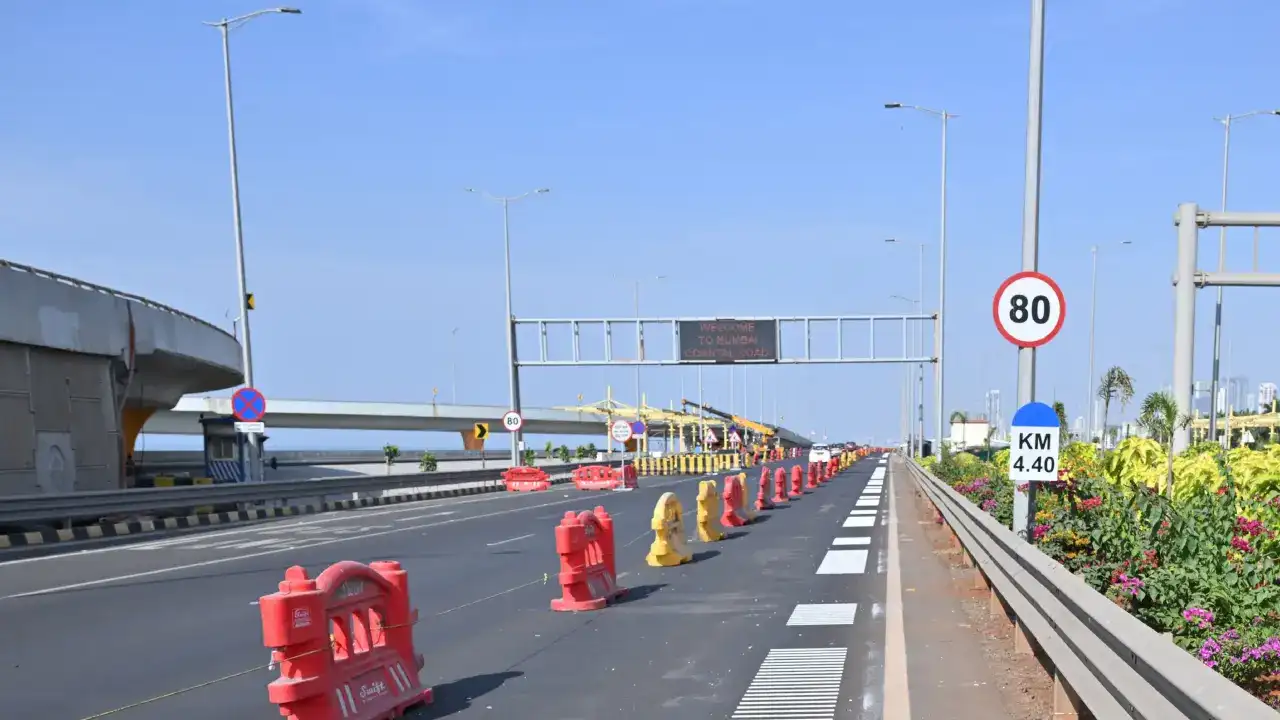
Mumbai’s experiment with sensory infrastructure on its flagship coastal corridor has triggered a policy rethink, with the Brihanmumbai Municipal Corporation modifying access to a recently introduced “musical road” feature after sustained objections from residents. The decision to allow vehicle movement on the stretch only during daytime hours reflects a growing tension between urban innovation and liveability in dense neighbourhoods.
The stretch, part of the Chhatrapati Sambhaji Maharaj Coastal Road, was designed to produce sound through tyre friction, creating a musical effect for passing vehicles. While positioned as a public engagement feature within a major infrastructure project, it has quickly become a point of friction with nearby residential communities. Civic officials had initially considered restricting access during select nights, before briefly moving towards a full closure. Within a short span, the approach was recalibrated to a time-based restriction—keeping the route operational during the day while barring traffic overnight. The shift, according to officials, was intended to balance citizen experience with concerns around disturbance in adjoining areas.
Residents, however, argue that the issue extends beyond late-night inconvenience. Community representatives have pointed to the continuous nature of the sound generated, suggesting that even daytime traffic volumes create persistent acoustic discomfort. Urban acoustics experts note that repetitive tonal noise, even within permissible decibel thresholds, can have a higher perceived impact on human well-being than irregular traffic sounds. The episode underscores a broader challenge in urban infrastructure planning—how to integrate experiential or aesthetic elements into functional assets without undermining quality of life. In high-density cities like Mumbai, where transport corridors often run in close proximity to residential zones, even minor design interventions can have amplified social consequences.
From a governance perspective, the reversal also highlights the role of citizen feedback in shaping project outcomes. Urban planners suggest that early-stage public consultation, particularly for non-essential design features, could help avoid such post-implementation adjustments. This is especially relevant as Indian cities increasingly adopt global design concepts without always accounting for local context. There are also cost and operational considerations. Maintaining time-based restrictions may require daily enforcement measures, raising questions around long-term feasibility and administrative efficiency. Experts indicate that adaptive infrastructure—capable of modification based on user response—will become increasingly important as cities experiment with new forms of public space design.
The coastal road project itself remains a critical mobility intervention aimed at reducing congestion and improving connectivity. However, the melody stretch controversy illustrates how even small components within large infrastructure projects can influence public perception and usability. As Mumbai continues to expand its transport network, the focus is likely to shift towards more context-sensitive planning—where innovation is balanced with environmental comfort, and infrastructure serves not just mobility goals but also the everyday well-being of urban residents.
BMC Alters Melody Road Plan Keeps It Open Only In Daytime, Shut At Night