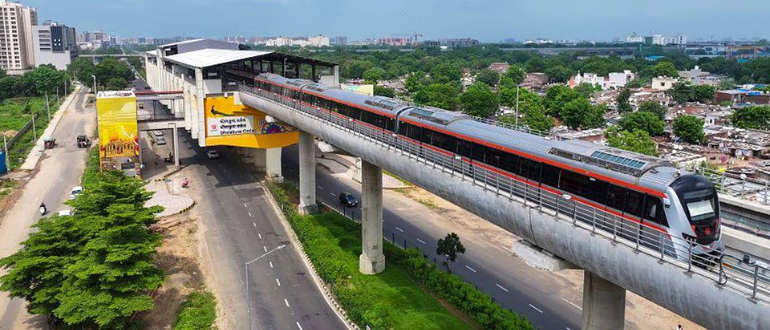
Surat Metro Diamond Corridor Trial Signals Transit Shift
Urban mobility in Surat has taken a significant step forward as trial operations commenced on a key section of the city’s upcoming Surat Metro system. The testing phase on the corridor popularly known as the “Diamond Corridor” marks an important milestone in the city’s effort to introduce high-capacity public transport to support its rapidly expanding population and economic activity.The trial runs involve testing train movement, track alignment, signalling systems and operational safety procedures along the corridor. Engineers and metro officials are using these trials to verify the performance of core infrastructure and ensure the system meets regulatory safety standards before passenger services begin.
Surat, one of India’s fastest-growing cities and a global hub for diamond processing and textile manufacturing, has experienced rapid urban expansion over the past two decades. This growth has placed increasing pressure on road networks, leading to longer commute times and higher congestion levels in several parts of the city.The Surat Metro corridor is designed to address these challenges by providing a modern, electric rapid transit system capable of carrying thousands of passengers each hour. By shifting commuters away from private vehicles and road-based transport, metro systems can reduce traffic congestion, lower emissions and improve overall urban mobility.Urban transport experts note that metro rail systems have become a central component of sustainable transport strategies across Indian cities. High-capacity electric rail networks help reduce dependence on fossil-fuel vehicles while providing predictable travel times for commuters.The Diamond Corridor connects several important urban districts, linking residential areas with commercial and employment hubs. Once operational, the corridor is expected to significantly shorten travel times across key parts of the city and improve access to workplaces and educational institutions.
Infrastructure specialists say trial operations typically involve multiple rounds of testing under different conditions, including varying train speeds and operational loads. These stages help engineers identify and resolve technical issues before commercial services begin.The Surat Metro project is part of a broader push to strengthen urban infrastructure in rapidly growing Indian cities. Investments in mass transit systems are increasingly viewed as necessary to support sustainable economic growth while reducing environmental impacts.City planners also expect metro stations to stimulate transit-oriented development in surrounding areas. Mixed-use development, improved pedestrian access and integrated public transport connections often emerge around metro corridors, gradually reshaping urban land use patterns.Surat’s growing economic influence has intensified the need for efficient mobility systems capable of supporting both residents and a large daily workforce. As industries expand and new residential neighbourhoods develop, reliable mass transit becomes critical for maintaining productivity and quality of life.
The ongoing trial phase will continue over the coming months as engineers evaluate system performance and safety parameters. Once the tests are successfully completed and approvals are granted, the Surat Metro corridor is expected to move toward passenger operations.For Surat, the start of metro testing signals the city’s transition toward a modern, low-emission public transport network designed to keep pace with its fast-changing urban landscape.