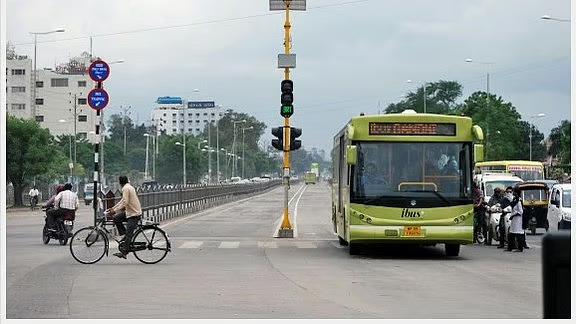
Indore Rajwada Bus Diversion Disrupts Daily Commutes
Public transport users in Indore are facing longer walking distances after authorities redirected city buses away from the busy Rajwada Circle, one of the city’s most important commercial and transit nodes. The change has forced many passengers to walk nearly a kilometre to access alternate stops, highlighting the challenges of managing traffic flows in dense historic urban districts.Rajwada, located in the heart of the old city, serves as a major interchange for the Indore city bus system, which connects dozens of neighbourhoods across the metropolitan region. However, recent traffic management measures have temporarily rerouted buses away from the circle, with passengers now required to board or disembark at alternative points along surrounding roads.
Urban transport officials say the decision was taken to reduce congestion and manage pedestrian pressure around the historic market zone. Rajwada is not only a cultural landmark but also a dense retail corridor that experiences heavy footfall throughout the day. During peak hours, the narrow streets struggle to accommodate buses, private vehicles, auto-rickshaws and large pedestrian volumes simultaneously.While the traffic adjustment may improve circulation in the immediate area, daily commuters say the diversion has created practical difficulties. Many passengers—particularly elderly residents, students and workers carrying goods from nearby markets—now have to walk significantly longer distances to reach the nearest functioning bus stop.The Indore city bus network, operated through a public–private transport model, forms the backbone of the city’s public mobility system. Introduced in the mid-2000s, the service runs across a wide network of routes linking residential areas, industrial zones and surrounding towns. The system carries thousands of passengers daily and is considered one of the more structured urban bus networks in central India.
Urban mobility experts say the situation reflects a broader challenge for rapidly expanding Indian cities: balancing heritage preservation, pedestrian safety and efficient public transport. Historic city centres often lack the street width required for modern high-capacity transit vehicles, forcing authorities to redesign routes or relocate bus stops.Transport planners argue that such changes should ideally be accompanied by clear signage, designated pedestrian corridors and improved last-mile connectivity. Without these supporting measures, temporary diversions can inadvertently reduce the accessibility of public transport—particularly for those who depend on it the most.The issue also underscores the importance of integrated mobility planning. Cities that rely heavily on buses must ensure that route changes do not disrupt the continuity of the network or discourage commuters from using public transport.
For Indore, which has gained national recognition for its urban management initiatives, the Rajwada diversion serves as a reminder that transport planning in historic districts requires careful coordination between traffic authorities, heritage planners and public transport operators.Officials are expected to review the effectiveness of the diversion in the coming weeks. Any long-term redesign of the Rajwada traffic system may need to incorporate pedestrian-friendly streets, organised bus access points and improved wayfinding so that the Indore city bus network remains accessible even as the historic core adapts to modern mobility demands.