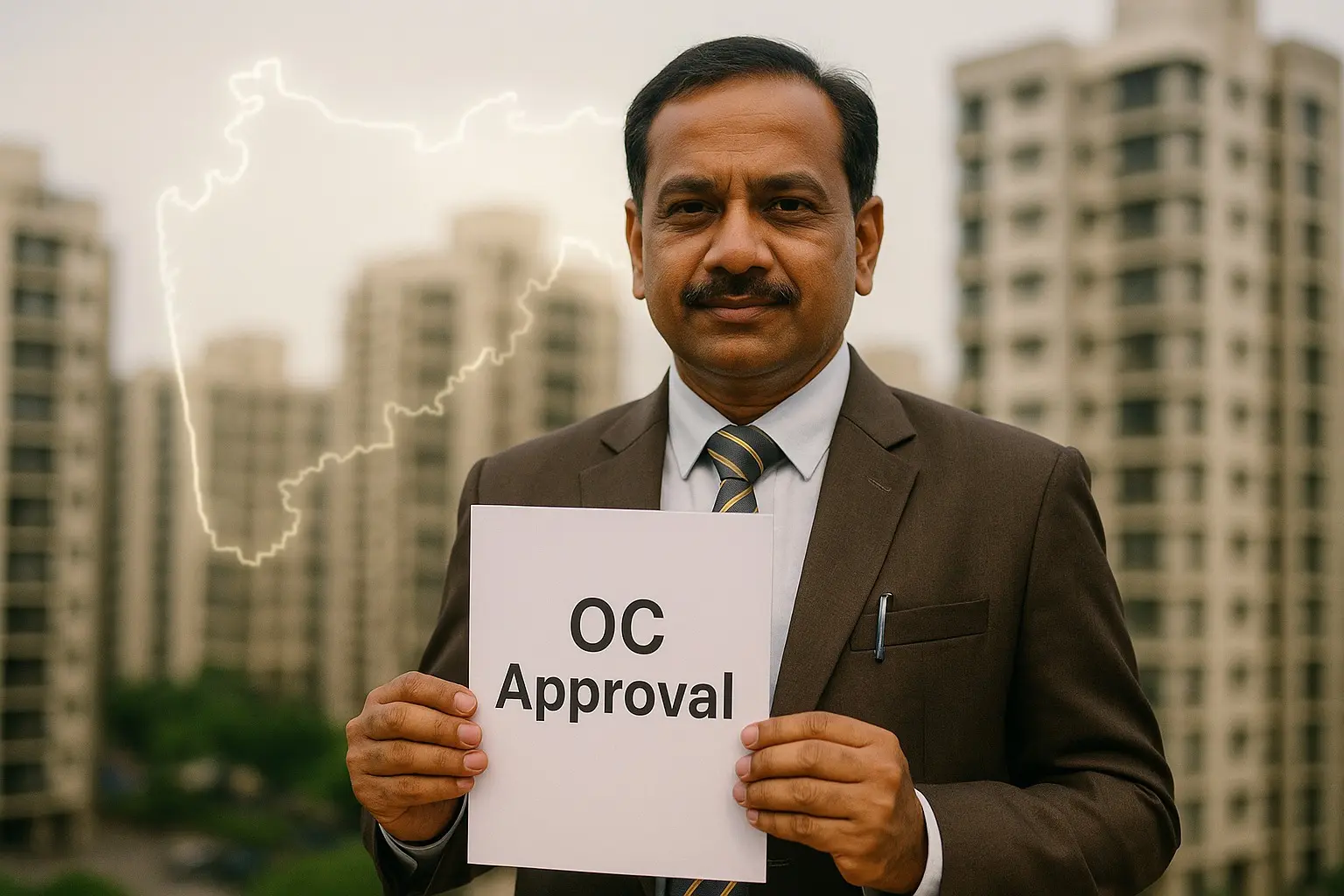
A long-standing regulatory gap affecting thousands of residential buildings in Mumbai may soon be addressed, as the city’s municipal authority prepares a framework to regularise pending Occupation Certificates (OCs). The proposed move, expected to be cleared shortly, could unlock legal status for a large segment of the city’s housing stock and reshape how compliance is handled in India’s most expensive real estate market.
Officials familiar with the process indicate that the new Mumbai Occupation Certificate policy is being structured as a time-bound amnesty window. Housing societies that have been unable to secure OCs often due to historical deviations, documentation gaps, or procedural delays may be allowed to apply within a defined period, subject to payment of charges linked to the nature and extent of non-compliance. For Mumbai’s urban ecosystem, the implications are significant. An OC is not merely a procedural document; it determines whether a building is legally fit for occupation and connected to essential civic services. In its absence, residents frequently face barriers in securing home loans, undertaking redevelopment, or obtaining clear utility connections. Urban planners note that this has created a parallel layer of informality within formally built environments an issue that complicates governance and long-term infrastructure planning.
The Mumbai Occupation Certificate policy is also expected to address ambiguity around mixed-use developments. Early indications suggest that both residential and commercial units may be brought under the same compliance umbrella, reflecting the evolving nature of urban land use in dense cities where commercial activity is often embedded within residential clusters. From a governance perspective, the initiative signals a shift towards reconciliation rather than enforcement alone. Experts argue that legacy regulatory challenges particularly in older cooperative housing societies cannot be resolved through punitive measures without disrupting livelihoods. Instead, structured regularisation allows municipal bodies to bring more properties into the formal system, improving data accuracy, tax compliance, and service delivery. There are also broader economic and environmental dimensions. Formalising a large base of housing stock could accelerate redevelopment in ageing buildings, many of which are structurally inefficient and energy-intensive.
This, in turn, aligns with the push for safer, climate-resilient urban infrastructure, especially in a coastal city increasingly exposed to extreme weather risks.However, the success of the policy will depend on clarity in implementation. Urban policy analysts caution that the framework must balance ease of compliance with safeguards against future violations. Transparent guidelines, predictable penalty structures, and digital processing systems will be critical to avoid bureaucratic bottlenecks that have historically delayed approvals. As the proposal moves through final approvals, attention will shift to how effectively it can bring thousands of housing societies into legal compliance. If executed well, it could set a precedent for other Indian cities grappling with similar regulatory backlogs offering a pathway to more accountable, inclusive, and resilient urban development.