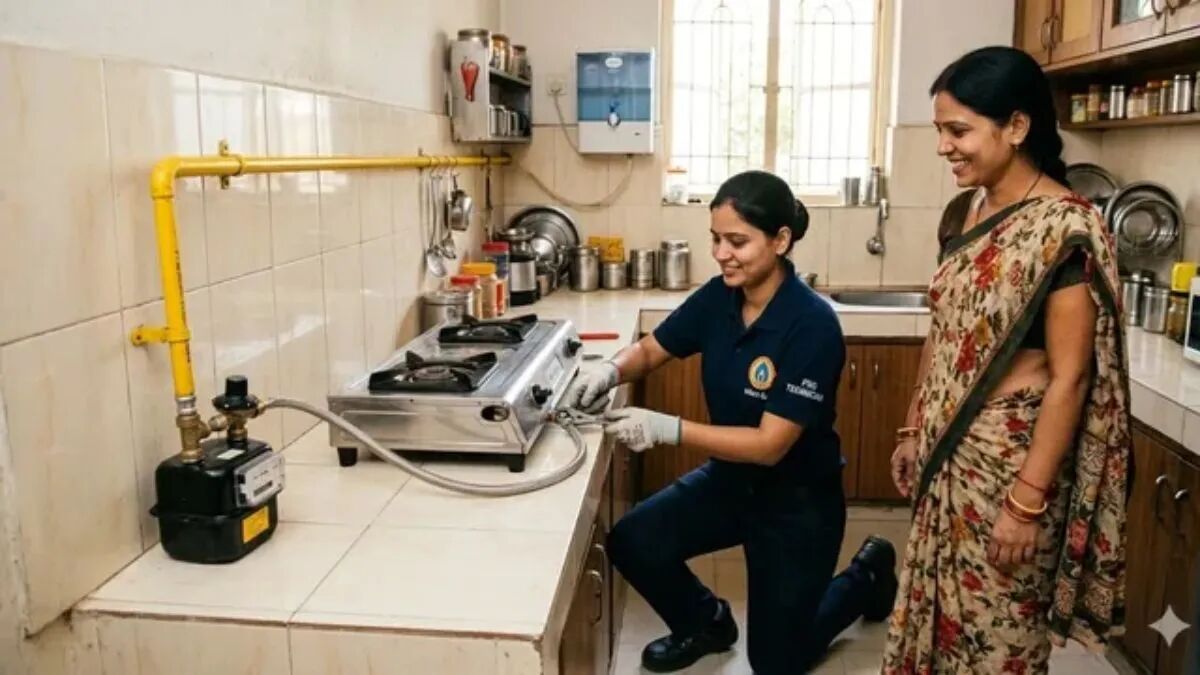
More than 30,000 households in Patna are now connected to the city’s piped natural gas network, marking a major shift in how the state capital is approaching urban energy infrastructure. The expansion, led by a state-owned gas utility, signals a broader transition away from cylinder-based cooking fuel towards a more stable and lower-emission energy system for dense urban neighbourhoods.
Officials indicated that the milestone reflects steady progress in laying distribution pipelines across residential zones that have seen rapid housing growth over the past decade. The expansion is not limited to existing urban centres but is also expected to reach newly developing residential clusters, where gas infrastructure is increasingly being treated as an essential service alongside water supply, drainage, and electricity networks. The growth in Patna PNG connections also comes at a time when the national government is accelerating the rollout of city gas infrastructure. Recent policy directives have called for faster approvals for pipeline projects and prioritisation of domestic piped gas connections, particularly in urban areas where large numbers of households still rely on LPG cylinders. The policy push is being linked to both energy security concerns and the need to reduce dependence on imported fuels. Urban planners say the development has wider implications beyond energy access. In fast-growing cities such as Patna, pipeline-based cooking fuel reduces the need for large-scale LPG storage and transportation, which often creates safety risks in densely populated areas.
It also reduces road-based delivery traffic, a factor that indirectly contributes to lower congestion and improved air quality. As a result, the increase in Patna PNG connections is increasingly being viewed as a core urban-infrastructure upgrade rather than just a utility expansion. The next phase of expansion is expected to focus on extending the network to more residential areas and strengthening distribution capacity. Industry experts point out that such projects typically become financially viable only after reaching a certain scale of household connections. Crossing the 30,000-home mark therefore represents an important stage in making the city’s gas network sustainable in the long term. The shift is also being driven by changing consumer behaviour. Across several cities in eastern India, demand for piped gas has increased as households look for uninterrupted supply and more predictable monthly costs. National data released recently shows a sharp increase in new PNG connections in March alone, highlighting how urban households are gradually moving towards pipeline-based fuel systems.
If the expansion continues at the current pace, the city could see a significant transformation in how urban energy is delivered over the next few years. For planners and policymakers, the real challenge will be ensuring that future housing developments integrate gas infrastructure at the planning stage — a step that could help smaller Indian cities transition more quickly towards cleaner and more resilient urban growth.