


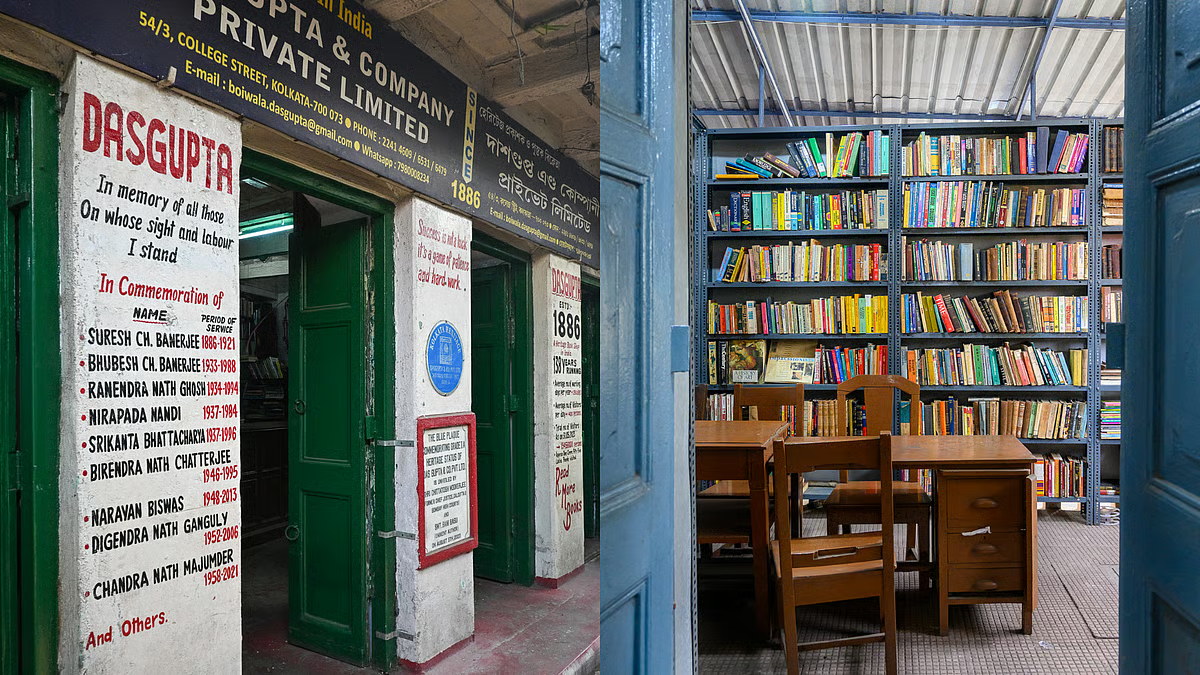
A quiet transformation is underway across Kolkata’s independent bookstores and reading spaces, where literature is increasingly being used to foster community interaction and redefine how urban residents engage with public and semi-public environments.
These evolving cultural hubs are emerging as more than retail outlets, positioning themselves as inclusive spaces that support dialogue, creativity and local economic activity.At the heart of this shift are Kolkata reading spaces, which are hosting curated events such as book discussions, author interactions and open-mic sessions. These initiatives are drawing diverse audiences, from students and professionals to independent artists, reflecting a broader demand for accessible and participatory cultural experiences within the city. In a dense urban setting, such spaces are filling a gap between formal cultural institutions and informal public areas.Urban planners and cultural economists view this trend as part of a larger movement towards adaptive reuse and mixed-use development. Many of these reading spaces operate within compact or repurposed properties, demonstrating how underutilised real estate can be transformed into active community assets. This aligns with sustainable urban development goals, where smaller, decentralised cultural nodes reduce the pressure on large infrastructure while enhancing neighbourhood-level engagement.
The rise of Kolkata reading spaces also highlights the growing role of the creative economy in shaping city dynamics. Independent bookstores are increasingly functioning as micro-enterprises that generate employment, support local authors and contribute to the circulation of ideas.
Industry observers note that such spaces can influence urban vibrancy, attracting footfall and encouraging ancillary businesses such as cafés and design studios.From a social perspective, these spaces are contributing to more inclusive forms of public interaction. Unlike traditional commercial environments, they often operate with flexible formats that encourage participation across age groups and backgrounds. This inclusivity is particularly relevant in cities where access to cultural infrastructure can be uneven, and where safe, gender-neutral spaces for expression remain limited.There are also implications for long-term urban resilience. As cities face challenges linked to climate change and economic uncertainty, smaller community-driven spaces can provide stability by fostering local networks and supporting grassroots initiatives. Experts suggest that integrating such cultural ecosystems into planning frameworks could enhance social cohesion and reduce reliance on centralised infrastructure.However, sustaining these initiatives requires supportive policy and financial models. Rising rents, changing consumer habits and competition from digital platforms pose ongoing challenges. Urban development specialists argue that incentives such as flexible zoning, rental support and recognition of cultural spaces as essential urban infrastructure could help ensure their continuity.
As Kolkata continues to balance heritage with modernisation, the evolution of its reading culture offers insight into how cities can nurture both intellectual and social capital. The growth of Kolkata reading spaces signals a shift towards more people-centric urban environments, where culture and community play a central role in shaping the future of city life.
Also Read:Kolkata Rabindra Sarovar Drives Urban Public Space Growth
