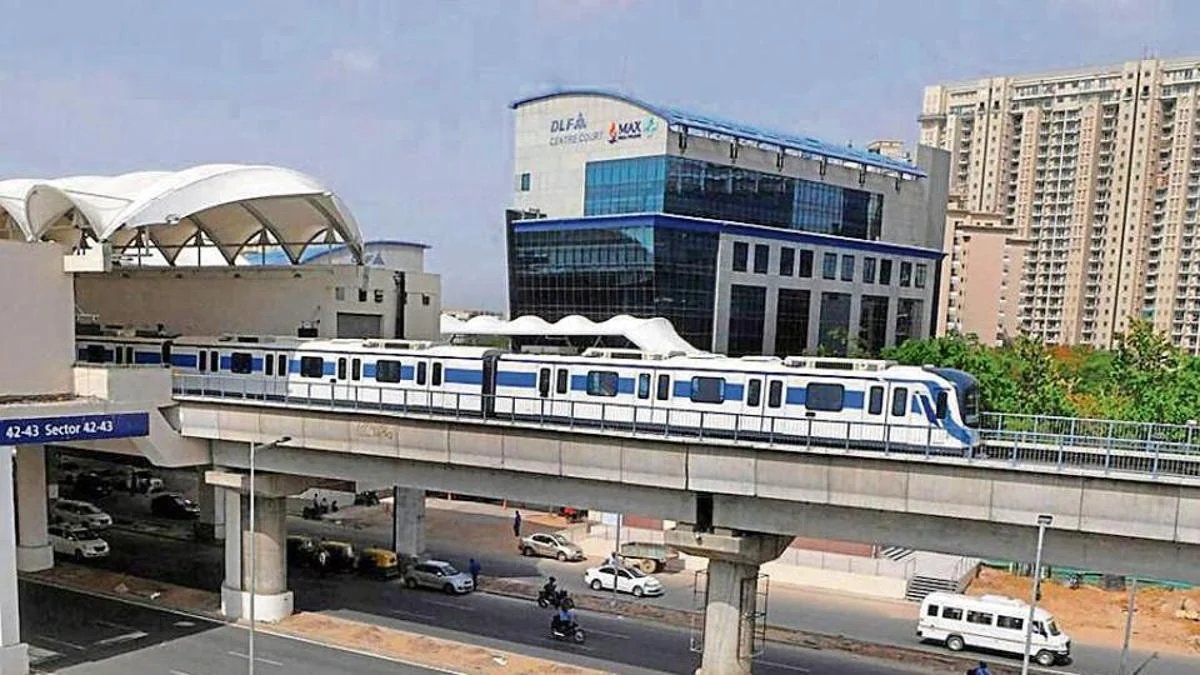
A major regional transit proposal is set to reshape mobility across the National Capital Region, with plans to develop 18 new stations as part of a high-speed corridor linking Gurugram, Faridabad and parts of western Uttar Pradesh. The Gurugram metro expansion is expected to significantly reduce travel time while strengthening economic and residential linkages across rapidly urbanizing zones. The proposed alignment, spanning roughly 64 kilometers, is designed as a high-speed regional system capable of operating at speeds of up to 180 kmph. Urban mobility experts say such infrastructure marks a shift from city-centric metro networks towards integrated regional transit, enabling daily commuting across multiple urban centers without reliance on road transport.
Of the planned stations, a larger share will be located in Faridabad, while key nodes in Gurugram will connect dense residential and commercial clusters. Strategic interchange points are expected to integrate with the existing metro network, allowing seamless transfers for passengers travelling between city and regional systems. One of the critical junctions will link the corridor with an established metro line, improving accessibility for office districts and institutional hubs.Planners indicate that the Gurugram metro expansion is being aligned with principles of transit-oriented development, where higher-density, mixed-use neighbourhoods are encouraged around stations. This approach can help reduce urban sprawl, lower dependence on private vehicles, and support more sustainable land use patterns. For a city like Gurugram, where rapid real estate growth has often outpaced infrastructure, such integration could improve long-term urban resilience.
The project also incorporates mitigation measures to address environmental and social concerns. Noise barriers are proposed along stretches passing through residential areas, reflecting a growing emphasis on reducing the externalities of large infrastructure projects. Experts note that such design interventions are essential to ensure that transport expansion does not compromise liveability. From an economic perspective, the corridor is expected to influence property markets along its route. Improved connectivity typically drives demand in peripheral areas, potentially unlocking new housing and commercial development. However, urban economists caution that without balanced planning, this could also lead to uneven growth or speculative activity. Institutional coordination remains a key factor in the project’s execution. The involvement of multiple state agencies and the need to align with existing transport systems underline the complexity of delivering cross-regional infrastructure. Policy analysts emphasise that timely approvals, funding clarity, and phased implementation will determine whether the project meets its intended outcomes.
As cities across India grapple with congestion and pollution, investments like the Gurugram metro expansion highlight the role of high-capacity public transport in building low-carbon, efficient urban regions. If implemented effectively, the corridor could serve as a template for integrating mobility, land use, and sustainability across metropolitan boundaries.