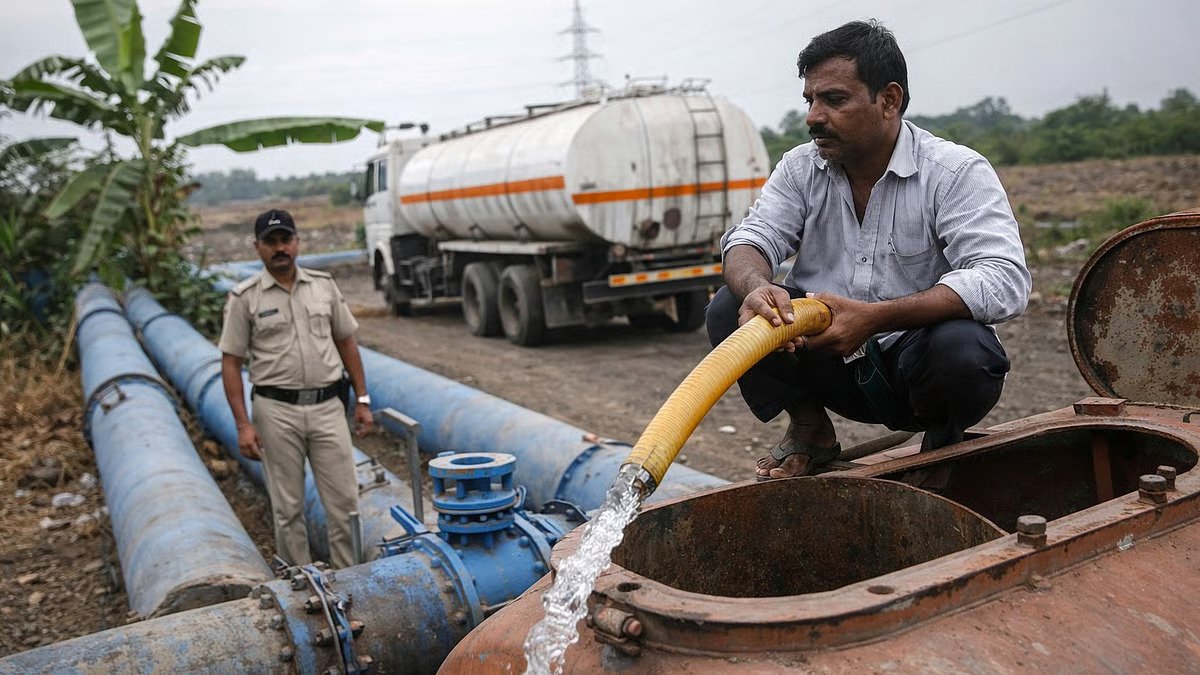
A case of illegal water extraction in Navi Mumbai has drawn attention to the growing strain on urban water systems, as authorities investigate unauthorised tapping of a key supply line amid persistent shortages across multiple nodes. The incident, detected in Kamothe, underscores the challenges of managing equitable distribution in rapidly expanding urban regions.
Officials from the City and Industrial Development Corporation (CIDCO) identified an unlawful connection to a primary water pipeline during a routine inspection in a residential-commercial cluster. The Navi Mumbai water theft case has since led to police action, with investigators examining the scale and duration of the unauthorised usage. Preliminary findings indicate that significant volumes of water were diverted over several months for commercial operations, even as surrounding areas such as Kharghar, Kalamboli and Taloja continued to face intermittent supply disruptions. Tanker-based distribution has become a common fallback in these zones, reflecting the widening gap between demand and piped supply.
Urban infrastructure experts say the Navi Mumbai water theft case highlights systemic vulnerabilities in utility management, particularly in peri-urban areas where rapid development often outpaces service delivery. Illegal tapping not only results in financial losses for civic agencies but also exacerbates inequities, depriving households of already scarce resources. The issue is further complicated by the mixed land-use patterns in nodes like Kamothe, where residential buildings coexist with small-scale commercial establishments. In such environments, monitoring consumption and enforcing compliance becomes more complex, requiring both technological interventions and stronger governance mechanisms.
Authorities have invoked provisions under the Bharatiya Nyaya Sanhita to address the offence, categorising it as damage to public resources. Officials suggest that similar inspections may be intensified across Navi Mumbai, particularly in areas experiencing acute shortages, to identify and curb unauthorised connections. From a broader perspective, the Navi Mumbai water theft case reflects the urgent need for more resilient and transparent water management systems. Experts advocate for smart metering, real-time monitoring, and stricter enforcement frameworks to prevent misuse while ensuring fair access. Additionally, long-term strategies such as water recycling, decentralised storage, and demand-side management are increasingly seen as essential for sustainable urban growth.
The incident also raises questions about how cities prioritise essential services in the face of rapid urbanisation. As Navi Mumbai continues to expand with new housing and infrastructure projects, ensuring reliable and equitable water supply will be critical to maintaining liveability and economic stability. Going forward, civic authorities are expected to tighten oversight and strengthen enforcement to prevent recurrence. For residents, the case serves as a reminder that infrastructure challenges are not only about capacity, but also about governance, accountability, and responsible usage of shared urban resources.
Navi Mumbai Police Act On Illegal Pipeline Water Extraction