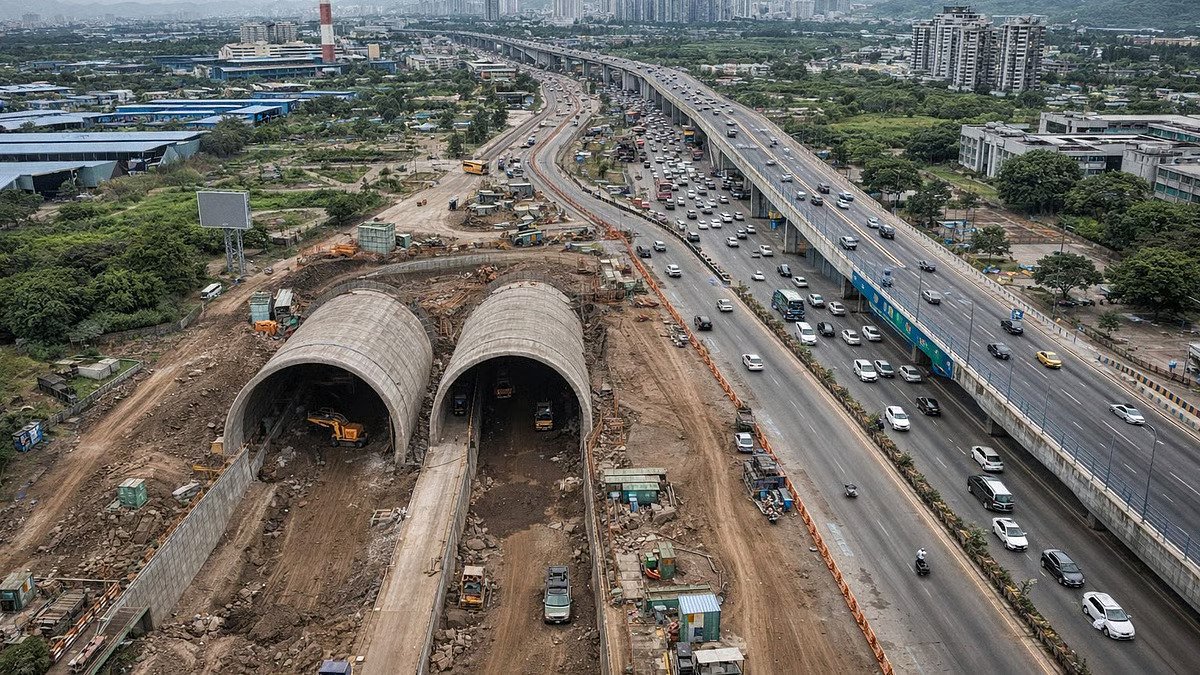
The Navi Mumbai Municipal Corporation has approved a series of road infrastructure projects aimed at addressing rising congestion across key industrial and residential corridors. The decision includes new flyovers along the Thane Belapur Road and a signal-free underground tunnel at a major junction in Belapur, signalling a push to strengthen mobility capacity in one of the Mumbai Metropolitan Region’s fastest-growing urban clusters.
The Navi Mumbai flyovers tunnel project focuses on three high-traffic junctions—Rabale, Pawane and Turbhe—where daily congestion has intensified due to a mix of industrial logistics and commuter traffic. These stretches serve as vital connectors between employment hubs and residential zones, making them critical for both economic activity and urban mobility. In parallel, a twin-tube underground tunnel is planned near Kille Junction, a key convergence point close to the city’s administrative centre and the terminus of Palm Beach Road. The junction has long been a bottleneck, with peak-hour delays affecting connectivity between multiple arterial routes. Officials expect the grade-separated design to enable uninterrupted traffic flow and reduce surface-level congestion.
Urban planners note that the Navi Mumbai flyovers tunnel project reflects a broader shift towards grade-separated infrastructure to manage increasing vehicular demand. With major developments such as the Navi Mumbai International Airport and regional connectors like Atal Setu expected to drive additional traffic into the city, the need for pre-emptive capacity enhancement has become more urgent. However, the proposal has also triggered debate around project prioritisation and financial transparency. Concerns have been raised within civic circles about the absence of detailed cost disclosures, contractor selection processes, and funding clarity at the approval stage. Governance experts suggest that such large-scale infrastructure interventions require robust pre-project evaluation to ensure long-term financial sustainability.
The projects are set to be implemented under the Hybrid Annuity Model, a framework that combines public funding with private sector participation. While this model has been widely used to accelerate infrastructure delivery, recent audits across India have highlighted the importance of strong oversight mechanisms to prevent cost inefficiencies and ensure accountability. From an urban development perspective, the Navi Mumbai flyovers tunnel project could significantly influence travel patterns and land use dynamics. Improved connectivity along the Thane–Belapur corridor may enhance accessibility to industrial estates while supporting residential expansion in surrounding areas. However, experts caution that road-based solutions must be complemented by investments in public transport and non-motorised mobility to achieve balanced and sustainable growth.
As Navi Mumbai continues to evolve as a key economic node within the metropolitan region, infrastructure decisions such as these will play a defining role in shaping its urban form. The effectiveness of the approved projects will ultimately depend on execution quality, integration with wider mobility systems, and their ability to deliver long-term congestion relief without compromising environmental and social considerations.
Navi Mumbai Approves Flyovers On Thane Belapur Corridor And Tunnel