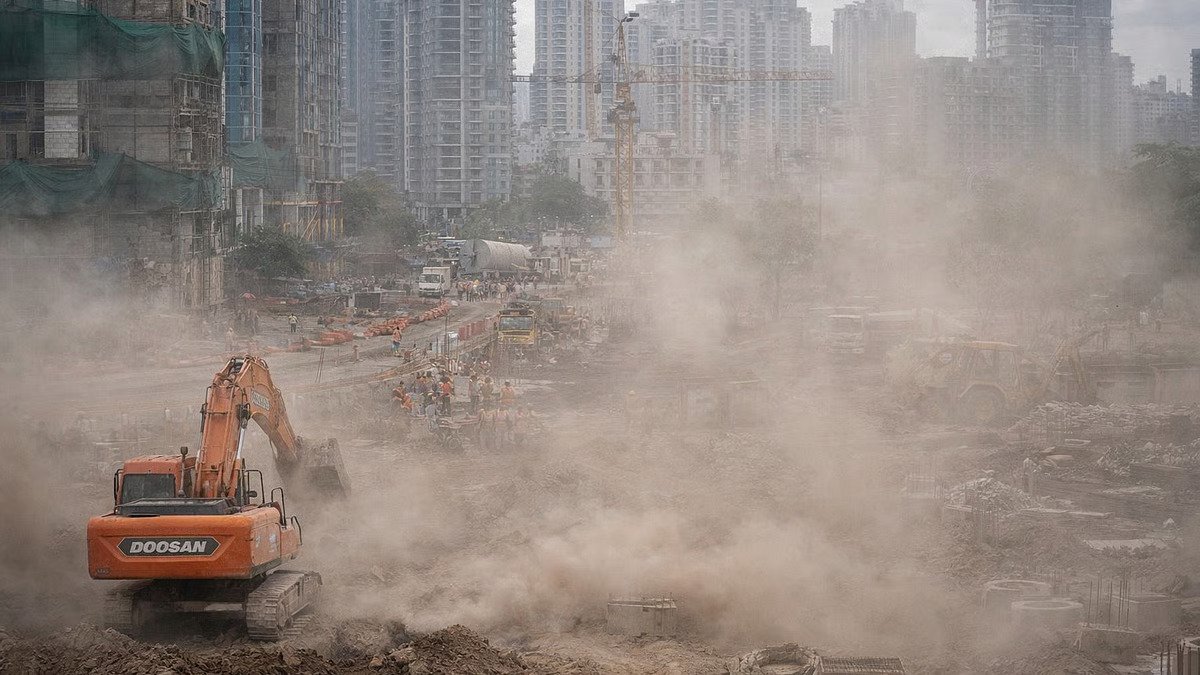
Mumbai’s civic administration has intensified enforcement against non-compliant construction activity, issuing over a thousand stop-work directives across the city in recent months as part of a broader effort to tackle worsening urban air quality.
Between October 2025 and February 2026, authorities initiated widespread action under the Mumbai construction pollution crackdown, targeting projects that failed to adhere to mandatory dust and emission control norms. The enforcement drive covered both private developments and public infrastructure works, reflecting the scale of construction-led pollution in a rapidly expanding metropolitan region. Officials indicate that only a small fraction of sites have resumed operations after demonstrating compliance, suggesting persistent gaps in on-ground implementation of environmental safeguards. Urban planners note that while regulatory frameworks have strengthened in recent years, consistent enforcement remains a challenge in cities experiencing high construction intensity.
Data from civic inspections show that certain suburban wards with dense construction activity recorded the highest number of violations. Areas such as Ghatkopar, Vikhroli, Malad, and parts of the western suburbs have emerged as hotspots, driven by ongoing residential, commercial, and infrastructure projects. In contrast, older, built-out areas with limited new construction reported fewer violations. The Mumbai construction pollution issue is closely linked to particulate matter emissions, particularly PM2.5 and PM10, which pose serious health risks. Studies by leading research institutions have previously highlighted that construction dust, along with road dust and vehicular emissions, forms a significant share of the city’s pollution load. With an increase in infrastructure projects over the past few years, experts believe the contribution from construction activity may be rising further.
In response, authorities have mandated a series of mitigation measures, including on-site dust suppression systems, covering of construction materials, wheel-washing facilities, and the installation of real-time air quality monitoring devices. These monitors are required to display particulate levels publicly, increasing accountability and transparency. Environmental experts emphasise that such steps are essential for building climate-resilient cities, particularly as urban centres balance infrastructure growth with sustainability goals. However, they caution that compliance must be continuous rather than reactive, requiring stronger monitoring systems and penalties that deter repeat violations.
The surge in enforcement also aligns with judicial directives pushing for stricter oversight of pollution sources in major cities. For developers and contractors, this signals a shift towards more accountable construction practices, where environmental compliance is becoming as critical as project timelines. Looking ahead, urban policy experts suggest that integrating green construction standards, incentivising low-dust technologies, and improving coordination between regulatory bodies could help reduce the environmental impact of large-scale development.
As Mumbai continues to expand vertically and horizontally, the effectiveness of the Mumbai construction pollution crackdown will be a key determinant in balancing growth with public health and environmental sustainability.
BMC Stops Work At Over Thousand Sites For Pollution Breach