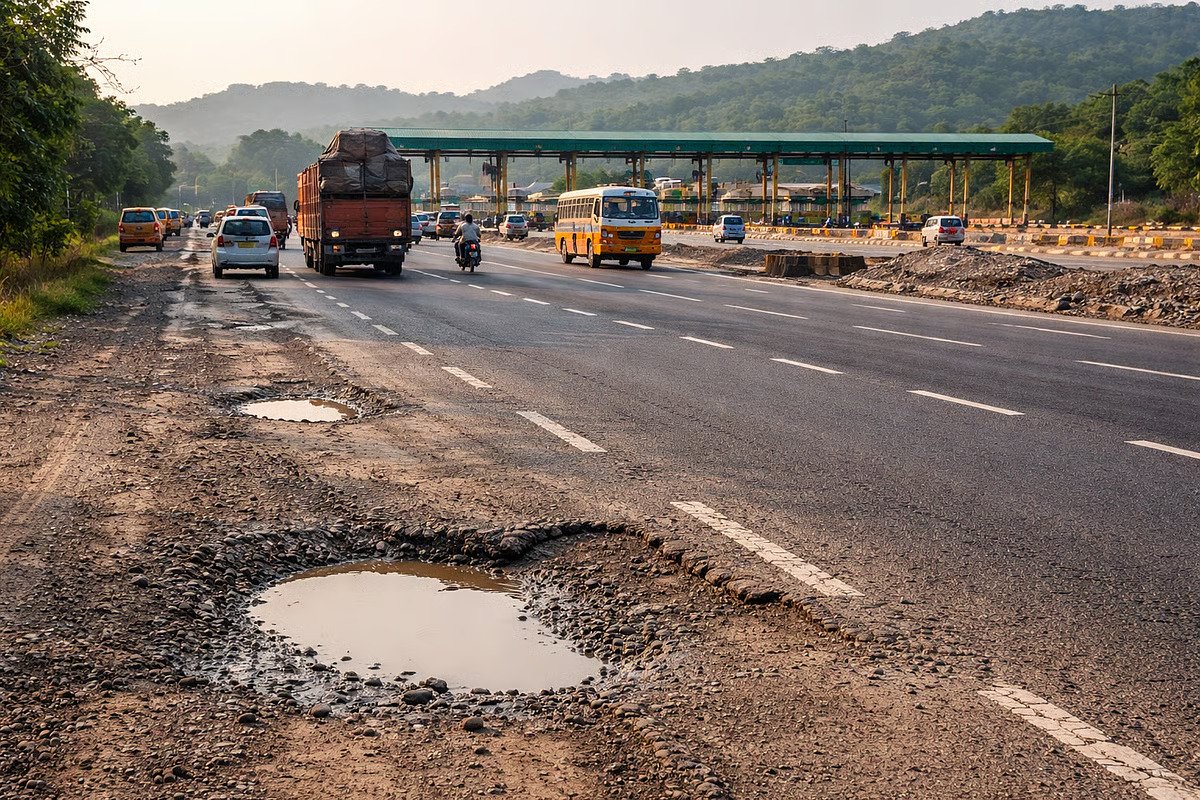
Concerns over safety, project delays and user costs are intensifying scrutiny of toll collection plans along the Mumbai Goa Highway, with growing calls to reassess charging mechanisms until the corridor is fully operational.
The highway, a critical arterial route connecting Mumbai to the Konkan region, has been under phased expansion for several years. While parts of the road are operational, significant stretches remain incomplete or under construction, prompting questions over whether tolling should proceed in its current form. The issue has gained traction during ongoing policy discussions around infrastructure accountability and public spending. Stakeholders have raised concerns that the Mumbai Goa Highway continues to face structural and operational gaps, including unfinished carriageways, inconsistent road quality, and the presence of accident-prone zones. Transport analysts note that tolling is typically linked to the delivery of a defined service standard — including safety infrastructure, signage, and emergency response systems — which, in this case, is perceived to be uneven across stretches.
Data cited by local observers suggests that the corridor has recorded a significant number of accidents over time, highlighting the need for improved safety design, better traffic management, and faster completion of pending works. Experts caution that incomplete infrastructure, combined with high vehicular movement, can increase risk exposure, particularly in regions with challenging terrain such as the Konkan belt. Another dimension of the debate relates to the economic impact on local communities. Residents in towns and villages along the alignment rely on the highway for daily commuting, access to healthcare, and market connectivity. Urban planners argue that toll frameworks must consider such local usage patterns, potentially through exemptions or differential pricing models, to avoid placing disproportionate financial burdens on frequent users.
The broader economic implications are also under discussion. The Mumbai Goa Highway was envisioned as a catalyst for regional growth, supporting tourism, logistics, and small businesses across coastal Maharashtra. However, prolonged construction timelines and recurring disruptions have affected travel reliability, with stakeholders indicating that this has dampened economic activity in certain pockets. From an infrastructure governance perspective, the situation underscores the importance of aligning project delivery with user expectations. Experts suggest that toll collection mechanisms should be closely linked to completion milestones, ensuring that road users pay for a fully functional and safe corridor rather than a partially developed asset.
There are also calls for enhanced transparency in project execution, including regular public updates on timelines, quality audits, and safety compliance. Integrating technology-driven monitoring systems could further improve oversight and accountability. As discussions continue, policymakers may need to balance financial sustainability of highway projects with equitable access and user safety. The trajectory of the Mumbai Goa Highway will likely influence how future road projects structure tolling policies, particularly in cases where construction spans extended timelines.
Mumbai Goa Highway Toll Debate Grows Over Safety Issues