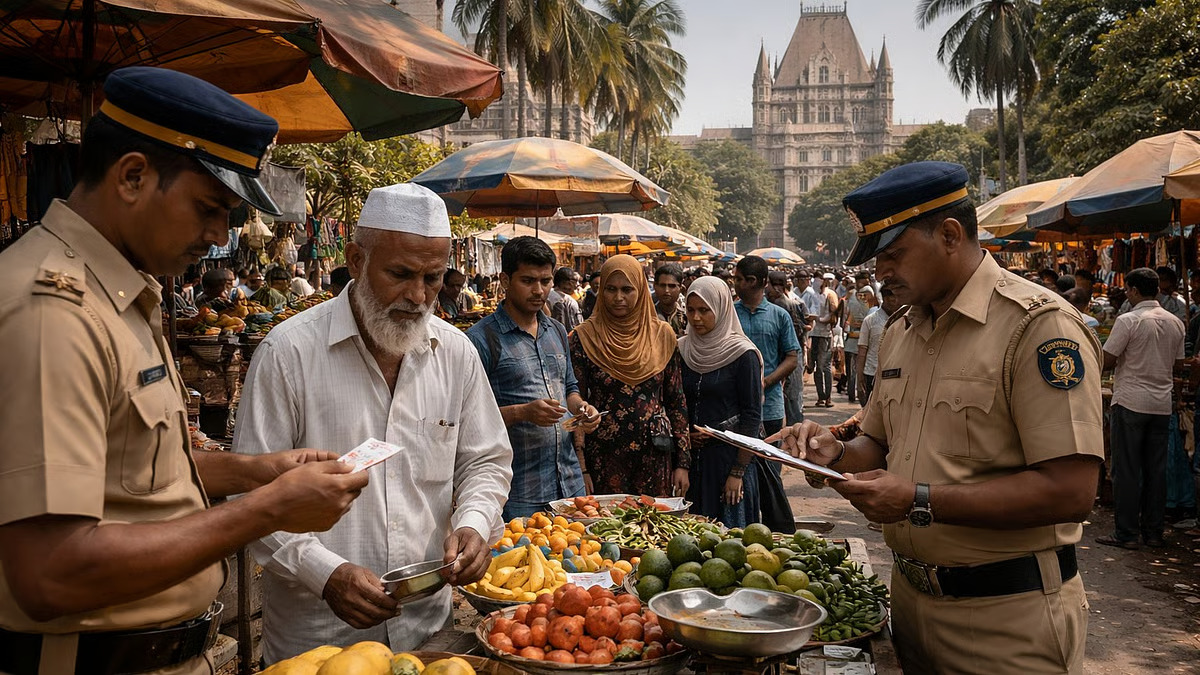
A judicial directive to verify the identity of street vendors across Mumbai is set to reshape how informal commerce is regulated in one of India’s most densely populated urban economies.
The Bombay High Court has instructed the Brihanmumbai Municipal Corporation and law enforcement agencies to undertake a comprehensive street vendor verification exercise, covering not only licensed hawkers but also assistants and workers associated with roadside businesses. The move follows concerns raised in ongoing legal proceedings over unregulated vending and gaps in enforcement. Officials familiar with the matter said the directive aims to establish clearer accountability within Mumbai’s vast informal retail network, which supports thousands of livelihoods but often operates outside formal regulatory frameworks. The verification process is expected to include identity checks and documentation review, particularly in cases where individuals’ residency status is unclear.
Urban policy experts note that street vendor verification in a city like Mumbai presents both administrative and social challenges. Street vending is a critical component of the urban economy, offering affordable goods and employment opportunities, especially for migrant populations. However, the absence of accurate data and inconsistent licensing practices has led to congestion, encroachment on public spaces, and friction with formal businesses and pedestrians. The court has also signalled a stricter stance on enforcement, indicating that officials could face consequences for inaction. This is likely to accelerate coordination between civic departments and police authorities, particularly in high-density commercial zones where unregulated vending is most visible.
The directive comes at a time when the implementation of the Street Vendors Protection of Livelihood and Regulation of Street Vending Act 2014 remains uneven. The legislation was designed to balance the rights of vendors with urban management needs through licensing, designated vending zones, and town vending committees. In practice, delays in surveys and policy execution have limited its effectiveness in Mumbai. Urban planners argue that any street vendor verification exercise must be paired with transparent rehabilitation and licensing mechanisms. Without this, enforcement-led approaches risk displacing vulnerable workers without addressing the structural demand for informal retail in the city. There is also growing recognition that inclusive planning — including well-designed vending zones integrated into transport corridors and public spaces — can reduce conflicts while sustaining livelihoods.
From a broader urban development perspective, the court’s intervention reflects increasing pressure on cities to manage public space more efficiently amid rising population density and infrastructure expansion. As Mumbai invests in road upgrades, metro networks, and pedestrian-friendly initiatives, the regulation of street-level activity becomes central to ensuring accessibility and safety. The coming weeks are likely to see intensified on-ground activity as authorities begin implementing the directive. How effectively Mumbai balances enforcement with inclusion will determine whether this exercise leads to a more organised and equitable urban vending ecosystem.
Mumbai Court Orders Citywide Verification Of Hawkers And Assistants