


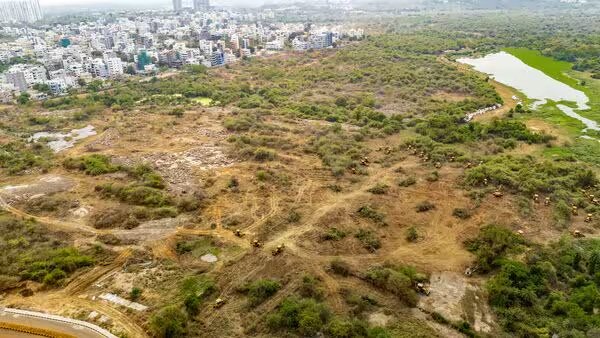
Nagpur’s long-awaited urban expansion blueprint is facing delays as ongoing land use mapping exercises slow the finalisation of its revised development plan. The lag is beginning to affect how the city prepares for future growth, raising concerns about planning certainty, investment timelines, and infrastructure coordination. At the centre of the issue is the Nagpur land use survey, a foundational process that determines how land parcels are classified for residential, commercial, industrial, and green purposes. Officials involved in the exercise suggest that discrepancies in existing records, combined with rapid and often unregulated urban expansion, have made data consolidation more complex than anticipated.
Urban planners note that without a completed Nagpur land use survey, authorities cannot accurately allocate land for critical infrastructure such as roads, drainage systems, and public amenities. This creates a ripple effect, delaying approvals for new projects and limiting the city’s ability to guide growth in a structured manner. The delay comes at a time when Nagpur is emerging as a logistics and industrial hub, particularly with increased activity in regions like MIHAN. Industry stakeholders indicate that uncertainty around zoning and land classification can deter investment decisions, especially for large-scale projects that require clear regulatory frameworks. There are also implications for housing. In the absence of an updated plan, developers often face ambiguity over permissible land use, which can slow down project launches or lead to fragmented development. Experts warn that such conditions can push growth towards informal or poorly serviced areas, increasing long-term urban management challenges. From a governance perspective, the Nagpur land use survey highlights the difficulty of aligning legacy land records with contemporary urban realities. In many Indian cities, outdated cadastral maps and overlapping jurisdictional records complicate planning exercises. Digitisation and geospatial mapping are seen as essential tools, but their implementation requires coordination across departments and consistent data standards. The environmental dimension is equally significant. Accurate land use mapping enables cities to protect natural assets such as water bodies, green belts, and floodplains. Delays in completing the Nagpur land use survey could risk these areas being encroached upon or misclassified, undermining climate resilience efforts.
Experts suggest that accelerating the survey process will require a combination of technological integration and institutional alignment. Real-time data sharing, satellite-based mapping, and community-level verification can help improve accuracy while reducing timelines. For Nagpur, the stakes extend beyond administrative efficiency. A timely and robust development plan will determine whether the city can manage its growth sustainably, ensuring equitable access to infrastructure while preserving environmental balance. Until then, the pace of urban transformation may remain uneven, shaped as much by uncertainty as by opportunity.
ALSO READ – Nagpur Power Disconnections Expose Urban Payment Gaps
Nagpur Land Use Survey Delays Development Roadmap
