


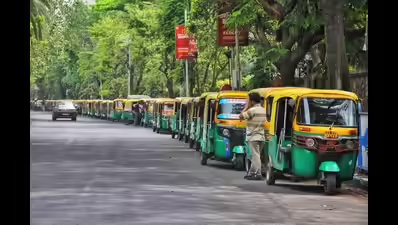
A sudden drop in autorickshaw availability disrupted daily travel across parts of Kolkata, leaving commuters struggling to find last-mile connectivity and exposing structural gaps in the city’s transport ecosystem.
The Kolkata auto disruption saw a significant portion of vehicles remain off the roads, particularly on key routes, affecting both routine and weekend travel patterns.Transport observers indicate that a large share of autorickshaws—often the backbone of short-distance mobility—were unavailable due to operational concerns linked to enforcement, route regulations, and localised disputes. While such interruptions are not uncommon, their impact is amplified in dense urban corridors where alternative options are limited or already operating at capacity.The Kolkata auto disruption underscores the critical role informal and semi-formal transport systems play in Indian cities. Autorickshaws bridge the gap between mass transit hubs and residential or commercial zones, especially in areas underserved by metro rail or bus networks. When this layer weakens, the ripple effects are immediate—longer wait times, higher fares in unregulated segments, and increased reliance on private vehicles.Urban planners highlight that recurring disruptions point to deeper coordination challenges between regulators and transport operators. Route permits, fare structures, and compliance measures often vary across jurisdictions, creating friction that can lead to sudden service withdrawals. For commuters, this translates into uncertainty and reduced trust in everyday mobility systems.
From an economic standpoint, the disruption also affects productivity. Workers dependent on autos for first- and last-mile travel face delays, while small businesses experience reduced footfall. In a city where a large segment of the workforce operates in informal or time-sensitive roles, even short-term transport gaps can have disproportionate impacts.There are also environmental implications. A reduction in shared mobility options often pushes commuters towards private cars or app-based taxis, increasing congestion and emissions. Experts argue that strengthening intermediate public transport—such as autos—can play a key role in reducing the carbon footprint of urban travel, provided systems are better integrated and regulated.The Kolkata auto disruption further raises questions about resilience in urban mobility planning. Cities are increasingly being encouraged to diversify transport options, including non-motorised mobility, electric vehicles, and integrated ticketing systems. However, without stable operations in existing networks, these transitions risk being uneven.Officials in the transport department are expected to engage with stakeholders to restore services and address operational concerns. Longer-term solutions may involve clearer policy frameworks, improved dialogue mechanisms, and investments in multimodal connectivity.
For Kolkata’s commuters, the episode serves as a reminder of how dependent the city remains on fragile mobility networks—and how essential it is to build systems that are both reliable and adaptable in the face of recurring disruptions.
Also Read:Kolkata Restaurant Fuel Shift Reshapes Urban Energy Use
