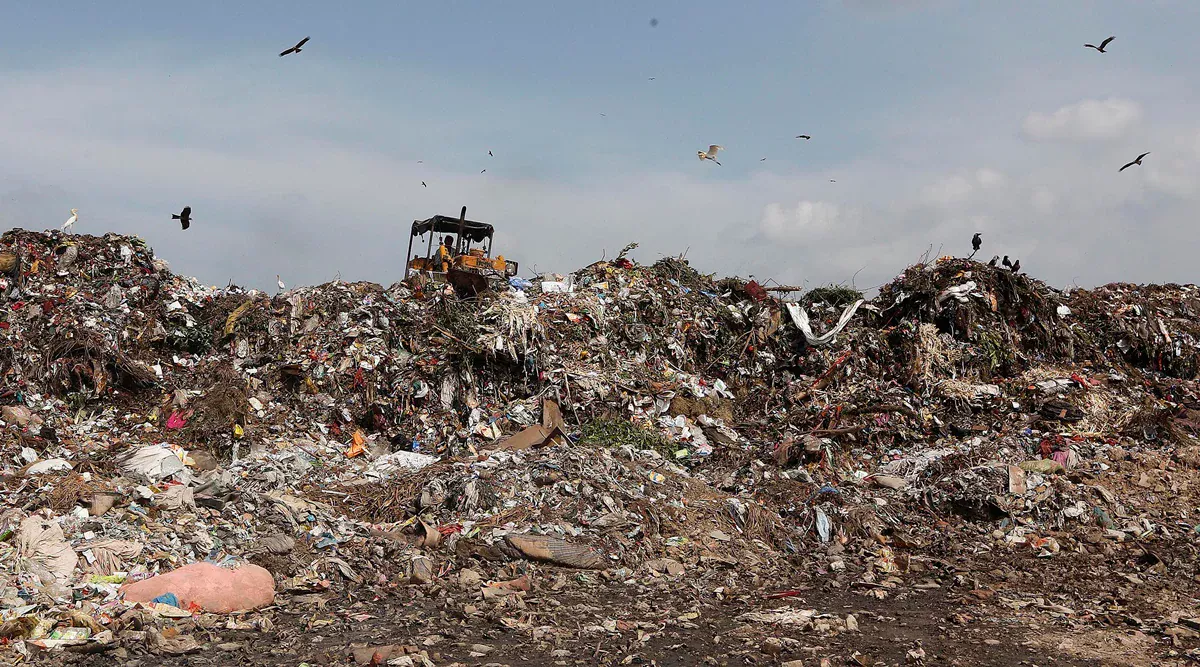
Chandigarh’s long-delayed effort to eliminate the Dadumajra garbage dump has received a fresh push after the Centre approved financial support for remediation work — a development that could significantly influence how the city tackles one of its most persistent urban environmental challenges.
The funding approval relates to the clearance and scientific treatment of legacy waste accumulated at the Dadumajra landfill, the only designated dumping ground for the Union Territory. Official documents and earlier policy reports show that the site has been receiving municipal waste for more than four decades and remains central to the city’s waste-management system, processing around 450 tonnes of waste every day.
Urban development experts say the project is not only about cleaning a landfill but also about reclaiming valuable urban land. The Dadumajra site covers more than 40 acres and has long been associated with groundwater contamination, foul odour, and repeated complaints from nearby residential colonies. Studies published under national waste-management programmes describe the site as one of the most critical legacy-waste locations in the region, with bio-remediation and scientific processing already under way in phases. The fresh funding approval comes after years of delays and partial progress. Parliamentary discussions in late 2025 also highlighted the urgency of clearing the garbage mound, with representatives pointing out that earlier deadlines had repeatedly been extended despite multiple allocations and ongoing bio-mining work. Urban planners say this pattern reflects a broader challenge facing many Indian cities — legacy landfills created decades ago are now surrounded by dense residential areas, making environmental remediation both urgent and complex.
The Dadumajra remediation project is also part of a larger shift toward scientific waste management. Municipal budget documents for 2025-26 show continued investments in composting plants, waste-processing machinery, and legacy-waste clearance, indicating that the city is trying to transition from open dumping to structured waste-processing systems. From an urban-development perspective, the impact of the project could go beyond sanitation. Cities that successfully clear legacy dumpsites often convert reclaimed land into public spaces, green areas, or new infrastructure, improving both environmental conditions and real-estate value in surrounding neighbourhoods. For Chandigarh, which has limited land availability and a strong planning legacy, reclaiming the Dadumajra site could become a key step toward more sustainable urban expansion.
At the same time, experts caution that remediation alone will not solve the problem unless waste-segregation and recycling systems improve at the household level. Without consistent waste-processing capacity, many cities risk repeating the same landfill crisis even after older dumpsites are cleared. The funding approval is therefore being seen as an opportunity rather than a final solution. If implemented efficiently, the Dadumajra project could help Chandigarh move closer to the goal of becoming a zero-landfill city — while also demonstrating how older urban centres can modernise their waste systems without compromising environmental sustainability.
The next stage will depend on how quickly remediation work accelerates and whether the reclaimed land can be integrated into the city’s long-term planning framework. If successful, the project could become one of the most significant environmental upgrades in Chandigarh’s recent urban-development history.