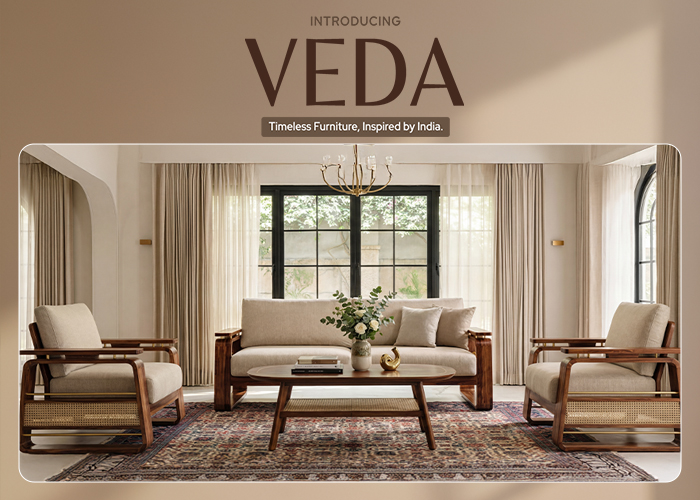
Wooden Street Veda Collection Blends Tradition And Modern Living
Furniture retailer Wooden Street has introduced a new design-led collection aimed at aligning traditional Indian aesthetics with the evolving needs of contemporary urban homes, signalling a broader shift in how domestic spaces are being conceptualised.The newly launched “Veda Collection” brings together furniture across living, dining, and bedroom categories, drawing on principles of balance, proportion, and material authenticity rooted in Indian design traditions. The range incorporates materials such as solid wood, cane, and brass—elements increasingly being revisited in modern interiors for their durability and tactile appeal.
The move reflects a growing demand among urban homeowners for spaces that are both functional and culturally grounded. As Indian cities densify and residential layouts become more compact, furniture is playing a more central role in defining liveability. Multi-functional pieces, adaptable layouts, and long-lasting materials are becoming critical to how homes are designed and experienced.Within this context, Wooden Street appears to be positioning its new offering as a response to changing consumer expectations—where design is no longer driven solely by visual appeal, but also by longevity, comfort, and spatial efficiency. The collection spans sofas, beds, dining units, and storage solutions, reflecting a comprehensive approach to interior environments rather than standalone product design. Urban design experts note that such shifts are closely linked to broader transformations in housing patterns. With rising real estate costs and shrinking per capita living space in cities like Mumbai, Delhi, and Bengaluru, the role of furniture has expanded from utility to spatial optimisation. Well-designed furniture can enable better circulation, improved ventilation, and more efficient use of available area—key considerations in high-density urban living.
The emphasis on natural materials also ties into the increasing focus on sustainability in the built environment. Solid wood and cane, when responsibly sourced, offer durability and lower lifecycle replacement needs compared to synthetic alternatives. Their use also supports traditional craftsmanship ecosystems, linking contemporary urban demand with regional production networks.At the same time, the integration of traditional design elements into modern formats reflects a cultural shift in urban housing preferences. Younger homeowners are showing greater interest in interiors that combine global design sensibilities with local identity, moving away from purely minimalist or imported aesthetics.The approach taken by Wooden Street highlights how design innovation in the furniture sector is increasingly intersecting with questions of sustainability, cultural continuity, and urban functionality. As cities expand vertically and living spaces evolve, such design strategies may play a larger role in shaping the quality and adaptability of residential environments.
Looking ahead, the success of such collections will depend on how effectively they balance affordability, durability, and environmental performance. For India’s urban housing landscape, the integration of thoughtful design with everyday functionality is likely to remain central to creating more resilient and liveable homes.