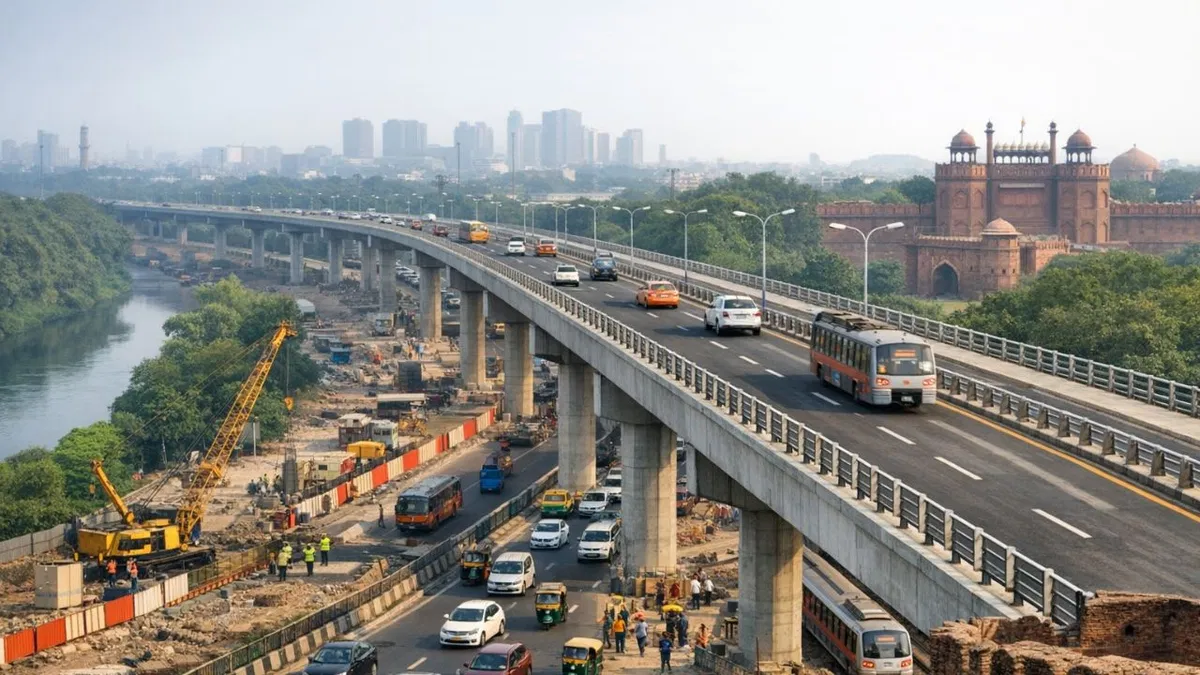
Delhi Clears Elevated Road Projects To Improve Urban Mobility
Delhi has approved two large road infrastructure projects aimed at easing congestion across some of the capital’s busiest transport corridors, signalling a renewed focus on improving citywide connectivity as population and vehicle numbers continue to rise. The projects—spanning east and south Delhi—are expected to streamline daily travel for thousands of commuters while strengthening key mobility links between residential districts, employment centres and healthcare hubs. According to senior government officials, one of the approved projects involves completing the long-pending third phase of a major elevated road corridor connecting eastern neighbourhoods to the southern institutional district of the capital. Once operational, the corridor is expected to provide uninterrupted travel between residential clusters in east Delhi and major destinations around the city’s medical and research institutions.
Urban mobility planners say the project could significantly reduce pressure on several heavily used road networks, including sections of the city’s inner ring corridors and key bridges that currently serve as major commuting routes. The Delhi elevated corridor projects are designed to create a continuous signal-free route that cuts across the city’s central transport spine, potentially shortening travel time and reducing bottlenecks during peak hours. Officials indicated that the infrastructure had faced prolonged construction delays in previous years. Authorities have now initiated a review to examine administrative and procedural reasons that slowed implementation. The inquiry is expected to determine where project execution stalled and identify accountability gaps in earlier planning cycles. The Cabinet also cleared another major intervention along Mehrauli–Badarpur Road in south Delhi, a stretch widely considered one of the most congested arterial routes in the region. Transport planners note that the corridor carries large volumes of daily traffic from rapidly growing residential neighbourhoods toward employment centres and metro stations.
Under the new plan, a multi-level road system will be constructed along the corridor. The design includes a six-lane elevated roadway, underground traffic passages at key intersections and connecting ramps that integrate with existing bus corridor infrastructure. The project will be implemented in phases by a specialised urban transport engineering agency. The first stage will focus on building an integrated structure combining an elevated flyover and grade-separated junction improvements across one of the busiest sections of the road. This approach aims to segregate through-traffic from local traffic movements, reducing delays at intersections where congestion is currently severe. In the second stage, a nearly 2.5-kilometre elevated section will extend the flyover across another high-density stretch of the corridor. Engineers will construct the structure above an existing metro tunnel, requiring careful alignment planning and advanced construction methods. Urban transport experts say the Delhi elevated corridor projects highlight the growing complexity of mobility planning in megacities where road infrastructure must coexist with metro networks, bus corridors and dense urban settlements. While elevated roads can provide short-term congestion relief, planners increasingly emphasise integrating such infrastructure with public transport systems and pedestrian networks.
If executed efficiently, the projects could ease traffic movement across several southern and eastern neighbourhoods that experience daily commuting delays. For policymakers, the challenge will be ensuring that new infrastructure not only improves traffic flow but also aligns with the broader goal of building a more accessible, low-emission and well-connected urban transport ecosystem.