Nagpur Railway Division Accelerates QR Payment Adoption
India’s first domestically manufactured high-speed trainset is expected to enter testing on a section of the Mumbai–Ahmedabad high-speed rail corridor by August 2027, marking a major step in the country’s effort to build indigenous high-speed rail technology. The prototype train will be introduced on the Surat–Vapi stretch in Gujarat, where early operations and system validation are planned. Railway officials say the project represents a milestone in India’s evolving rail manufacturing capabilities. The India bullet train project has so far relied heavily on Japanese technology and engineering expertise, particularly for track systems, signalling and safety protocols. The introduction of a domestically produced trainset signals a gradual shift toward local design and manufacturing in the high-speed rail ecosystem.
The Mumbai–Ahmedabad corridor, India’s first dedicated high-speed railway line, is designed to transform passenger mobility between two of the country’s most important economic regions. Spanning more than 500 kilometres, the corridor will connect major cities in Maharashtra and Gujarat through trains capable of speeds exceeding 300 kilometres per hour. Officials overseeing the India bullet train project say the Surat–Vapi section has been identified as one of the earliest stretches likely to become operational. Testing the indigenous trainset there will allow engineers to assess performance under real operating conditions, including acceleration, braking, track stability and passenger safety systems. High-speed rail is widely viewed as a critical component of future low-carbon transportation systems. Compared with short-haul flights and highway travel, electric high-speed trains produce significantly lower emissions per passenger kilometre. Urban transport researchers argue that if integrated with metro systems and regional rail networks, high-speed rail can shift a substantial portion of intercity travel toward cleaner mobility options. The India bullet train project is also expected to stimulate new economic clusters along the corridor. Cities connected by high-speed rail often experience growth in logistics, tourism, knowledge industries and real estate development around station districts. Urban planners frequently describe these areas as “transit-oriented zones,” where housing, offices and commercial spaces are built around major transport hubs. Infrastructure experts say developing domestic expertise in high-speed rail technology could have long-term benefits for India’s manufacturing sector. Producing trainsets, components and signalling equipment locally may reduce costs for future corridors while supporting industrial supply chains across engineering, electronics and advanced materials. However, large-scale rail infrastructure also requires careful planning to ensure social and environmental sustainability. Land acquisition, ecological protection and integration with existing transport systems remain critical factors in determining how effectively such projects serve both economic growth and community needs.
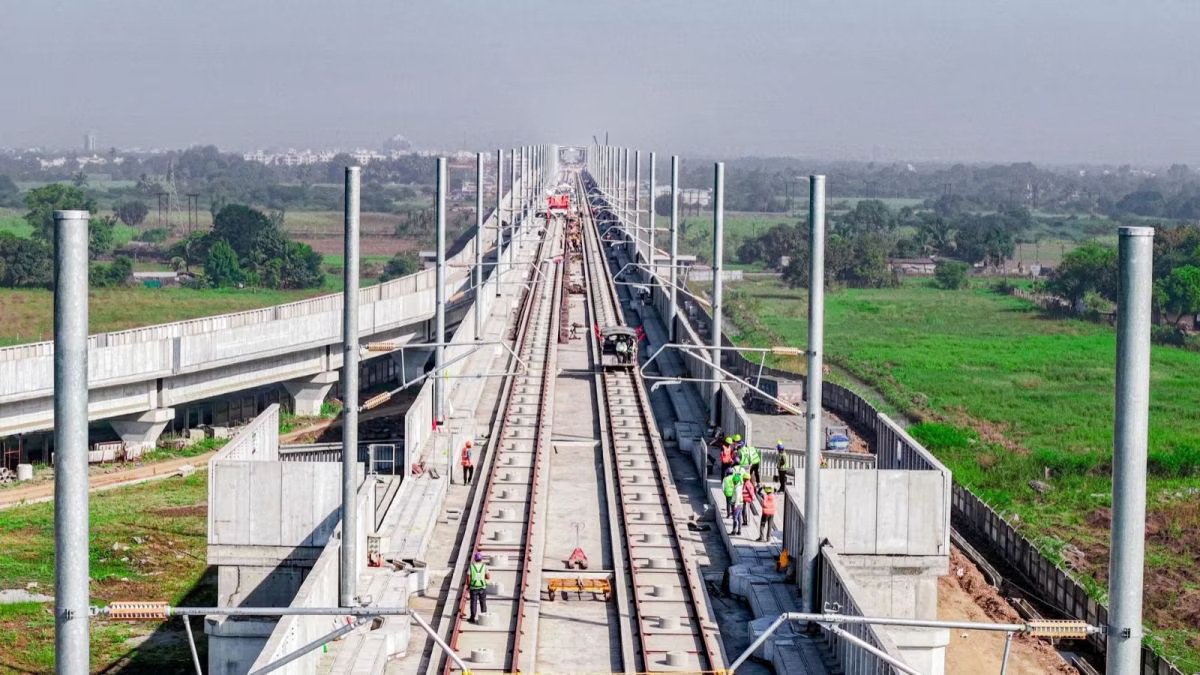
As construction progresses along the corridor, railway authorities continue to focus on completing key infrastructure elements including bridges, elevated tracks and station complexes. The introduction of the indigenous trainset will represent an important technical milestone before commercial operations begin. For India’s broader transport strategy, the testing of a locally built high-speed train signals a transition from technology adoption to technological capability. If successful, the development could pave the way for future high-speed corridors across the country while strengthening the foundations of a modern, low-emission intercity transport network.