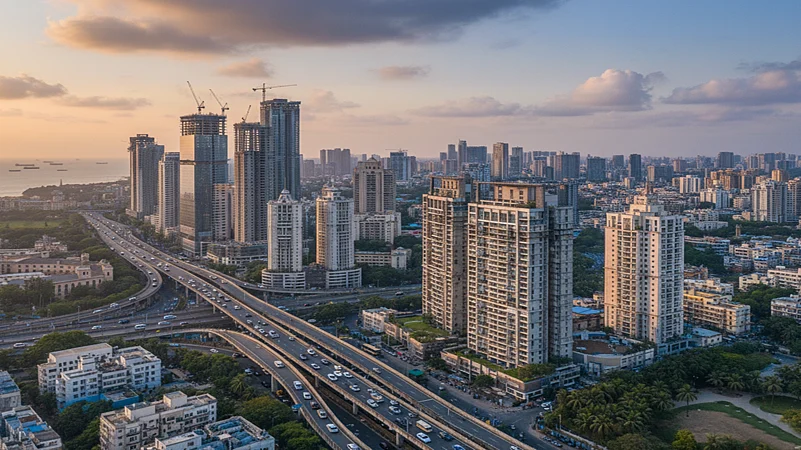
Mumbai New Home Prices Outpace Resale Market Trends
A fresh Andheri West redevelopment project is set to reshape a long-standing housing society in Mumbai’s western suburbs, reflecting the city’s accelerating shift towards urban renewal as land scarcity pushes developers to rebuild ageing residential complexes.The project involves the redevelopment of a cooperative housing society located off Veera Desai Road in Andheri West. Spread across roughly three acres, the development carries an estimated gross development value of around ₹1,400 crore and is expected to yield nearly 0.4 million square feet of residential carpet area once completed. Industry observers say such projects are becoming central to how India’s financial capital expands housing supply without extending its urban footprint.
Redevelopment has increasingly emerged as a structural solution for Mumbai’s land constraints. Large parts of the city’s suburban housing stock were built decades ago and now face limitations in infrastructure capacity, safety compliance and space utilisation. By reconstructing these complexes, developers can deliver modern housing units while existing residents receive upgraded homes with improved amenities and safety standards. Urban planners note that Andheri West redevelopment projects are particularly attractive due to the neighbourhood’s proximity to business hubs, metro corridors and established civic infrastructure. The area has evolved into one of the city’s most active mixed-use districts, connecting employment clusters in the western suburbs with media and commercial centres nearby.
Beyond market demand, redevelopment also plays a role in urban resilience. Replacing ageing structures with contemporary buildings allows developers to integrate improved construction standards, energy efficiency features and better water management systems. As Indian cities confront rising climate risks and population density pressures, these upgrades are becoming essential to long-term urban sustainability. The redevelopment site is surrounded by well-established social infrastructure including educational institutions, healthcare facilities and retail centres. Such neighbourhoods often maintain strong housing demand because they combine accessibility with mature civic ecosystems, a factor that supports residential redevelopment viability.
Industry analysts say redevelopment-led growth is reshaping Mumbai’s real estate pipeline. Instead of relying solely on greenfield expansion at the metropolitan edge, developers are increasingly focusing on underutilised plots within the existing city fabric. This approach can reduce travel distances, support public transport networks and limit urban sprawl. For residents of older housing societies, redevelopment also offers an opportunity to access larger apartments, better building services and improved safety compliance without relocating from familiar neighbourhoods. As redevelopment activity expands across Mumbai’s western suburbs, city authorities and planning experts emphasise the need for coordinated infrastructure upgrades. Ensuring that transport capacity, drainage systems and public amenities keep pace with higher residential density will remain critical for creating inclusive and resilient urban communities in the years ahead.