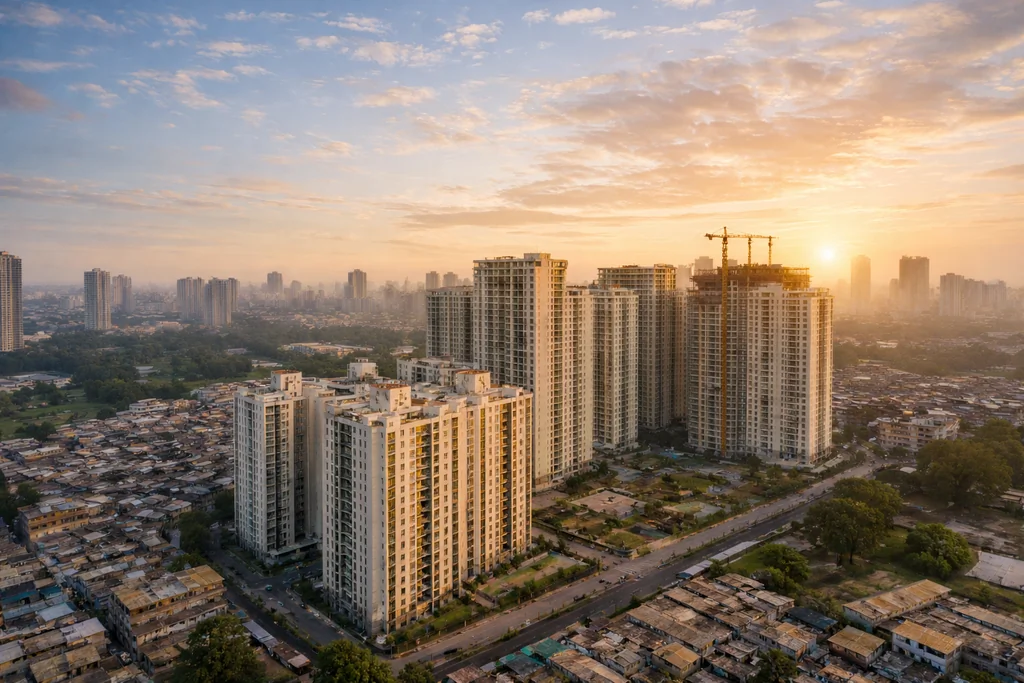
Mumbai’s public housing strategy is shifting toward large-scale urban regeneration, with authorities planning to unlock extensive land parcels through cluster redevelopment to expand affordable housing supply across the city. Officials from the state housing authority indicate that the model could create around 20,000 new homes over the next several years while modernising ageing residential layouts that occupy significant land in the metropolitan region.
The initiative marks a shift away from isolated building-by-building redevelopment that has historically shaped Mumbai’s real estate transformation. Instead, policymakers are prioritising integrated neighbourhood redevelopment covering larger land clusters, which allows infrastructure upgrades, better planning of public spaces, and higher housing capacity within the same urban footprint. Officials involved in the programme say approximately 800 to 1,000 acres of land across multiple housing layouts could be redeveloped through the cluster redevelopment approach. These projects are expected to generate significant residential inventory while also improving living standards for existing residents who currently occupy older housing units built decades ago.
Urban planners say cluster-based redevelopment has several advantages over traditional redevelopment models. By combining multiple plots into a single planning framework, infrastructure such as roads, drainage networks, and open spaces can be designed more efficiently. This reduces per-unit infrastructure costs and allows cities to improve environmental performance through better land use and building design. Authorities estimate that around 10 lakh square metres of housing stock could be generated through these projects over the next six to seven years. Much of this supply is expected to fall within the affordable housing category, typically ranging between 500 and 700 square feet in size, aimed primarily at lower- and middle-income households.
The cluster redevelopment model also prioritises rehabilitation of existing residents before new housing supply is created for the open market. In many older neighbourhoods, families currently live in compact homes with limited amenities. Redevelopment projects are designed to replace these units with larger apartments equipped with modern infrastructure and improved safety standards. Several major housing layouts across Mumbai are currently under evaluation or at different stages of approval for cluster redevelopment. These include large residential precincts in both the island city and suburban districts where ageing housing stock and fragmented ownership structures have slowed conventional redevelopment.
Urban housing experts note that the strategy could play a crucial role in addressing Mumbai’s persistent housing affordability challenge. Property prices in the city remain among the highest in the country relative to household incomes, making access to formal housing difficult for large sections of the population. At the same time, policymakers emphasise that successful implementation of cluster redevelopment will require coordination between multiple government agencies, developers, and residents. Regulatory frameworks, infrastructure planning, and financing mechanisms must align to ensure projects remain financially viable while protecting the interests of existing occupants.
The approach also supports broader goals of sustainable urban development. Redeveloping underutilised land parcels within the existing city reduces pressure on peripheral greenfield expansion and enables more efficient use of transport networks and public services. If implemented at scale, the cluster redevelopment strategy could reshape large parts of Mumbai’s urban fabric while simultaneously expanding access to affordable housing and modern infrastructure.
Mumbai Plans Major Affordable Housing Push Through Cluster Redevelopment