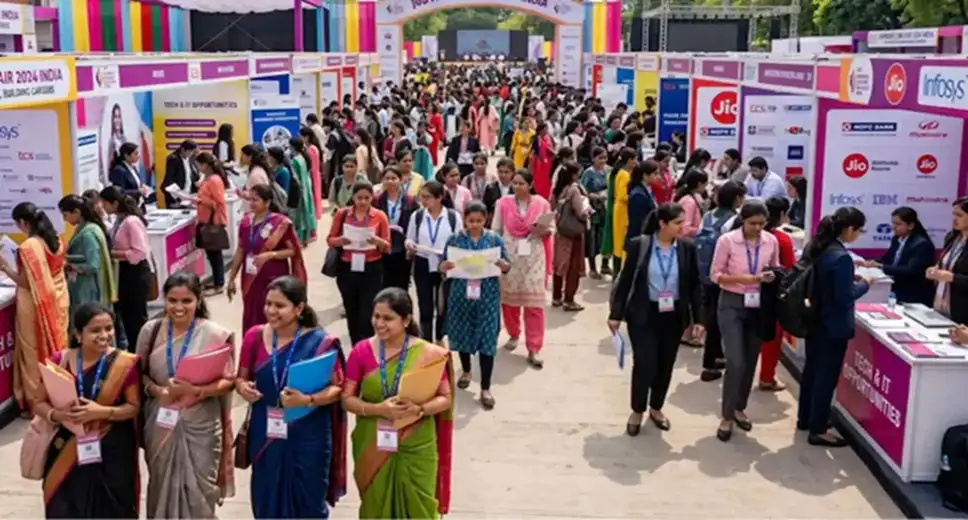
Patna Women Mega Job Fair Expands Employment Access
Patna will host a large employment event aimed at expanding workforce participation among women, as the state government prepares to organise the Patna Women Mega Job Fair 2026, bringing together dozens of employers and job seekers at a single recruitment platform in the city.
The two-day employment initiative is scheduled for 16 and 17 March at a major convention venue near Gandhi Maidan, where recruiters from more than 50 companies are expected to conduct interviews and shortlisting processes. Organisers estimate that the event could generate over 2,000 employment opportunities across a range of sectors. The Patna Women Mega Job Fair 2026 is being coordinated by the state’s social welfare ecosystem through a women-focused development corporation, with participation from candidates trained under state skill development initiatives. The event is designed to help women with formal education or vocational training connect directly with private employers looking to expand their workforce. Companies participating in the recruitment drive represent industries such as information technology services, retail, healthcare, garments manufacturing, beauty and wellness, electronics, and customer service operations.
The multi-sector approach is intended to provide job options for candidates with varying skill levels—from secondary school graduates to technical diploma holders and degree-level applicants. A distinguishing feature of the fair is the direct recruitment format. Applicants will be able to interact with company representatives at on-site interview booths, allowing employers to evaluate candidates’ qualifications and skills immediately. In several cases, successful applicants could receive provisional appointment letters or job offers during the event itself. Eligibility for participation covers women aged roughly 18 to 35 years with educational backgrounds ranging from secondary school certification to graduate degrees or technical training.
Organisers have also opened registration through digital platforms while allowing walk-in participation at the venue for candidates who complete on-site verification. Policy analysts say events such as the Patna Women Mega Job Fair 2026 reflect a broader shift in labour market planning, where state governments increasingly collaborate with private employers to bridge the gap between vocational training programmes and real job placements. In urban centres like Patna, the challenge is not only job creation but also workforce inclusion. While the city has seen expanding demand in service sectors, women’s labour force participation remains uneven across regions and income groups. Structured hiring events can help reduce barriers to entry by providing direct access to recruiters, clearer information about job requirements, and immediate feedback for candidates.
Urban development experts also point out that stronger participation of women in the formal workforce has wider economic implications. Cities with higher female employment levels typically see improvements in household incomes, local entrepreneurship, and human capital development. By linking training programmes with real hiring opportunities, the job fair model is increasingly viewed as a practical way to translate skill development investments into measurable employment outcomes.
If the Patna Women Mega Job Fair 2026 achieves its expected placement numbers, policymakers say similar employment platforms could be expanded to other districts—turning periodic recruitment fairs into a recurring mechanism for connecting Bihar’s growing talent pool with emerging labour markets.