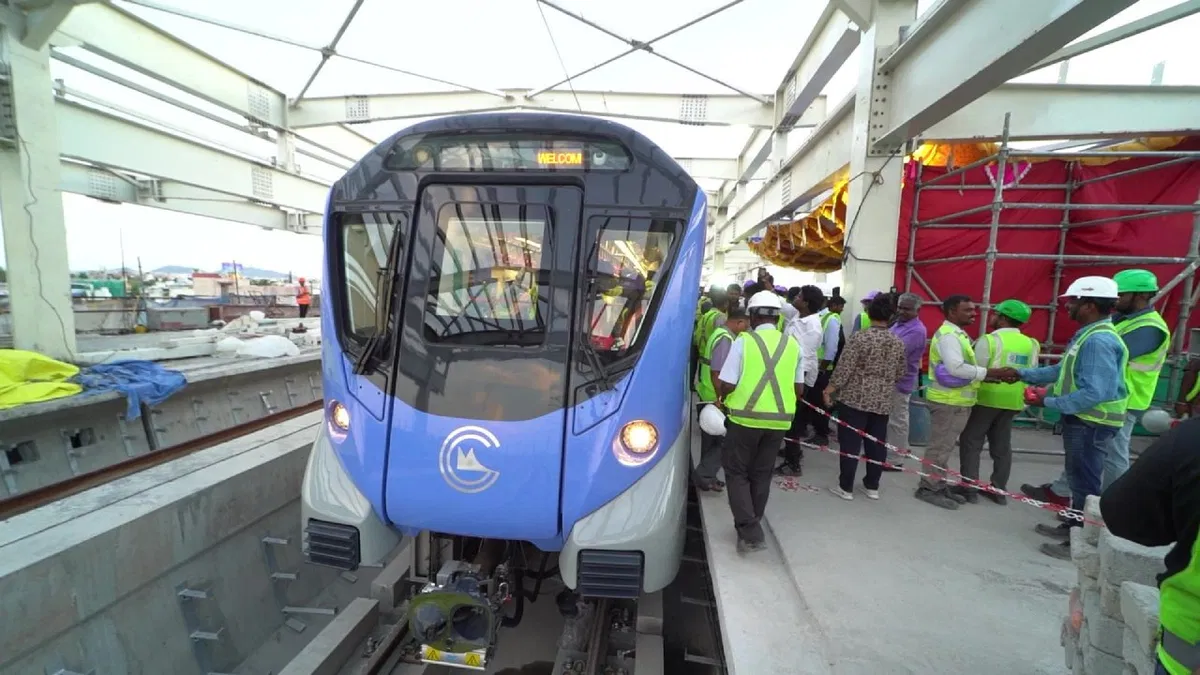
Chennai’s expanding metro network may soon operate faster and more frequently on a new stretch currently preparing for launch, as the city’s transit authority seeks regulatory clearance to optimize operations on a key corridor linking western suburbs with central urban districts.
The request relates to the upcoming Poonamallee–Vadapalani section under the Chennai Metro Phase II programme, a major public transport expansion designed to strengthen mass transit connectivity across rapidly growing neighborhoods. Metro officials have approached the national railway safety regulator seeking operational flexibility on train speed and service intervals before passenger services begin on the line.Transport planners say the request aims to ensure that the new corridor can deliver efficient services from the outset, especially during peak travel hours when passenger demand is expected to be high. The Poonamallee–Vadapalani alignment connects several densely populated residential zones, commercial clusters and educational institutions, making it an important commuter corridor within the wider Chennai Metro Phase II network.According to officials familiar with the process, safety authorities recently carried out a detailed inspection of the infrastructure along the new stretch. These evaluations typically examine track systems, signalling equipment, emergency protocols and station readiness before regulatory approval is granted for passenger operations.
Metro authorities say that enabling trains to run at optimal speeds and intervals could significantly reduce waiting times for commuters. For large urban transit systems, frequency plays a critical role in passenger convenience because shorter gaps between trains allow stations to handle higher footfall without overcrowding.Urban mobility experts note that Chennai Metro Phase II represents one of the most ambitious public transport investments in southern India. The expansion is expected to extend metro connectivity to several new parts of the metropolitan region, helping reduce reliance on private vehicles and improving daily travel reliability for thousands of residents.Beyond commuting convenience, infrastructure such as the Chennai Metro Phase II network is also closely linked with long-term urban sustainability goals. Expanding rapid transit options can lower traffic congestion, reduce vehicle emissions and support more climate-resilient mobility systems in rapidly urbanizing cities.Transport analysts say that corridors connecting outer suburbs with established employment zones are particularly important for inclusive urban growth. Efficient metro services enable workers, students and small business owners to access economic opportunities across the city without depending on personal vehicles.Authorities involved in the project indicate that once services begin, operations will be monitored closely to assess passenger demand and service performance. Adjustments to train frequency and scheduling are often made during the early months of operations to align capacity with real-world travel patterns.
As Chennai continues to expand outward, the success of projects such as Chennai Metro Phase II will depend not only on infrastructure development but also on operational efficiency. Ensuring that new lines function smoothly from the beginning could play a vital role in strengthening public trust in the city’s evolving mass transit network.
Chennai Metro Expansion Awaits Speed Rule Clearance.