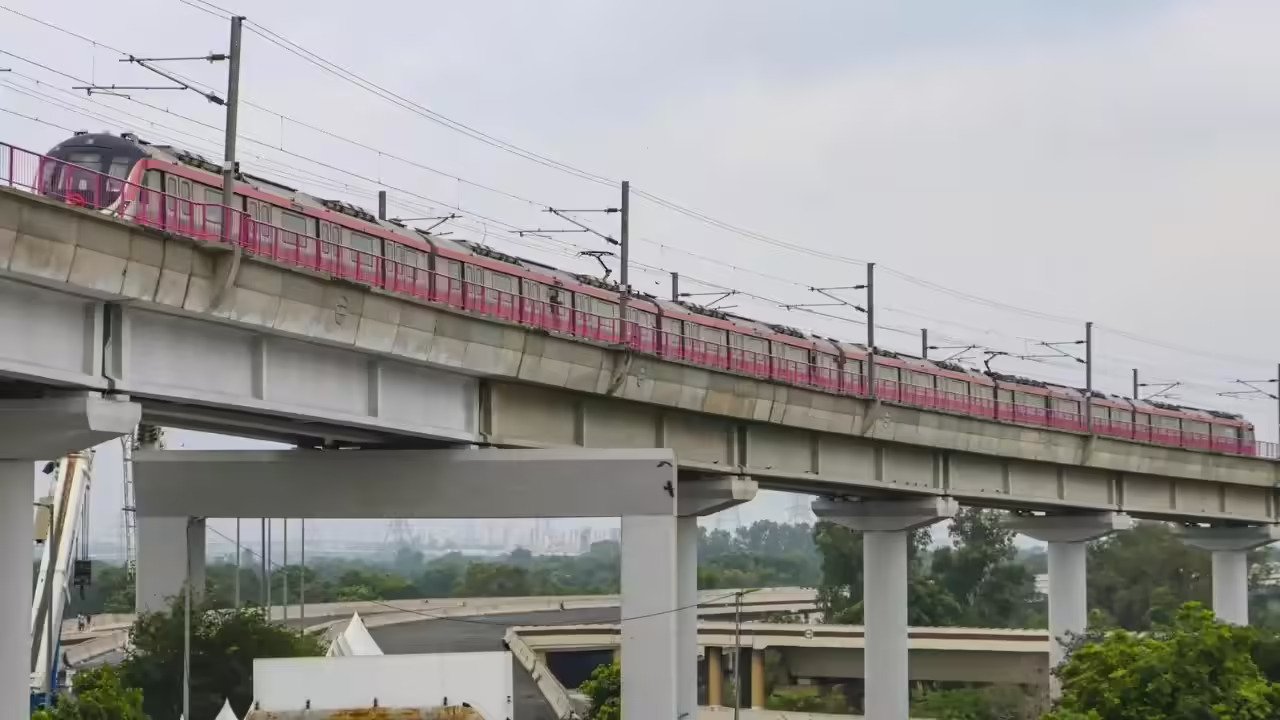
Delhi’s rapid transit system has crossed another milestone in its evolution as a major urban mobility network, with new corridors pushing the metro grid to more than 400 kilometres across the National Capital Region. The latest expansion has also resulted in the capital’s first circular metro alignment, marking an important shift in how passengers move across the city’s outer districts. Two newly opened sections—one extending an existing east–west route and another expanding a north–west corridor—have strengthened connectivity in densely populated neighbourhoods of north and north-east Delhi. With these additions, the metro system now spans roughly 416 kilometres and includes over 300 stations, reinforcing its position as one of the largest urban rail networks in the world.
The most significant outcome of the expansion is the completion of the Delhi Metro Pink Line, which now forms a continuous loop of approximately 71.5 kilometres with more than forty stations. Urban transport planners say circular rail routes play a strategic role in large metropolitan regions by allowing passengers to travel between outer zones without passing through already crowded central interchanges. For commuters, the completed Delhi Metro Pink Line introduces new journey patterns across residential and commercial clusters located in the northern and eastern parts of the capital. Areas that previously depended heavily on road transport—often involving long bus transfers to reach metro stations—now have more direct rail access to the city’s wider public transport system. Infrastructure experts involved in the project highlighted the complex engineering required along the new stretch, particularly where the line crosses the Yamuna river. The alignment incorporates a dedicated metro bridge and a double-decker viaduct structure designed to accommodate both rail and road traffic within a single elevated corridor. The metro track runs on the upper deck while the lower level is being prepared to carry vehicular traffic once additional ramp connections are completed.
Such integrated transport structures are increasingly being used in high-density urban environments where land availability is limited. By combining road and rail infrastructure vertically, planners can expand mobility capacity while minimising the footprint of large transport projects. The metro network has now built multiple bridges across the Yamuna as it expands its reach between eastern and western parts of the city. According to infrastructure officials, these crossings are critical for linking residential neighbourhoods that are separated by the river but economically tied to employment centres elsewhere in the capital. The second corridor introduced under the expansion extends another metro line into north-west Delhi through a fully elevated route with several stations and interchange points. Transport planners say the alignment will improve connectivity between western residential districts and northern employment hubs, while also offering passengers additional interchange options with existing metro lines. Officials also confirmed that groundwork has begun for the next phase of metro development, with foundation work launched for three additional corridors expected to add over 16 kilometres to the network in the coming years. These routes will strengthen airport access and improve links between central Delhi and rapidly growing peripheral districts.
As Delhi continues to expand outward, mobility experts say the growing metro network especially the operational Delhi Metro Pink Line ring will play a critical role in reducing road congestion, improving air quality and supporting more climate-conscious urban growth.