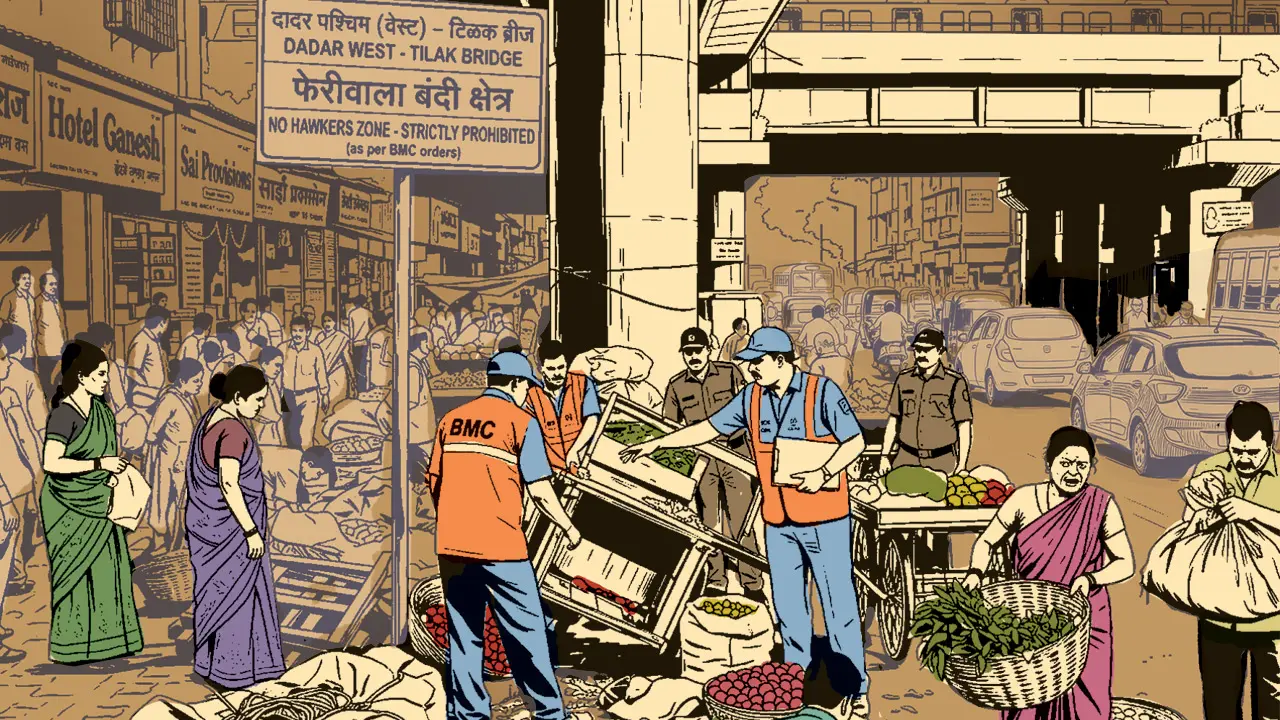
Civic authorities in Mumbai have intensified enforcement against illegal street vending around Dadar railway station as part of a broader push to restore pedestrian access in one of the city’s busiest transit districts. The operation aims to clear pavements and improve mobility for thousands of commuters who pass through the area daily, while also preparing a more structured system for licensed vendors.
Municipal officials overseeing the initiative say the Dadar footpath clearance drive has already removed thousands of unauthorised vendors operating along key roads near the station. The campaign forms part of a larger effort to ensure that footpaths remain usable for pedestrians in dense commercial zones where informal markets often spill onto walkways. Dadar is among Mumbai’s most heavily used transport nodes, linking suburban railway lines with bus routes and surrounding commercial districts. The area also hosts a thriving retail ecosystem, particularly around local markets and small shops. Over time, unregulated vending activity had significantly reduced the space available for pedestrians, forcing commuters to walk on busy roads and increasing safety risks.
Authorities say several arterial stretches west of the railway station have now been cleared of encroachments. These include important corridors connecting markets, residential neighbourhoods and public transport hubs. In addition, smaller internal streets that previously experienced heavy footpath obstruction have been opened up following enforcement action. Urban planners note that reclaiming pedestrian space is essential in high-density transit districts. Areas like Dadar handle large volumes of daily foot traffic, and uninterrupted walkways help reduce congestion while improving road safety. Experts say such measures also support climate-friendly mobility by encouraging walking and public transport use over private vehicle travel.
While the crackdown has targeted illegal vending activity, civic officials have indicated that licensed vendors will be accommodated through a planned reorganisation of market space. Under the next phase of the Dadar footpath clearance programme, authorities will conduct a survey of authorised hawkers who have set up semi-permanent or permanent structures on pavements. Officials say these vendors may be shifted to designated streets nearby where they can operate in organised clusters without obstructing pedestrian movement. The city administration is also exploring uniform design guidelines for shopfronts and display areas to prevent encroachment on footpaths.
Another step under consideration involves installing bollards near pedestrian entry points and underpasses around the railway station. These barriers are intended to discourage future encroachments while protecting walkway space for commuters. Urban policy analysts say Mumbai’s approach reflects a broader challenge facing large Indian cities: balancing livelihoods linked to street vending with the need for safe and accessible public spaces. Structured vendor zones, combined with well-designed footpaths and enforcement mechanisms, are increasingly being seen as the way forward.
As the city continues to improve transport infrastructure and pedestrian access in key districts, officials say maintaining clear walkways around transit hubs will remain a priority. For thousands of commuters navigating Dadar each day, sustained enforcement and thoughtful urban design could transform one of Mumbai’s most crowded junctions into a more accessible and pedestrian-friendly environment.
Mumbai Clears Encroachments To Reclaim Pedestrian Space Near Dadar Station