


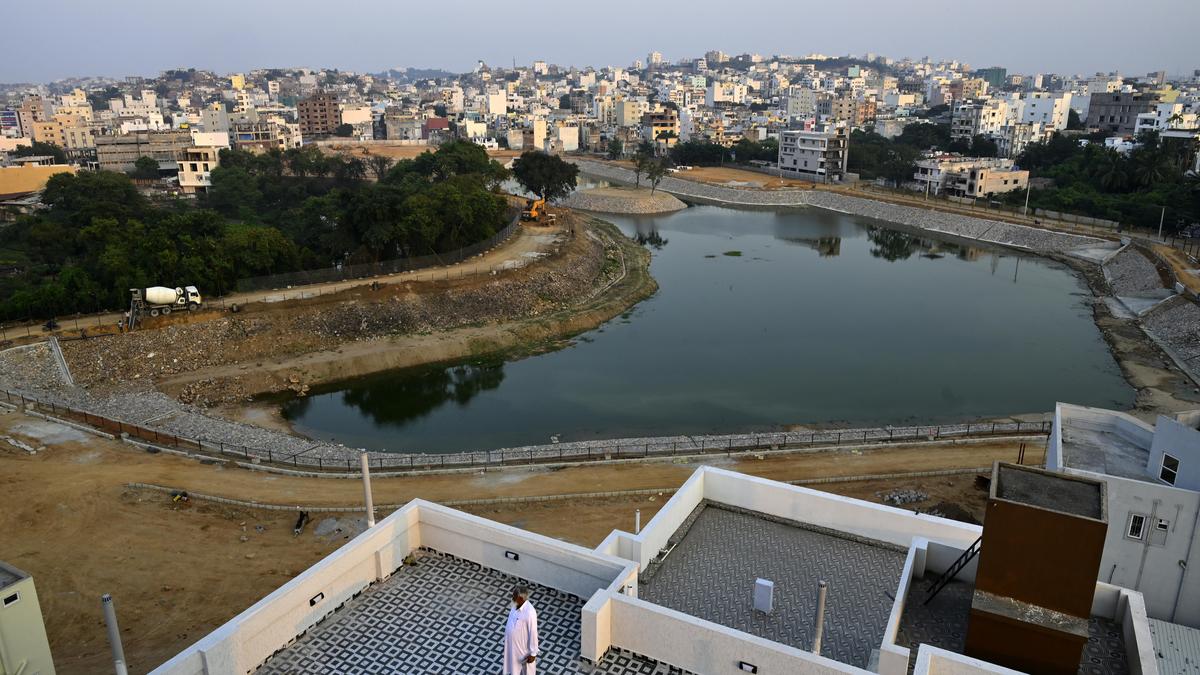
Hyderabad’s urban planning agenda is increasingly linking ecological restoration with local economic development, as the city government calls for a Hyderabad lake economy model around rejuvenated water bodies. The approach aims to transform restored lakes into public spaces that support small businesses, community activities and recreational infrastructure.
The strategy was outlined during the reopening of Bum Rukn ud Daula Lake in the Rajendranagar area, a historic waterbody that recently underwent a major restoration programme. The project forms part of broader efforts to revive the network of lakes that historically shaped Hyderabad’s urban landscape.Officials involved in the restoration said the lake had significantly shrunk over the decades due to encroachments and environmental degradation. Originally spanning close to 100 acres, the waterbody had reduced to just a fraction of its earlier size before restoration work began in 2024.
The latest rehabilitation effort has expanded the lake area to about 17 acres, alongside landscaping and public access improvements.Urban planners say the Hyderabad lake economy concept aims to extend the benefits of such restoration projects beyond environmental gains. By encouraging small retail kiosks, food stalls and community markets around lakefront walking tracks, authorities hope to create micro-enterprises that support local livelihoods while activating public spaces.Policy advisers suggest that these lakefront developments could prioritise women-led businesses and neighbourhood vendors, creating low-barrier economic opportunities for nearby communities. Integrating small-scale commerce with recreational spaces also aligns with broader goals to expand Hyderabad’s evening and night-time urban economy.
The city once relied on an extensive network of lakes and tanks for water supply and flood management. Many of these water bodies were constructed during the historic era of the Hyderabad state and served as vital sources of drinking water and irrigation. Over time, rapid urbanisation, infrastructure expansion and encroachments significantly altered this hydrological network.Experts in sustainable urban development say restoring lakes can provide multiple benefits. Beyond improving biodiversity and urban cooling, well-designed lakefronts can enhance property values, attract visitors and create public gathering spaces that improve quality of life in dense neighbourhoods.The revived waterbody in Rajendranagar is part of a wider programme aimed at rehabilitating several historic lakes across the metropolitan region.
Infrastructure officials indicate that further projects are being planned to strengthen connectivity around water bodies and improve public access.One such project involves a proposed bridge across Mir Alam Tank, a prominent historic reservoir in the southern part of the city. The planned infrastructure is expected to improve mobility while complementing ongoing lake restoration initiatives.Urban economists note that if implemented carefully, the Hyderabad lake economy approach could become a model for combining environmental restoration with inclusive urban development. As cities across India grapple with shrinking water bodies and rising climate risks, integrating ecological assets with local economic activity may prove crucial to building resilient and people-focused urban environments.
Hyderabad Revives Historic Lake With Local Economy Vision
