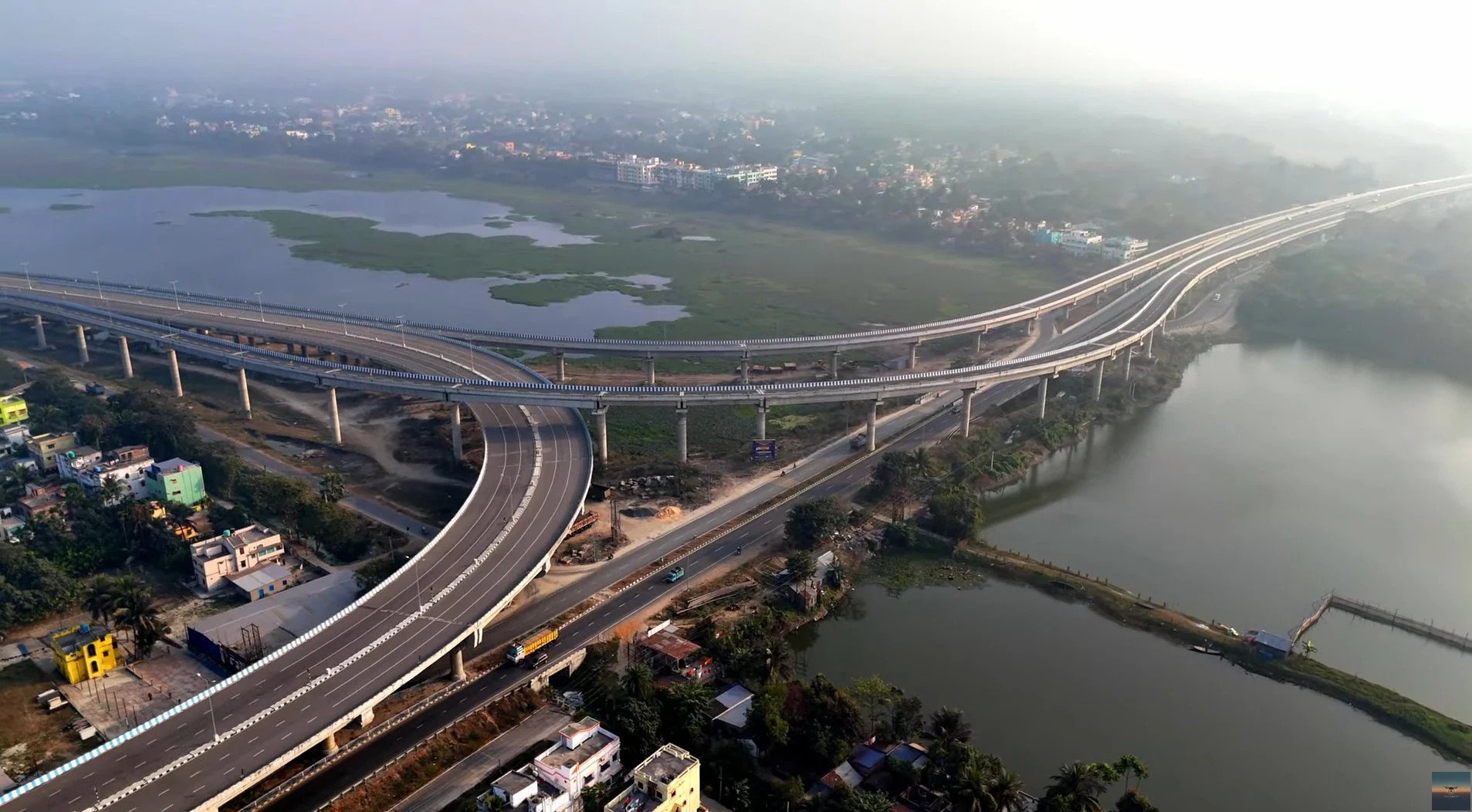
A 44-kilometre, access-controlled upgrade between Kolkata’s northern fringes and Kalyani is recalibrating mobility across eastern West Bengal, compressing travel time from over two hours to under 45 minutes. The revamped Kalyani Expressway is now operational as a largely signal-free corridor, marking one of the region’s most consequential transport interventions in recent years. For daily commuters navigating the dense urban stretches of North 24 Parganas, the change is tangible. Long queues along arterial roads historically slowed passenger vehicles and freight moving toward North Bengal and the Northeast. The redesigned Kalyani Expressway, developed at an estimated investment of ₹2,500 crore by the state’s highway development agency, introduces grade separators, multi-lane expansions and elevated connectors to eliminate bottlenecks that once defined the route.
Transport planners say the corridor’s 21 flyovers covering nearly half its length create uninterrupted flow, reducing idling time and vehicular emissions in some of the state’s most congested suburban belts. A key elevated link now integrates the route directly with the Belgharia Expressway, improving access toward the airport and easing pressure on BT Road and Jessore Road. The infrastructure also holds implications beyond convenience. Faster connectivity to AIIMS Kalyani strengthens emergency healthcare logistics, offering what officials describe as a dependable medical transit spine for the metropolitan region. Industrial freight operators, meanwhile, gain a bypass that streamlines cargo movement toward NH-12 and onward to eastern trade corridors, including routes serving Bangladesh.
Urban economists note that transport efficiency often precedes real estate and institutional growth. Early signals along the corridor suggest rising interest in residential layouts, logistics parks and educational infrastructure around Kalyani, where established institutions such as Kalyani University anchor the local economy. Reduced travel friction effectively narrows the psychological and commercial distance between the satellite town and Kolkata’s core. The project is being delivered in phases, extending from Nimta toward Muragacha and further north. Its long-term strategic value is expected to deepen once a second Ishwar Gupta Setu an extradosed cable-stayed bridge across the Hooghly connects industrial clusters in Hooghly district to the expressway grid. That linkage would form a broader regional network capable of redistributing freight traffic away from saturated city roads.
Mobility experts caution, however, that highway expansion must align with sustainable urban planning. Without parallel investment in public transport integration, land-use regulation and pedestrian infrastructure, high-speed corridors risk inducing car-dependent sprawl. The coming years will test whether the Kalyani Expressway evolves as a balanced growth axis supporting inclusive housing, resilient logistics and lower-emission mobility or merely shifts congestion further outward. For now, the corridor stands as a significant recalibration of how northern West Bengal connects, trades and accesses essential services reshaping both commute patterns and development trajectories across the metropolitan periphery.