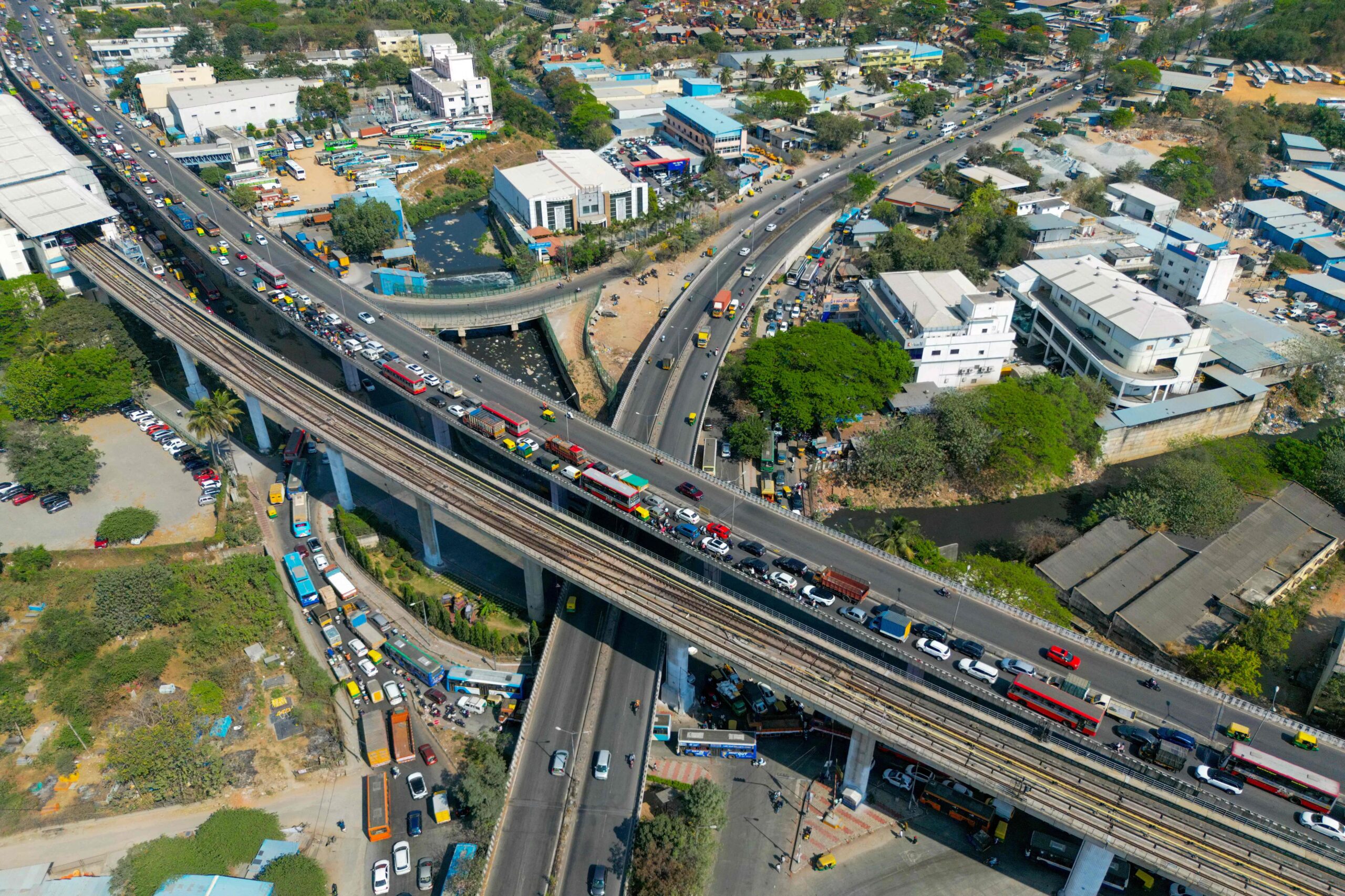
Bengaluru Infrastructure Expansion Slowed By Land Issues
Major mobility initiatives aimed at reducing Bengaluru’s chronic traffic congestion are facing significant delays, raising concerns about urban connectivity, commuter convenience, and economic efficiency. Projects including the Bengaluru Suburban Railway, the Bengaluru Business Corridor, and expansions of the Namma Metro network are now projected to extend years beyond their original completion schedules, underscoring persistent challenges in land acquisition, planning, and project execution.
The Bengaluru Suburban Railway Project, envisioned as a 148-kilometre network linking peripheral suburbs to the city core, has seen timelines slip from December 2025 to March 2030. Sources within the implementing agency point to stalled land acquisition and unresolved encroachments along key corridors as the primary obstacles. Civil contractors, including major infrastructure firms, have cited delays in providing unencumbered land, forcing re-tendering and creating legal bottlenecks. Procuring rolling stock and streamlining administrative approvals have also slowed progress, while rising land costs have inflated the project budget.
Similarly, the Bengaluru Business Corridor, a 117-kilometre arterial expressway intended to link major highways and relieve inner-city congestion, remains mired in land acquisition disputes nearly two decades after conception. Farmers and landowners continue to challenge compensation valuations, claiming that government rates lag behind actual market values. While authorities have introduced multiple compensation options including cash, development rights, and commercial or residential plots, uptake remains limited, delaying construction and threatening broader economic gains from improved freight and commuter movement. Namma Metro’s Phase 2 and Phase 3 expansions also reflect the city’s infrastructure bottlenecks. The Pink Line, originally expected to open partially by September 2025, now targets May 2026 for initial elevated sections, citing slower civil work and underground tunnelling challenges. The Blue Line, connecting the city to its international airport, is progressing but will not be operational before late 2027. Meanwhile, the newly approved Orange Line and proposed Red Line continue to face planning and integration issues, particularly with double-decker flyover coordination, pushing completion beyond original projections.
Urban planners note that these delays highlight systemic issues in rapidly growing Indian cities: fragmented land records, protracted negotiations with stakeholders, and coordination gaps between multiple government agencies. Economic analysts warn that extended timelines may escalate costs and reduce the anticipated congestion relief, impacting daily commuters and business logistics alike. While work continues on select sections, experts stress that a combination of faster land acquisition, streamlined compensation frameworks, and integrated urban planning is critical for Bengaluru to achieve sustainable, climate-resilient, and inclusive urban mobility. Failure to address these challenges could undermine both commuter efficiency and broader urban economic growth.