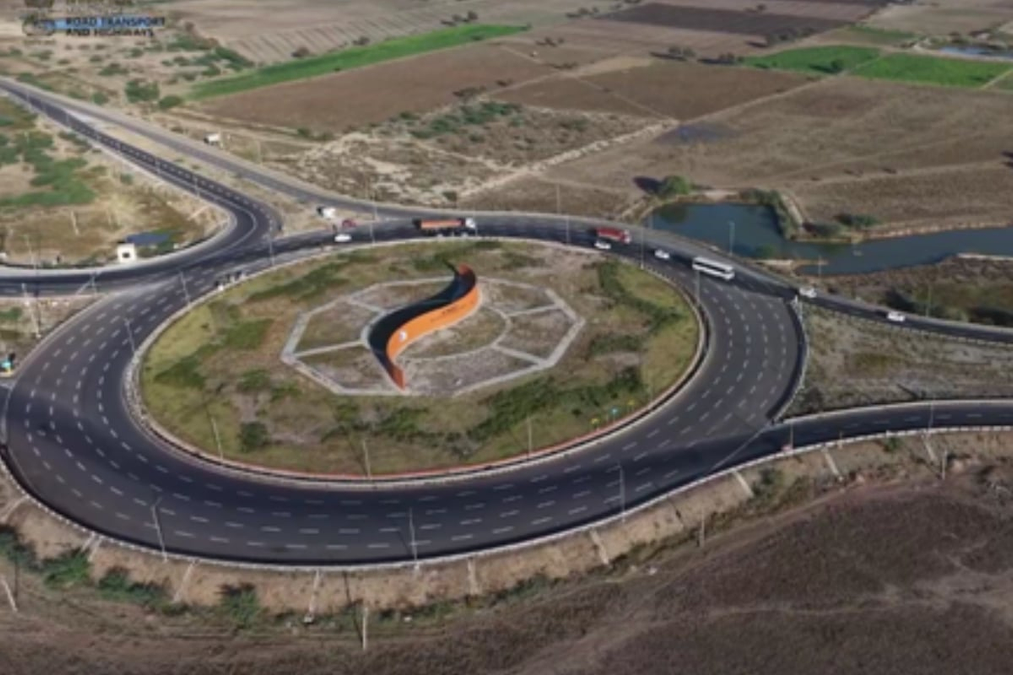
The operational rollout of the Ahmedabad Dholera Expressway is beginning to redraw Gujarat’s economic geography, compressing travel times between Ahmedabad and the emerging industrial hub of Dholera while reshaping development prospects along the corridor. Spanning just over 109 kilometres, the greenfield highway is among the region’s largest transport investments and is expected to accelerate integration between urban centres, industrial zones and coastal infrastructure.
Developed under the national Bharatmala programme, the ₹5,800 crore project links Ahmedabad district with Bhavnagar district and provides high-speed access to the Dholera Special Investment Region. The corridor also connects onward to the coastal highway network, strengthening freight mobility and commuter travel across southern Gujarat. Although final clearances and testing procedures are still underway, motorists have already reported substantial time savings. The journey from Ahmedabad to Dholera has been reduced to under an hour from more than two hours previously, while travel to Bhavnagar has nearly halved. For daily commuters and small business operators, this shift alters work-life patterns and reduces transport uncertainty.
Industrial analysts say the Ahmedabad Dholera Expressway addresses one of the principal constraints facing Dholera’s growth: connectivity. The Special Investment Region has been positioned as a long-term manufacturing and logistics hub, but investor confidence often hinges on reliable access to urban markets, airports and ports. Improved road connectivity reduces perceived distance, making land and industrial plots more attractive to developers and manufacturers. The expressway has been engineered with future expansion in mind. A 30-metre-wide median allows scaling from four to eight lanes, while a dedicated interchange will connect directly to the upcoming Dholera International Airport. A semi high-speed rail corridor is also planned alongside sections of the highway, signalling a multimodal transport vision rather than a road-only solution.
Environmental considerations have been embedded into construction practices. Authorities report that approximately 60 lakh metric tonnes of municipal waste and 22 lakh metric tonnes of fly ash were repurposed in embankment works, diverting material from landfills and reducing demand for virgin aggregates. Plantation drives along the corridor include over two lakh saplings and avenue trees, aimed at stabilising soil and mitigating heat impacts. Urban planners caution, however, that expressway-led growth must be managed carefully.
Rapid land appreciation near interchanges can trigger speculative real estate activity unless supported by zoning clarity, water infrastructure and climate-resilient planning. As the Ahmedabad Dholera Expressway moves toward full operational status, its long-term impact will depend on how effectively transport investment translates into inclusive economic opportunity. If aligned with sustainable land use and industrial policy, the corridor could become a template for low-carbon, regionally integrated growth in western India.
Ahmedabad Dholera Expressway Boosts Regional Growth