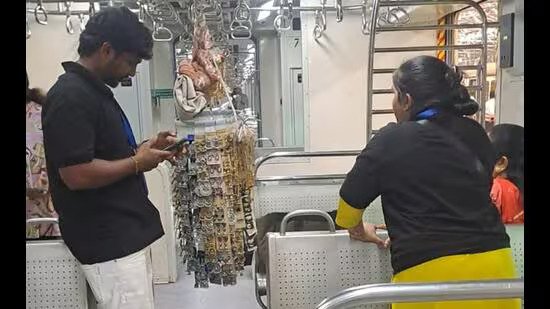
A new experiment on Mumbai’s suburban rail network has opened a debate on commuter safety, space, and informal livelihoods after the Central Railway permitted licensed vendors to operate inside local trains on the Harbour corridor. The initiative, introduced quietly earlier this month, allows authorised hawkers with official identity cards to sell non-consumable goods inside both air-conditioned and non-air-conditioned coaches.
The pilot is currently limited to the Harbour services running between Chhatrapati Shivaji Maharaj Terminus and Panvel, with a clear restriction on the sale of food items. Commuters report that vendors are largely selling small personal accessories such as trinkets and hair products. Railway officials describe the move as an attempt to formalise an activity that has long existed informally across the suburban system. However, the rollout has drawn criticism from commuter associations who argue that introducing hawkers into already crowded trains risks worsening safety conditions. Passenger groups say that even marginal increases in onboard activity can reduce usable space, particularly during peak and shoulder hours, when trains often operate beyond designed capacity.
Urban transport analysts note that the concerns emerge against the backdrop of heightened sensitivity around overcrowding on Mumbai locals, following a series of recent incidents linked to excessive passenger density. For daily commuters, especially women and elderly passengers, the presence of vendors carrying merchandise inside moving coaches has raised questions about personal safety and comfort. Railway officials defending the initiative say the number of authorised vendors has been capped and their operating hours restricted to non-peak periods, when passenger loads are relatively lower. The formal licensing process, they argue, creates accountability through identification and registration, making it easier to regulate who is permitted to operate within railway premises. From an administrative perspective, this is also aligned with broader efforts by Indian Railways to eliminate unauthorised hawking and improve security oversight.
The timing of the initiative is significant. Since the introduction of air-conditioned local services on the Harbour line earlier this year, ridership has increased steadily, with thousands of commuters opting for AC coaches despite higher fares. Transport economists say this indicates a growing willingness among Mumbai commuters to pay for comfort and predictability—making crowd management and onboard discipline even more critical. At a policy level, the move highlights a recurring challenge for large transit systems in emerging megacities: balancing inclusive economic opportunities with the primary function of mass mobility. Regulated vending can provide livelihoods, but only if it does not compromise safety or efficiency in a network that carries millions daily.
Commuter groups have sought formal consultations with railway authorities to review the pilot and clarify safeguards. Observers say the outcome could shape whether regulated onboard vending becomes a permanent feature or remains a limited trial. As Mumbai’s rail system evolves alongside metro expansion and station upgrades, the handling of such micro-level interventions will test how effectively authorities can reconcile people-first transport planning with operational realities on one of the world’s busiest suburban railways.
Licensed Vendors Enter Harbour Locals, Commuter Groups Raise Objections