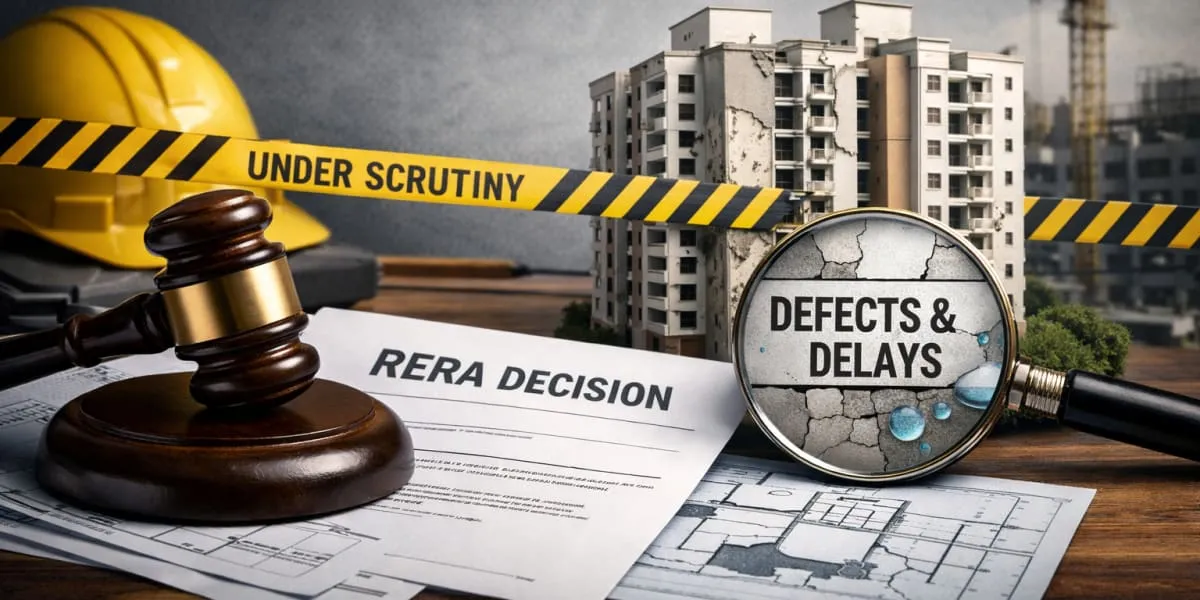
A recent order by the Delhi Real Estate Regulatory Authority has brought regulatory scrutiny to a high-end residential development in Dwarka, reinforcing that statutory housing norms apply equally to public agencies and private builders. The ruling in the Dwarka luxury housing dispute clarifies that homebuyers can seek redress under the Real Estate Regulation Act even when the developer is a government body.
The case centres on a premium housing project developed by the Delhi Development Authority (DDA) in Dwarka, where purchasers raised concerns related to delivery timelines and project commitments. After reviewing submissions, the regulator held that the authority falls within the ambit of the Act when it undertakes commercial residential development. Urban policy analysts say the Dwarka luxury housing dispute is significant because it strengthens consumer protection in publicly developed projects. While DDA has historically been viewed as a planning and land-owning agency, its role as a developer brings it under the same compliance framework governing private sector real estate.
Under the Real Estate Regulation Act, developers must adhere to declared possession timelines, maintain escrow accounts for project funds and disclose key approvals. Failure to comply can invite penalties or compensation orders. Legal experts note that the regulator’s interpretation reinforces accountability standards across the housing market. Dwarka has emerged over the past decade as a key residential hub in southwest Delhi, supported by metro connectivity and proximity to the airport corridor. The introduction of higher-end housing typologies in the area reflects rising demand from middle and upper-middle income households seeking planned infrastructure and larger apartment formats.
However, housing economists caution that disputes such as the Dwarka luxury housing dispute underline the importance of transparent project management in publicly led developments. Delays and specification changes can erode buyer confidence, particularly in premium segments where purchasers commit significant capital upfront. The ruling also highlights a broader shift in India’s urban governance framework. Since the Act came into force, regulators across states have increasingly adjudicated cases involving state development authorities, cooperative societies and public-private partnerships. This evolution is reshaping the relationship between citizens and urban institutions.
From a sustainability perspective, experts argue that regulatory certainty supports more responsible real estate expansion. Predictable delivery timelines reduce financial stress on households and discourage speculative vacancy, contributing to more stable urban growth patterns. Civic planners further observe that as public agencies diversify into mixed-income and luxury projects to cross-subsidise affordable housing, compliance obligations will intensify. Ensuring that such projects meet statutory benchmarks is central to maintaining trust in city-building programmes. The outcome of the Dwarka luxury housing dispute may therefore serve as a reference point for future conflicts involving government-backed residential schemes. For buyers, it reinforces that legal remedies exist irrespective of the developer’s institutional profile. For planning authorities, it signals that regulatory alignment is now integral to modern urban development.
Delhi RERA Orders Relief In Dwarka Dispute