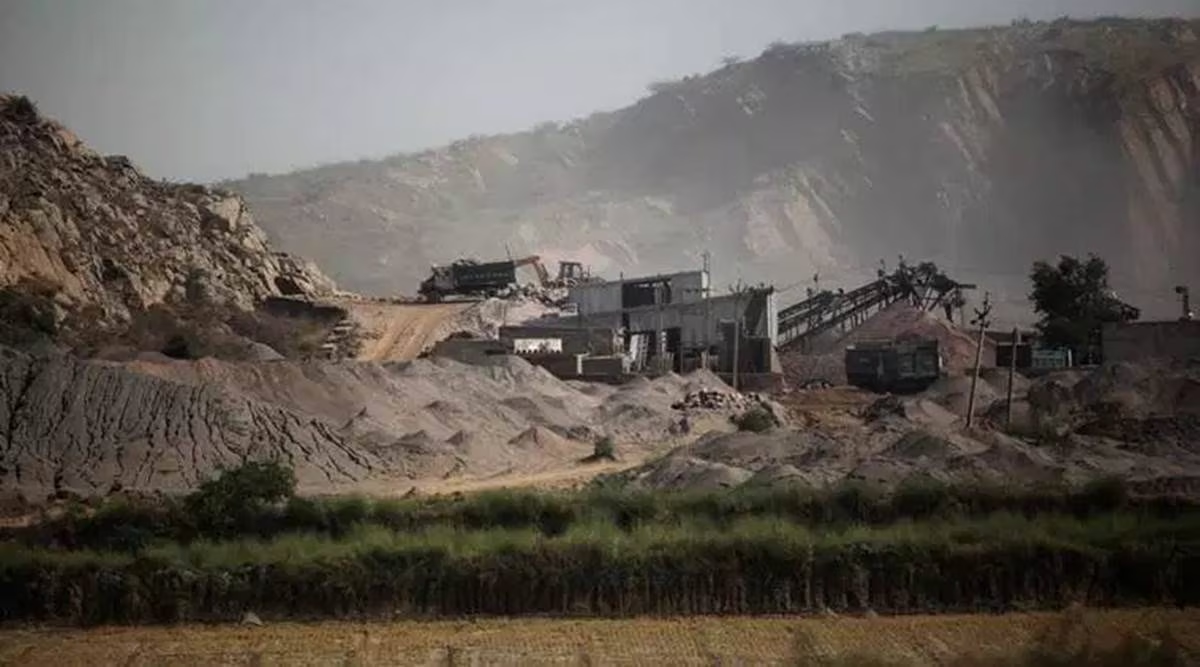
India’s Supreme Court has extended a stay on mining and related extraction activities in the ecologically fragile Aravalli Hills and Ranges, directing the constitution of a specialised expert panel to resolve persistent disputes over the geographic extent and environmental significance of the mountain system. The decision maintains protections for a region that plays a crucial role in groundwater recharge, biodiversity preservation and climate moderation across north-western India.
The court’s latest order comes amid national controversy surrounding an earlier attempt to standardise the definition of the range — a move that had implicitly narrowed the geographic scope of legal protection by using an elevation-based classification. Questions over whether that approach adequately reflected Aravalli’s complex ecology prompted widespread pushback from environmental groups, local communities and scientific stakeholders.A vacation bench led by the Chief Justice of India affirmed that status quo on mining activities must remain in place while the panel — to be composed of independent scientists, environmental experts and geologists — provides clarity on core issues: the precise topographical boundaries of the Aravalli system; the extent of existing forest cover; and whether certain regulated extraction could ever be permissible without compromising the region’s ecological functions.
Urban and environmental planners stress that the court’s insistence on an expert-led process underscores the complexity of balancing economic interests with environmental custodianship. The Aravalli Hills span parts of Delhi, Haryana, Rajasthan and Gujarat and form a natural barrier against desertification from the Thar Desert, while serving as a significant aquifer recharge zone and biodiversity habitat — functions that have direct implications for urban air quality, groundwater security and climate resilience in adjacent metropolitan areas.“If the geographic footprint is defined narrowly based on arbitrary metrics alone, we risk exposing large tracts of ecologically sensitive land to unregulated exploitation,” says a senior advisor on sustainable urban ecosystems. “Conversely, a comprehensive, science-based demarcation can protect these hills while allowing responsible land use planning in already urbanised or rehabilitated zones.”
The court’s move also reflects ongoing tension between state and central definitions of the Aravalli region. Disparate classifications had previously contributed to enforcement gaps, with certain districts and low-lying ridges falling outside protective frameworks despite their environmental significance. The expert panel is expected to reconcile these discrepancies using empirical data and robust ecological criteria.Critically, the expanded review comes at a time when several states — including Rajasthan — have recently intervened to halt mining operations once they were confirmed to fall within legally recognised Aravalli boundaries. Such actions, often driven by local environmental petitions and community mobilisations, highlight the socioeconomic stakes for rural communities that depend on the hills’ water and land resources.
As climate risks intensify and urban expansion presses on natural landscapes, the Supreme Court’s calibrated approach — favouring expert engagement over legal ambiguity — may set a precedent for how ecologically sensitive regions are defined, protected and integrated into sustainable development frameworks across India.