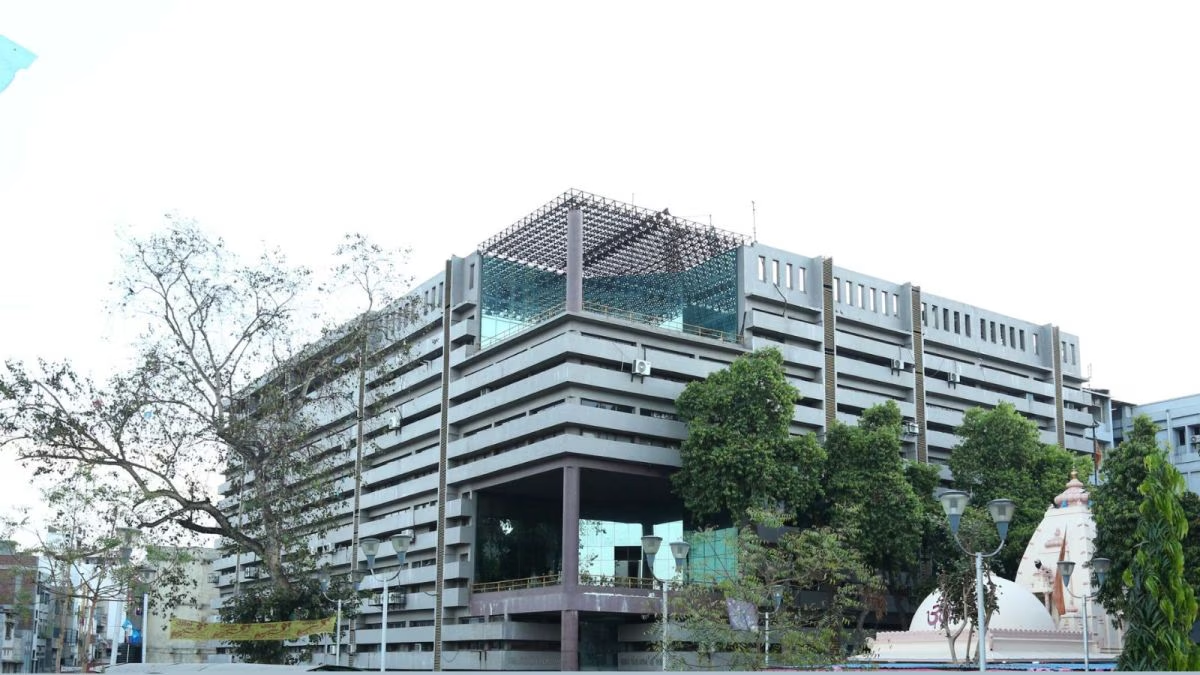
Ahmedabad’s civic administration has initiated a long-pending move to formally protect more than 400 historic structures located outside the city’s walled core, marking a significant expansion of its heritage status framework. The decision, expected to culminate in official notification within six months, signals a shift in how the city approaches conservation beyond its UNESCO-recognised Old City precinct.
For over a decade, many architecturally and culturally significant buildings situated in post-medieval neighbourhoods and institutional campuses remained without statutory safeguards. These properties were first documented in a comprehensive survey commissioned in 2014, when conservation experts mapped structures across the then municipal limits using geospatial tools and on-ground assessments. That exercise identified 861 buildings of historic value, of which 382 were graded based on architectural merit and condition. Categories ranged from the highest level of protection to structures of contextual importance. However, despite the documentation, formal heritage status was not conferred, leaving several properties vulnerable to redevelopment pressures in a rapidly expanding urban market.
The renewed push will cover over 400 buildings, including prominent institutional campuses, palatial residences, temples and stepwells that represent Ahmedabad’s layered urban history. Once notified under heritage status regulations, these properties will be shielded from demolition. Property owners will be eligible for transferable development rights (TDR), enabling them to monetise unused development potential elsewhere a mechanism designed to balance conservation with real estate economics. Urban planners say extending heritage status beyond the historic core is critical for sustainable city-building. Ahmedabad’s growth over the past two decades has accelerated land value appreciation, often placing older structures at risk. Protecting them not only preserves architectural identity but also reduces the embodied carbon loss associated with demolition and reconstruction.
A senior civic official indicated that a draft list will be placed in the public domain to invite objections and suggestions before final approval. This consultative approach is expected to address concerns from property owners while strengthening the legal defensibility of the heritage status notifications. The original condition assessment painted a mixed picture. While a portion of graded buildings were in sound condition, a significant number showed varying degrees of deterioration, and a small percentage were considered at risk of disappearance. Conservation architects argue that timely recognition and regulatory clarity are essential to prevent further decay.
Ahmedabad became India’s first UNESCO World Heritage City in 2017, but much of the attention since then has focused on the Walled City. By extending heritage status protections to structures outside that boundary, the municipal corporation appears to be broadening its conservation narrative to reflect the city’s 19th- and 20th-century evolution. As the notification process unfolds, implementation will determine whether regulatory intent translates into effective preservation. Integrating conservation with adaptive reuse, climate-sensitive retrofitting and inclusive public access could redefine how Ahmedabad balances growth with cultural continuity in the years ahead.
Ahmedabad Civic Body Widens Heritage Protection Net