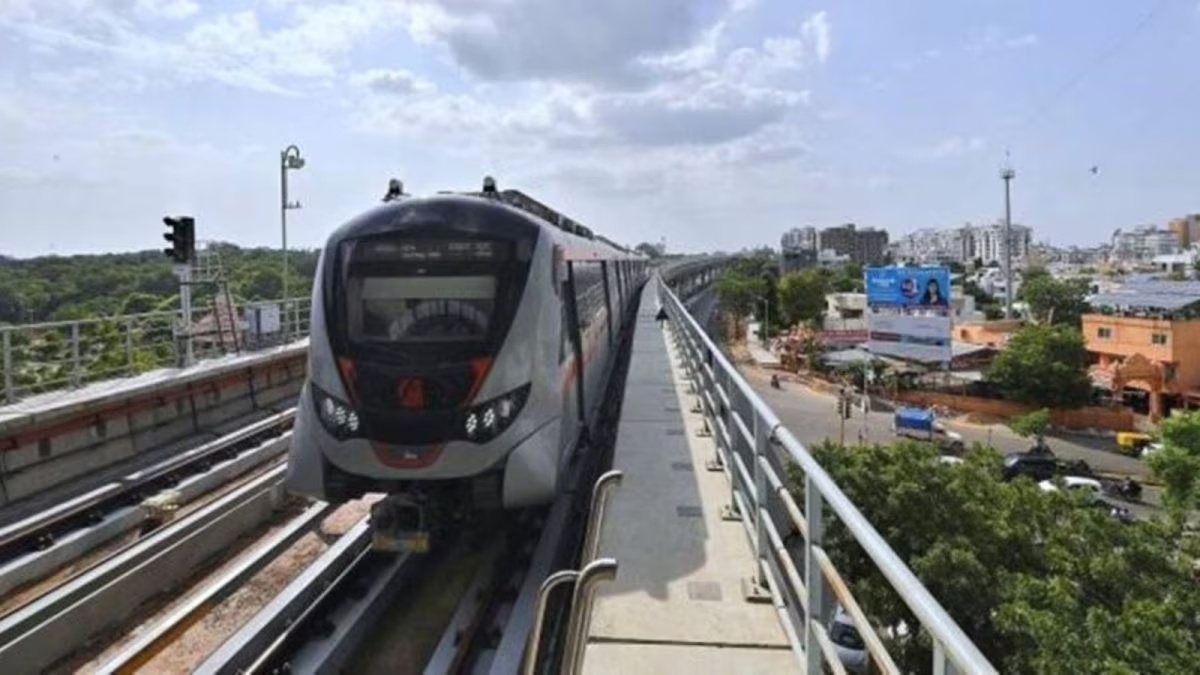
The Union government has cleared a new Ahmedabad Metro extension that will connect Gujarat’s financial district at GIFT City with Shahpur, adding a 3.33-kilometre elevated stretch to the city’s expanding rapid transit grid. The investment of over ₹1,067 crore signals continued policy emphasis on rail-based urban mobility as Ahmedabad’s economic geography stretches northwards toward high-density commercial zones.
Planned as a three-station corridor, the Ahmedabad Metro extension is expected to be completed within four years. Officials indicate the link will strengthen daily connectivity between residential neighbourhoods in Ahmedabad and the fast-growing Gujarat International Finance Tec-City (GIFT City), where banking, fintech and technology firms have clustered in recent years. Urban planners note that the corridor serves more than office commuters. Educational institutions and support services along the route are likely to draw students and service workers who currently depend heavily on private vehicles and road transport. By offering predictable travel times, the new section is expected to ease pressure on arterial roads that already experience peak-hour congestion.
Ridership projections suggest moderate uptake in the early years, with daily footfall anticipated to rise steadily as development intensifies around the corridor. Government estimates place expected daily ridership at over 23,000 passengers by the end of the decade, with numbers more than doubling by 2041. Transport economists say such growth assumptions reflect Ahmedabad’s demographic expansion and GIFT City’s ambition to attract global finance and allied services.
The Ahmedabad Metro extension also carries economic implications beyond passenger movement. Construction activity is expected to generate around a thousand jobs during the build phase, while operations and maintenance will support permanent roles once services begin. Infrastructure specialists point out that metro investments often catalyse secondary development, from rental housing to retail clusters, reshaping land values and urban density patterns.
Implemented by Gujarat Metro Rail Corporation, a joint venture between the state and central governments, the project aligns with a collaborative funding model increasingly adopted in Indian metro systems. Ahmedabad’s broader network spanning over 68 kilometres across two operational phases already records daily ridership of roughly 1.6 lakh passengers, reflecting gradual behavioural shifts towards public transport. From a sustainability perspective, expanding metro connectivity between Ahmedabad and GIFT City could play a critical role in lowering transport emissions. Rail-based transit reduces per-capita carbon output compared with private vehicles, a consideration as Indian cities confront air quality challenges and climate risks.
However, experts caution that last-mile connectivity, pedestrian access, and integrated land-use planning will determine whether the new corridor realises its full potential. As GIFT City positions itself as an international financial services centre, seamless transit links will shape its competitiveness and inclusivity. The success of the Ahmedabad Metro extension will ultimately depend not only on infrastructure delivery timelines, but on how effectively it integrates with the city’s evolving urban fabric.
Ahmedabad Metro Extension Links GIFT Corridor