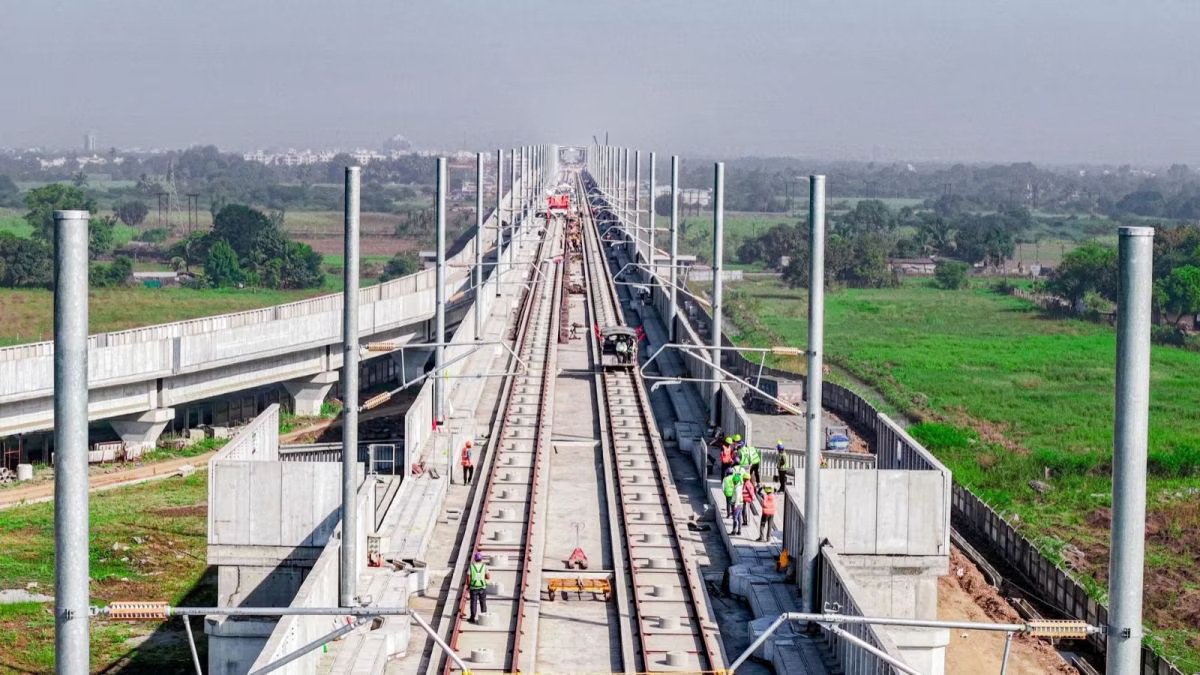
India’s first high-speed rail corridor has entered a decisive implementation phase, with project management consultancy services for railway systems formally awarded for the Mumbai–Ahmedabad route. The move marks a shift from civil construction towards complex systems deployment, signalling progress on a corridor expected to redefine intercity mobility between Maharashtra and Gujarat.
The contract has been awarded by National High Speed Rail Corporation, the special-purpose vehicle overseeing the project, to a joint venture between SYSTRA and DB Engineering and Consulting. The scope covers project management consultancy for core railway systems across the 508-kilometre alignment connecting India’s financial capital with one of its fastest-growing industrial regions. Industry experts describe the systems phase as the backbone of high-speed rail operations. Unlike civil works, which focus on viaducts, tunnels, and stations, railway systems determine safety, reliability, and capacity. The PMC mandate includes oversight of signalling, telecommunications, train control, and supervisory control and data acquisition systems, ensuring seamless coordination between rolling stock, stations, and central control facilities.
The Mumbai–Ahmedabad high-speed rail corridor is designed for operating speeds of up to 320 kilometres per hour, with average journey speeds significantly higher than existing rail services. Once operational, travel time between the two cities is expected to reduce to just over two hours, compared to six hours by conventional rail. Urban transport analysts note that such time compression could alter business travel patterns, regional labour markets, and real estate dynamics along the corridor. System equipment for the project is being supplied by a separate consortium involving global technology providers, while the PMC role focuses on integration, testing, and commissioning. According to transport planners, this separation of supply and oversight is intended to strengthen accountability and reduce operational risks in a project of unprecedented technical complexity for India.
Beyond mobility gains, the high-speed rail line carries broader urban and environmental implications. Electric high-speed rail is expected to offer a lower-carbon alternative to short-haul aviation and long-distance road travel, supporting national climate goals. The corridor is also expected to catalyse transit-oriented development around stations, encouraging compact growth rather than highway-led sprawl in intermediate cities. The project spans key economic zones in Maharashtra and Gujarat, linking manufacturing clusters, financial centres, and emerging residential hubs. Economists point out that reliable, fast intercity connectivity can deepen regional integration, enabling firms to access wider talent pools while reducing the need for carbon-intensive commuting patterns.
As systems work begins to gather pace, attention will turn to coordination between civil readiness, rolling stock delivery, and safety certification. For India’s high-speed rail ambitions, successful execution of this phase will be critical—not just for meeting timelines, but for setting operational benchmarks for future corridors planned across the country.
NHSRCL Advances Mumbai Ahmedabad Bullet Train Systems