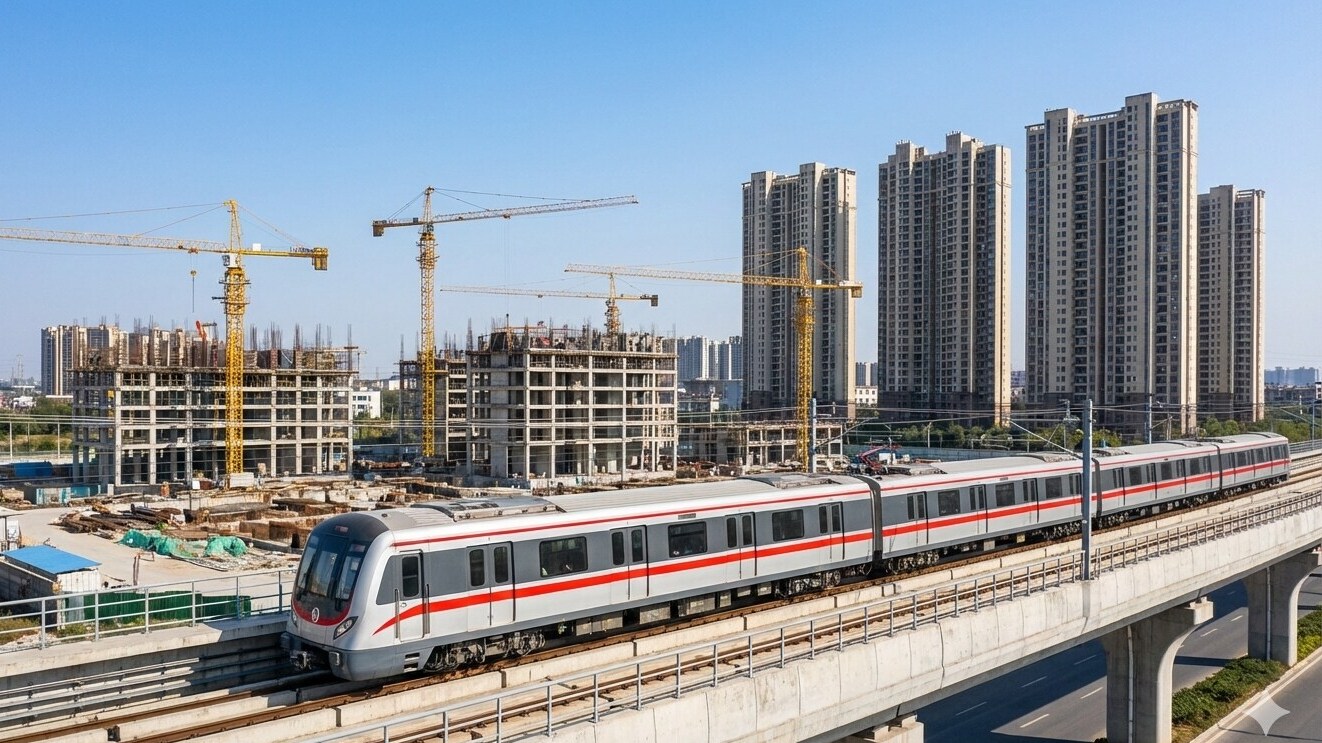
The Maharashtra government has cleared a critical urban transport corridor linking Mumbai’s two international airports, approving Metro Line 8 as a high-speed rail connection aimed at easing congestion and reshaping regional mobility. The project, spanning Mumbai and Navi Mumbai, is positioned as a strategic intervention to support airport-led growth while reducing dependence on road-based travel across the metropolitan region.
Metro Line 8 will connect Chhatrapati Shivaji Maharaj International Airport and Navi Mumbai International Airport through a 34.9-kilometre corridor designed for faster, high-capacity movement between the two aviation hubs. Urban planners say the link reflects a shift towards integrated, rail-based connectivity as air traffic, logistics activity, and passenger volumes expand across the Mumbai Metropolitan Region. The project will be executed by the City and Industrial Development Corporation under a Public–Private Partnership framework, with construction, financing, operation, and eventual transfer bundled into a single concession. To improve commercial viability, the Centre and the state will jointly support the project through viability gap funding, covering 40 per cent of the overall cost. Industry analysts note that such funding structures are increasingly central to delivering capital-intensive urban rail systems that deliver strong public value but limited short-term returns.
With an estimated investment of over ₹22,800 crore, the corridor will include 20 stations, combining elevated and underground sections to navigate dense urban zones and sensitive land parcels. More than two-thirds of the alignment is planned on elevated structures, while underground stretches are intended to minimise surface disruption near critical transport and residential areas. Transport experts say this hybrid design balances speed, capacity, and urban impact in one of India’s most complex metropolitan geographies. Beyond airport access, Metro Line 8 is expected to relieve pressure on heavily used road corridors such as the Sion–Panvel highway and the trans-harbour sea link, which currently handle a mix of freight, airport traffic, and daily commuters. By shifting a portion of this demand to electric rail, the project aligns with broader climate and air-quality goals, reducing emissions associated with private vehicles and long-haul taxis.
Operational planning suggests high-frequency services once the corridor becomes fully functional, with ridership projected to approach one million daily passengers in the early years of operation. Urban economists highlight that such volumes could stimulate transit-oriented development around stations, encouraging compact commercial hubs and mixed-use districts rather than car-dependent sprawl. Construction is scheduled to begin in mid-2026, with completion targeted for the early 2030s. A dedicated oversight mechanism led by senior administrative officials will monitor progress, while rehabilitation measures are planned for affected households and landholders. As Mumbai’s aviation and urban footprints continue to expand eastwards, the success of Metro Line 8 will likely shape how future infrastructure balances speed, sustainability, and equitable access across the region.
State Sanctions High Speed Metro Between Mumbai Airports