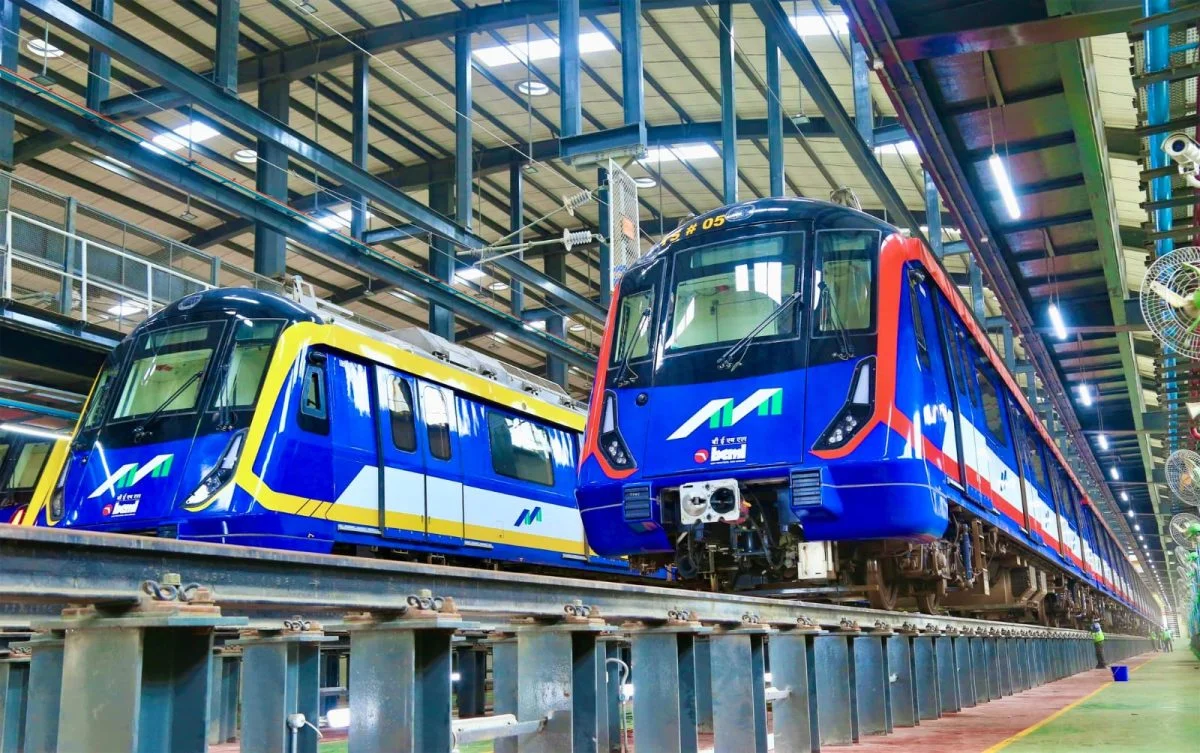
The board of Mumbai Metropolitan Region Development Authority has cleared a major addition to the region’s mass transit map, approving Metro Line 12A to strengthen east–west connectivity across some of the Mumbai Metropolitan Region’s fastest-growing urban clusters. The decision addresses chronic congestion along the Kalyan–Shilphata corridor while signalling a renewed emphasis on rail-led urban growth in peripheral cities.
Metro Line 12A has been designed as an extension of the existing Line 12, running largely parallel to the heavily burdened Kalyan–Shilphata Road. Spanning roughly 18.4 kilometres with 12 elevated stations, the corridor will link residential and employment zones across Kalyan-Dombivli, Thane, and Navi Mumbai, areas that have seen rapid population growth without corresponding upgrades in public transport capacity. Urban planners say the approval reflects a strategic shift away from road-dependent expansion. Daily traffic on the Kalyan–Shilphata stretch has risen sharply in recent years, driven by logistics hubs, housing developments, and industrial estates. The new metro line is expected to divert a significant share of commuters from private vehicles and buses, easing pressure on roads while improving travel reliability for workers moving between eastern suburbs and Navi Mumbai’s employment centres.
The project has received administrative clearance for an estimated investment of ₹8,414 crore. Officials involved in the planning process indicate that cost efficiency and construction timelines will be closely monitored, particularly as elevated corridors pass through dense urban pockets. Once operational, Metro Line 12A is projected to cut travel times substantially for daily commuters while offering predictable, all-weather mobility—an increasingly critical factor amid erratic monsoon patterns and climate stress. A key design feature is partial track and station integration with the proposed Metro Line 14 between Katai Naka and Kalyan Phata. Transport experts note that such interoperability reduces duplication of infrastructure, lowers long-term operating costs, and allows passengers to move across the metropolitan region with fewer interchanges. The corridor is also planned to interface with the Nilje depot and future regional rail and high-speed rail nodes, reinforcing multimodal integration.
Beyond mobility, the metro expansion is expected to influence real estate and land-use patterns. Improved transit access typically drives higher-density, mixed-use development around stations, creating opportunities for more walkable, inclusive neighbourhoods if supported by appropriate planning controls. Housing analysts caution, however, that affordability safeguards and last-mile connectivity will determine whether benefits are widely shared. As construction planning advances, attention will turn to execution timelines, environmental management, and coordination with local civic bodies. For a region grappling with congestion, emissions, and spatial inequality, Metro Line 12A represents not just a transport project, but a test of whether infrastructure investment can deliver more balanced and resilient urban growth.
MMRDA Expands Metro Network Across Eastern Corridor