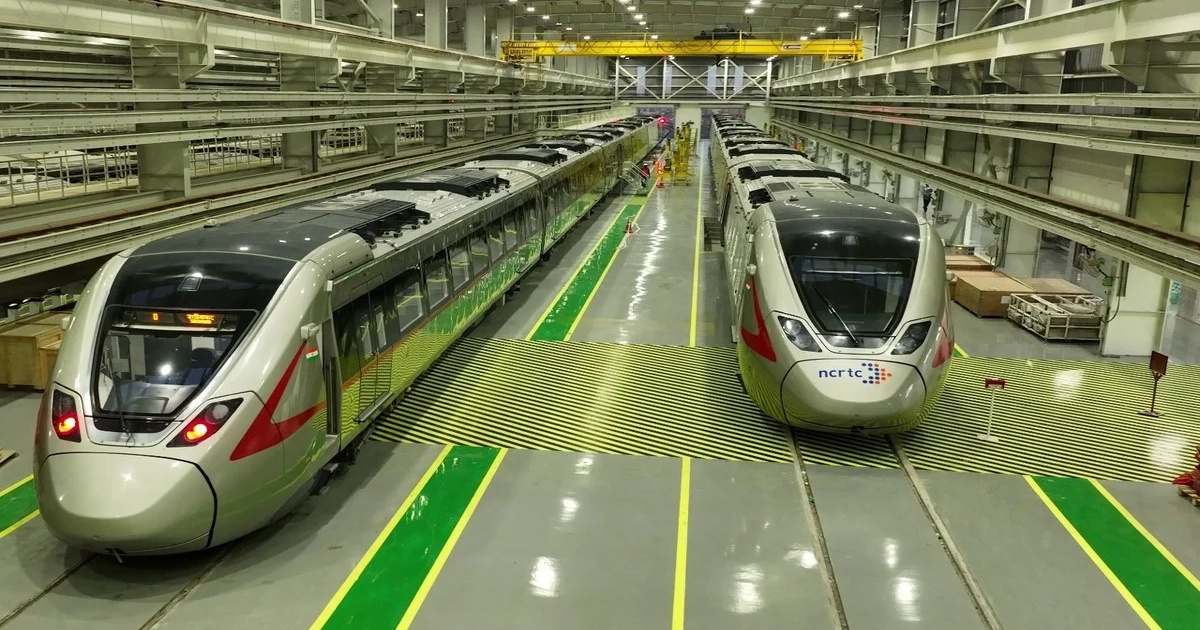
NCR Plans New Rapid Rail Corridors From Sarai Kale Khan
New Delhi — Plans are underway to extend the National Capital Region’s (NCR) high-speed Regional Rapid Transit System (RRTS) with two new corridors originating from the major interchange at Sarai Kale Khan, officials have confirmed, a move expected to significantly expand regional connectivity and enhance the sustainability of commuter networks in northern India.
These extensions, still awaiting final approvals, highlight how integrated transit infrastructure can reshape mobility, urban growth and economic linkages across state boundaries. The two proposed corridors — one linking Sarai Kale Khan to Karnal in Haryana, and another connecting Sarai Kale Khan via Babarpur to Neemrana in Rajasthan — are being studied by central agencies for environmental clearances and detailed engineering assessments. Transport authorities say these routes would complement the operational Delhi–Meerut RRTS (often branded as “Namo Bharat”), which has already transformed travel times and multimodal connectivity across the NCR. The existing RRTS network is designed to provide high-speed, regional rail travel at up to 180 km/h, drastically reducing travel times between cities and decongesting major highway corridors historically burdened by private cars and buses.
Complete 82 km operation between Delhi and Meerut was recently inaugurated, linking several major hubs in under an hour and integrating RRTS with metro, intercity rail and bus systems at stations like Sarai Kale Khan, Anand Vihar and New Ashok Nagar. As the RRTS blueprint evolves, Sarai Kale Khan is being developed into a multi-modal transport hub that can accommodate multiple regional corridors. The station is strategically located near the existing metro and national railway infrastructure, enabling smooth transfers and reducing passenger friction — a key requirement for sustainable urban mobility. Planners emphasise that expanding regional transit beyond the first priority corridor can catalyse equitable economic growth. New fast-rail links into Haryana and Rajasthan would tie industrial towns and satellite cities more closely to employment and service markets in Delhi and Gurugram, potentially decentralising economic activity and easing pressure on core metropolitan districts.
Early conceptual designs suggest such corridors could serve industrial zones, educational clusters, and logistics hubs, unlocking balanced regional development that spreads opportunity and reduces long, carbon-intensive commutes. The new corridors are also integral to a transit-oriented development (TOD) philosophy now being adopted across the NCR, where high-capacity transport projects drive concentrated growth along station-centred nodes. This model encourages compact, mixed-use development — including housing, retail and services — in proximity to transit access points, which can reduce dependence on personal vehicles and support healthier, greener communities. However, realising this vision will require coordinated planning across agencies and state boundaries. Integrating land use policies, financing frameworks and environmental safeguards is essential to ensure that infrastructure investments deliver equitable benefits, minimise displacement pressures, and support resilient, climate-aware growth.
Experts also note that last-mile connectivity — such as feeder buses, safe walking and cycling routes — must be prioritised to ensure regional rapid transit catalyses inclusive access across socioeconomic groups. If approved and funded, the new Sarai Kale Khan-anchored corridors could make the NCR one of Asia’s most sophisticated multi-modal regional transport networks. This would not only ease everyday commuting but also help cities transition toward low-carbon, high-capacity public transit demand as populations and economies expand in the decade ahead.