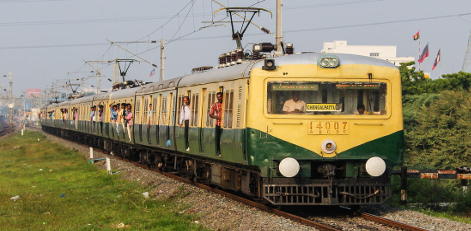
A temporary reconfiguration of tracks at Chennai Egmore railway station has triggered widespread disruption on the Chennai Beach–Chengalpattu suburban section, leaving thousands of daily commuters navigating delays, platform congestion and extended travel times. The operational changes, introduced to facilitate station redevelopment works, have reduced suburban frequencies and rerouted trains across fast and slow corridors, exposing the fragility of peak-hour mobility in India’s fourth-largest urban agglomeration.
Railway officials confirmed that suburban services on the corridor have been temporarily scaled down, with several trains diverted between fast and slow lines in the Park–Egmore–Chetpet stretch. The adjustments are intended to accommodate maintenance and capacity upgrades at Egmore, a key interchange within Chennai’s dense commuter rail grid. However, the knock-on effects have rippled across major stations including Tambaram, Guindy and Chennai Beach, where platforms witnessed heavy overcrowding during the morning and evening rush.
Commuters reported average delays of 30 to 40 minutes, with some services halted repeatedly at signals to allow crossing movements. Transport planners note that when suburban and long-distance express services share limited track infrastructure, even minor sequencing changes can cascade into system-wide bottlenecks. The decision to shift local trains from designated slow-line platforms to fast-line corridors has increased the need for track crossings, slowing throughput during peak demand. The Chennai suburban rail network is among the city’s most affordable and energy-efficient transport systems, carrying lakhs of passengers daily across the metropolitan region. Disruptions to the Chennai Suburban Rail system therefore carry broader economic implications. For many workers employed in central business districts such as Broadway and the IT corridors, delays translate into lost work hours, higher last-mile costs and greater reliance on private vehicles or ride-hailing services outcomes that undermine efforts to build a low-carbon, transit-oriented city.
Urban mobility experts argue that while station redevelopment is essential for long-term capacity enhancement, transitional planning must prioritise passenger communication and service continuity. Reduced frequencies reportedly brought down for several weeks to accommodate works have intensified platform crowding, raising safety concerns and prompting some commuters to exit trains between stations. Chennai’s transport ecosystem is already under strain from rapid peri-urban growth stretching toward Chengalpattu. Investments in multimodal integration, better timetable coordination and real-time passenger information systems are increasingly viewed as critical to resilience. As redevelopment progresses at Egmore, officials have appealed for commuter cooperation, but the episode underscores a structural challenge: expanding infrastructure without paralysing the very network it seeks to improve. With suburban rail central to equitable urban mobility, the coming weeks will test how effectively authorities balance upgrade ambitions with the everyday needs of a city that depends on reliable public transport.