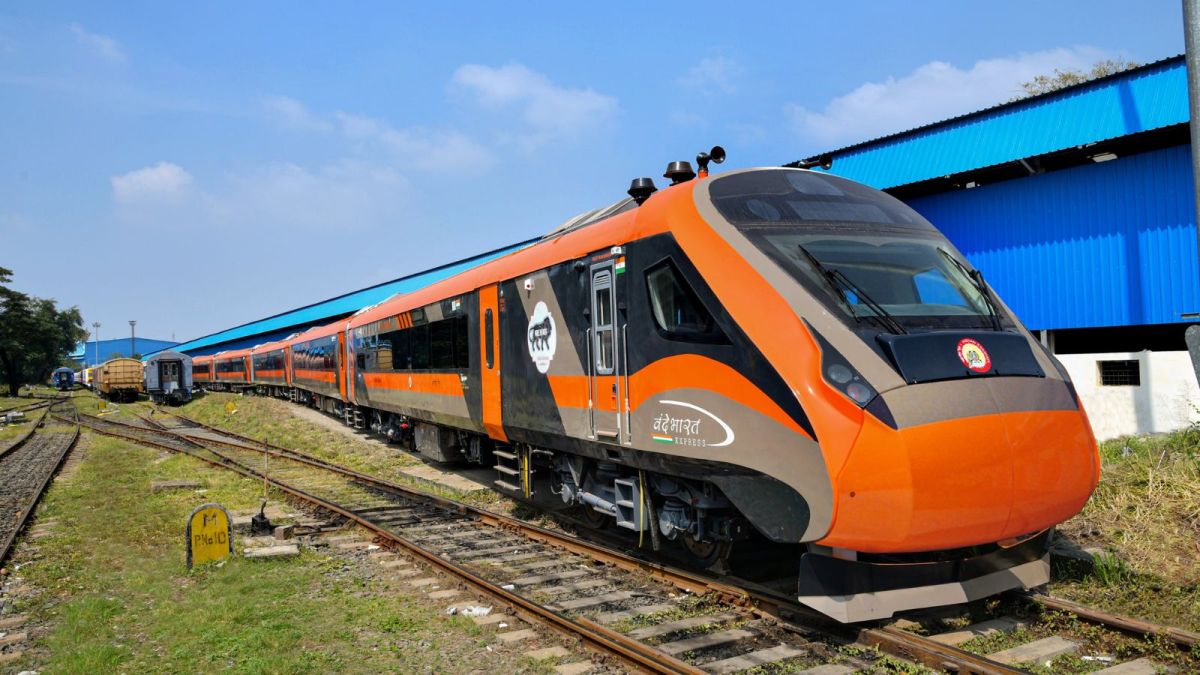
The newly introduced Ahmedabad Udaipur Vande Bharat service has begun operations with an average speed lower than several other semi high speed trains originating from Gujarat, highlighting how terrain and corridor readiness shape performance beyond rolling stock capability. Covering roughly 296 kilometres in a little over four hours with scheduled halts en route, the train’s operational average stands at about 70 kmph.
By comparison, other premium services from Ahmedabad towards Mumbai and Saurashtra record higher averages. Railway officials indicate that the difference reflects geographical and infrastructure realities rather than technical limitations of the train set. The Ahmedabad Udaipur Vande Bharat traverses the Aravalli hill range after departing the plains near Asarwa. The alignment climbs steadily through sections marked by gradients, curves and elevation changes before reaching Udaipur. Mountain rail geometry requires controlled acceleration and braking, particularly on continuous inclines, which reduces sustained high speed running.
Although the corridor has been gauge converted and electrified in recent years, operational certification for higher speeds depends on multiple factors. Track geometry stabilisation, signalling upgrades and fencing along vulnerable stretches are prerequisites for permitting trains to approach their design potential. Railway engineers note that while the route is technically cleared for higher maximum speeds, sectional limits remain in place until safety infrastructure is fully standardised. The corridor’s transformation from metre gauge to electrified broad gauge represents a significant infrastructure milestone linking Gujarat and southern Rajasthan. Improved connectivity is expected to strengthen tourism flows, small business trade and regional mobility between industrial clusters and heritage destinations. Even at its current average speed, the Ahmedabad Udaipur Vande Bharat is the fastest option available on this route.
Transport analysts argue that expectations around semi high speed services must be contextualised. Speed is only one metric; reliability, comfort and journey time predictability also influence economic value. In hilly regions, incremental travel time gains can still translate into meaningful productivity benefits for intercity commuters and tourism-linked enterprises. From a sustainability perspective, electrified corridors reduce dependence on diesel traction and lower operational emissions. However, to unlock the full climate and efficiency benefits of high speed capable trains, supporting infrastructure must evolve in parallel.
Railway planners suggest that gradual improvements in fencing, elimination of remaining level crossings and advanced signalling systems could allow higher sectional speeds over time. As the Ahmedabad Udaipur Vande Bharat matures operationally, its performance may improve in line with corridor upgrades.
For now, the service illustrates the complex balance between engineering ambition and terrain realities. Delivering faster, low carbon rail connectivity across varied landscapes will require sustained investment not only in trains, but in the tracks, safety systems and integrated planning that underpin modern intercity mobility.
Ahmedabad Udaipur Vande Bharat Faces Speed Limits