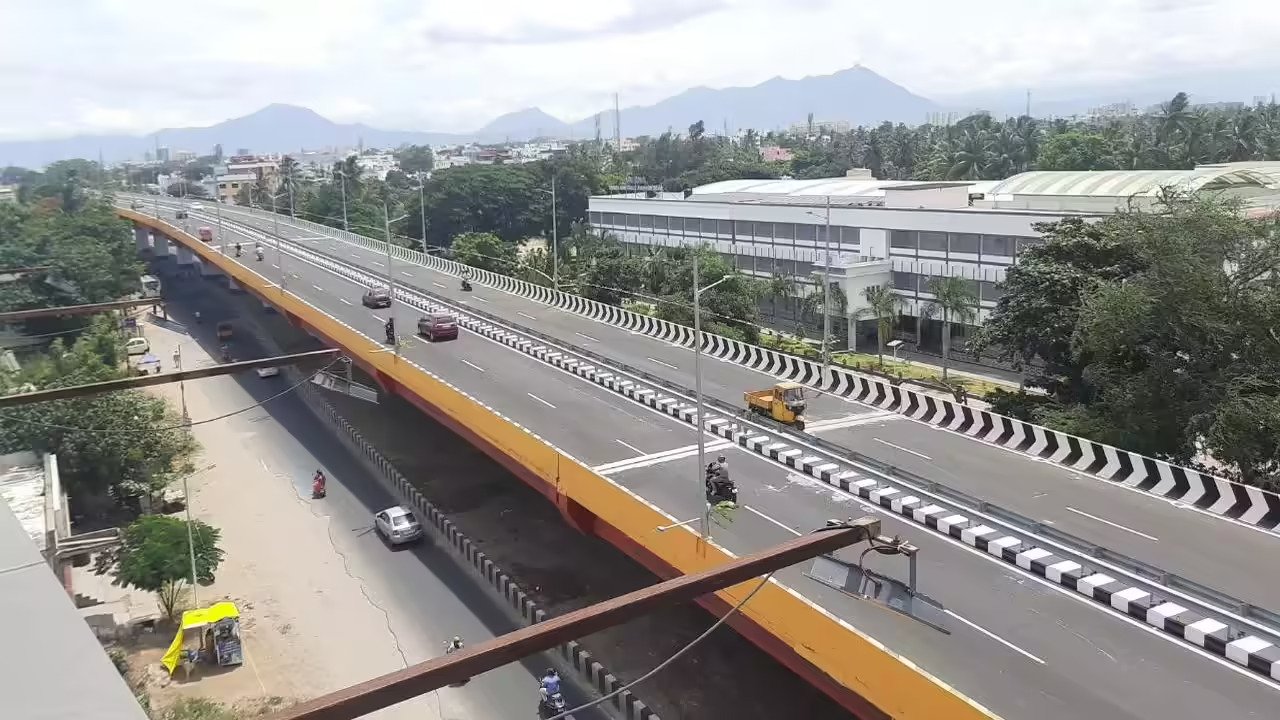
Coimbatore authorities have abandoned plans for a major flyover at Saravanampatti Junction on Sathyamangalam Road, citing the absence of clearance from the Chennai Metro Rail Limited (CMRL). The decision halts a project aimed at easing one of the city’s most congested intersections, raising concerns over long-term traffic management and urban mobility in the growing industrial and residential corridor.
The four-lane, 1.4 km flyover, originally projected to cost over ₹80 crore, had been revived recently following stakeholder consultations despite earlier shelving due to overlapping metro rail proposals. Highway officials now plan to implement junction improvements and road widening measures at an estimated ₹13 crore, a fraction of the flyover’s initial budget. The revised plan has been submitted to the Ministry of Road Transport and Highways (MoRTH) for approval.
Urban planners note that Saravanampatti Junction is a critical node linking residential hubs to Coimbatore’s IT and industrial zones. While short-term interventions like road widening can provide temporary relief, experts caution that piecemeal upgrades rarely address underlying congestion or support climate-resilient transport systems. A senior infrastructure official explained that the overlapping alignment with CMRL’s proposed two-tier metro plan has created regulatory and operational complications, preventing construction of a standalone flyover. The decision also comes amid the ongoing transfer of NH 948 to the National Highways Authority of India (NHAI), covering the 329-km Coimbatore–Bengaluru stretch. Officials indicate that future flyover or grade-separator projects may be reconsidered once NHAI assumes full jurisdiction, though no timeline has been provided. Meanwhile, residents and commuters argue that repeated deferrals risk worsening traffic safety and economic efficiency, particularly as vehicular volumes continue to grow.
Critics emphasise the need for a holistic, people-first approach to urban infrastructure that integrates public transport, walking, and cycling options alongside road-based solutions. Examples from other city junctions show that temporary improvements without strategic planning offer limited congestion relief, while long-term coordination with transit authorities can prevent costly redesigns and delays. Analysts suggest that integrating junction upgrades with climate-resilient design and multi-modal transport planning could enhance mobility while reducing emissions and urban heat impacts. For Coimbatore, the Saravanampatti Junction episode highlights the challenges of synchronising highway infrastructure with planned metro expansion. Authorities are expected to monitor the effectiveness of the current road widening measures and explore coordinated solutions once national highway control is formalised.