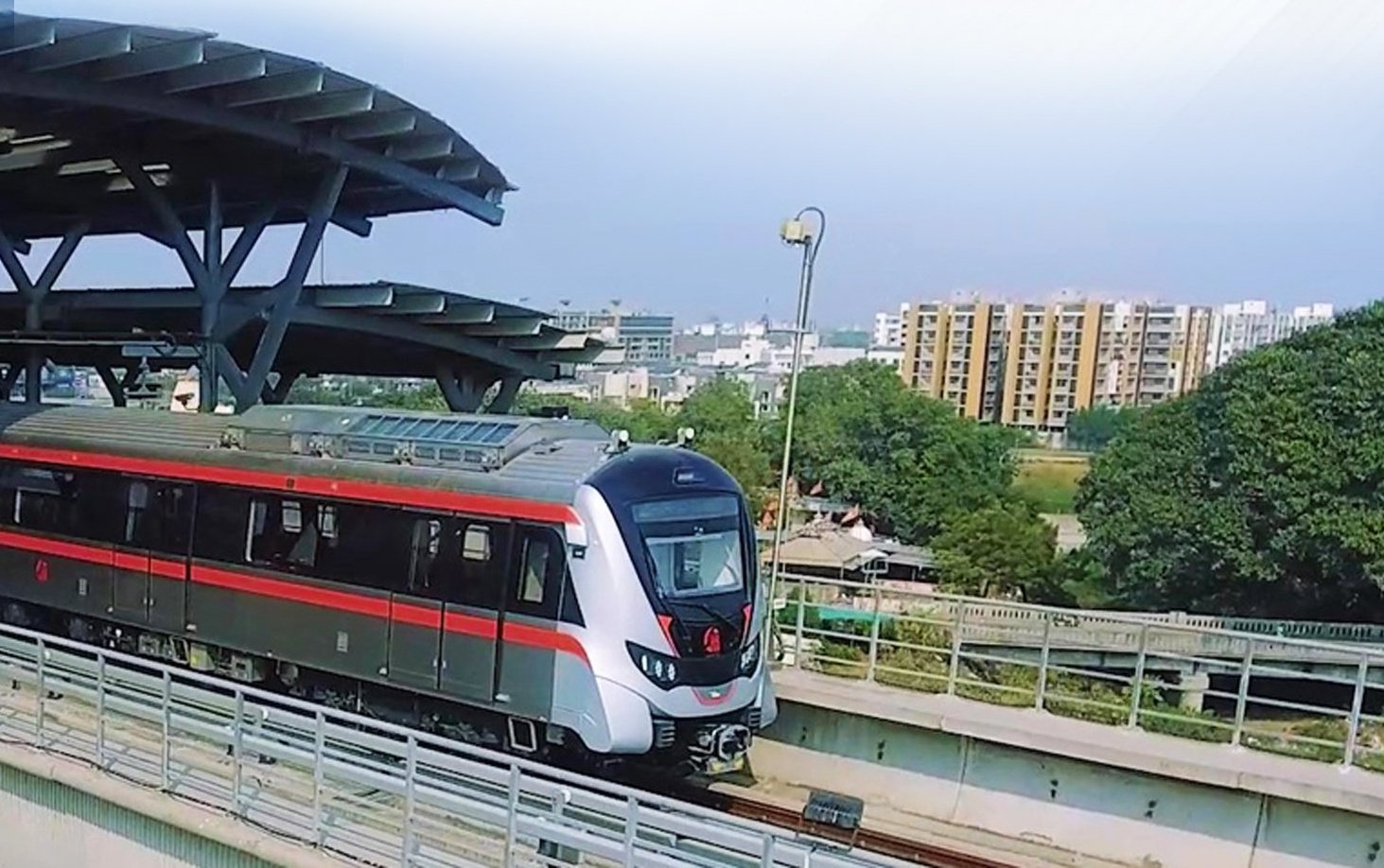
Ahmedabad Metro Timetable Updated For Gift City Link
The Gujarat Metro Rail Corporation has rolled out a revised operational plan for the Ahmedabad–Gandhinagar corridor, altering departure and arrival timings between APMC and GIFT City from 14 February. The move is aimed at tightening peak-hour frequency and improving reliability on a route increasingly central to the region’s economic and administrative mobility.
Under the updated timetable, early morning services have been recalibrated and headways during high-demand hours adjusted to reduce platform crowding and waiting time. The Ahmedabad Gandhinagar Metro schedule now seeks to better align train movement with office, institutional and event-driven commuter flows across the state capital region.The corridor connects key civic and economic nodes including Old High Court, Motera Stadium, Koteshwar Road, GNLU, Infocity, Sachivalaya, Mahatma Mandir and GIFT City. Together, these stations serve government departments, educational institutions, financial offices and convention facilities making schedule precision critical for daily commuters as well as business travellers.Urban transport analysts note that timetable optimisation is often a more cost-effective intervention than adding rolling stock. By refining turnaround times and adjusting dwell periods, metro authorities can extract higher efficiency from existing assets while lowering operational stress. For a growing metropolitan cluster like Ahmedabad–Gandhinagar, such refinements support long-term transit adoption.
The Ahmedabad Gandhinagar Metro schedule revision also arrives at a time when state agencies are encouraging modal shift away from private vehicles. Reduced waiting times and predictable arrival windows are known to influence commuter behaviour, particularly among women, senior citizens and first-time public transport users who prioritise safety and time certainty.From a sustainability standpoint, improved frequency management contributes to higher occupancy rates and more efficient energy use per passenger kilometre. As India’s cities grapple with rising vehicular emissions, optimised metro operations remain a cornerstone of zero-carbon urban transport planning.Real estate consultants tracking the capital region say that dependable metro connectivity continues to shape residential and commercial demand patterns near transit stations. The GIFT City stretch in particular has witnessed heightened investor interest, with connectivity improvements reinforcing its positioning as a financial services hub.
A senior official associated with operations indicated that the revision follows internal ridership assessments conducted over recent months. Periodic timetable adjustments are expected as passenger volumes evolve and as feeder services expand.For daily riders, the changes may appear incremental. Yet in rapidly urbanising regions, such operational fine-tuning often determines whether public transport becomes the backbone of growth or remains a supplementary option.As Ahmedabad and Gandhinagar deepen their integration, transport authorities will likely continue calibrating service delivery balancing efficiency, inclusivity and environmental responsibility in one of western India’s fastest-growing urban corridors.