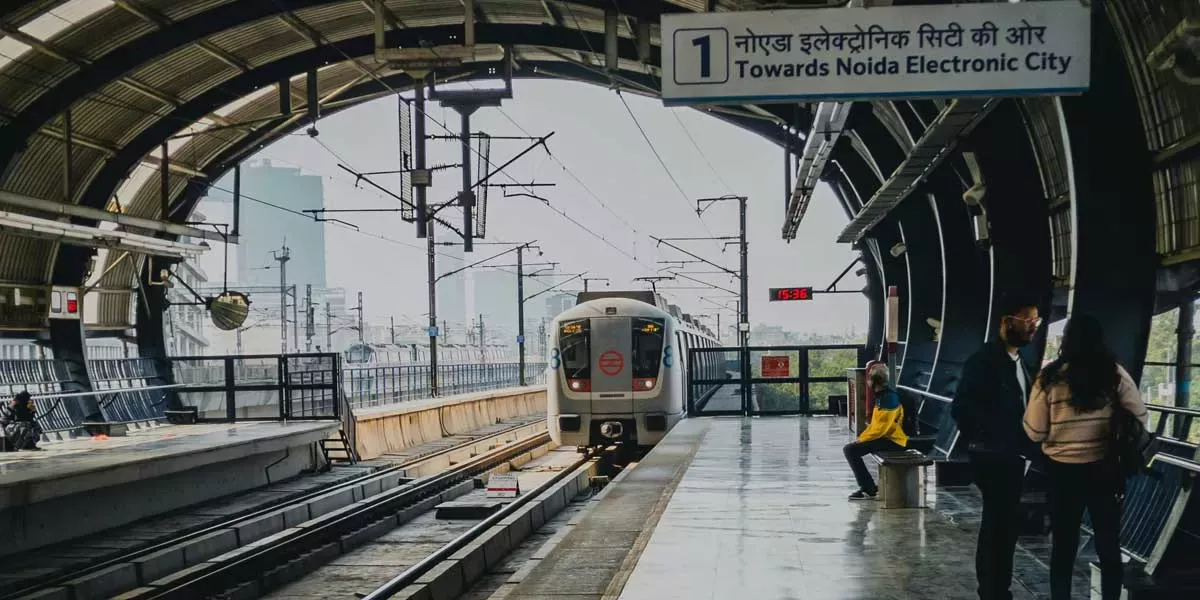
Noida — The Noida Metro Rail Corporation (NMRC) has launched a fresh commercial bidding process for retail and service spaces at the Sector 83 station on the Aqua Line, part of a broader strategy to integrate mobility and urban services while strengthening non-fare revenue streams.
The initiative reflects evolving approaches in urban transport planning that extend the role of metro systems beyond movement to ecosystem-oriented hubs catering to daily commuter needs. Under the tender, approximately 610 square metres of usable kiosk and commercial area on the first floor of the Sector 83 station will be leased to private operators, with additional spaces — totalling about 845 sq m and 1,530 sq m — available at platform and property development levels. A minimum reserve price has been set at ₹205 per square metre, signalling a competitive market for such transit-adjacent retail real estate.
Station-integrated commerce is gaining traction in Indian cities as operators seek sustainable ways to fund expanded services amid rising operating costs. By enabling shops, kiosks and service outlets that are accessible both from outside the paid concourse and directly by commuters, the metro authority aims to create a “one-stop solution” for passengers’ daily errands, food services and convenience needs. This model mirrors similar mobility-oriented development approaches seen in other urban rail systems globally and domestically. The Aqua Line corridor — connecting Noida Sector 51 to Depot Station in Greater Noida — already serves tens of thousands of passengers daily, with average ridership exceeding 63,000 in January 2026.
Sector 83 is among several stations where the transport agency has identified latent commercial value that can support both rider experience and financial sustainability. Alongside the kiosk tender, the metro operator is advancing connectivity improvements such as a soon-to-open skywalk between Sector 51 and Sector 52, and an approved extension towards Noida Sector 142 spanning roughly 11.6 kilometres. Urban mobility specialists emphasise that such efforts can yield multiple benefits when planned coherently. Retail and service nodes within transit stations not only save commuter time but also help reduce short-distance vehicular trips, support micro-enterprise opportunities, and anchor footfall that enhances safety and urban vibrancy around stations. However, they note that execution must balance commercial activation with spatial design and safety standards, ensuring that retail activities do not impede passenger flows or platform operations.
For Noida, blending commercial use with transit infrastructure forms part of a broader citywide trend to embed mixed-use functions into public transport assets. Such integration can reinforce the metro network’s role as an urban spine around which economic and community activities coalesce — a key objective in sustainable urban development.