


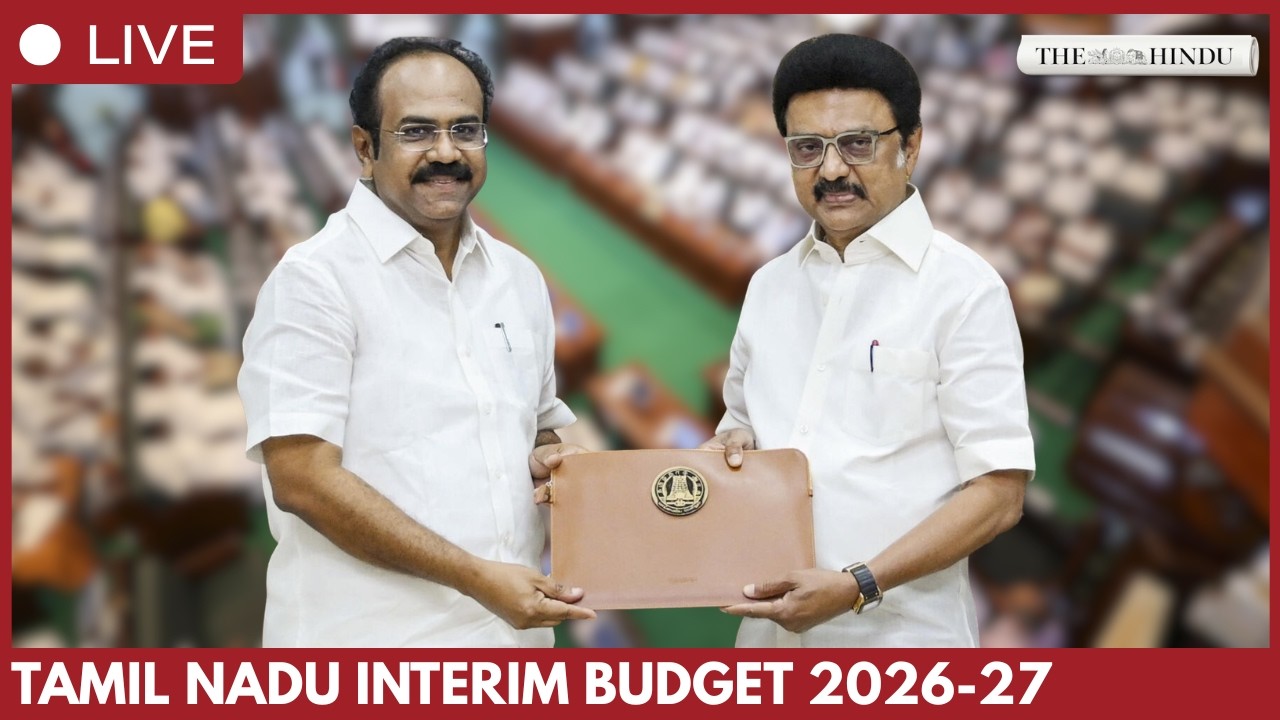
The Tamil Nadu government has unveiled its Tamil Nadu Interim Budget for 2026–27, outlining a spending blueprint that combines welfare expansion with large-scale investments in water security, transport and industrial infrastructure. Presented in the State Assembly months ahead of elections, the fiscal plan signals a calibrated attempt to sustain social support while accelerating the state’s ambition of emerging as a trillion-dollar economy by 2031.
A key urban announcement is a ₹3,109 crore ring main pipeline project designed to strengthen drinking water distribution across Chennai. By interlinking supply stations under the Greater Chennai Corporation, the project aims to build redundancy into the network, reduce supply disparities and enhance resilience against drought cycles. Urban water experts say looped distribution systems are critical for climate adaptation in coastal megacities facing erratic rainfall and groundwater stress.Transport and logistics remain central to the capital outlay. The Highways Department has been allocated over ₹21,000 crore to expand and upgrade road corridors, while the state reiterated its push for metro rail expansion in tier-two cities. Infrastructure analysts view this as part of a broader strategy to distribute growth beyond Chennai and reduce spatial inequality in job creation.
Energy transition is another pillar. With ₹18,091 crore earmarked for the power sector and a forthcoming integrated renewable energy policy, the state is positioning itself to scale clean generation capacity. Tamil Nadu already ranks among India’s leaders in wind energy, and further diversification into solar and storage could support industrial decarbonisation.Industrial policy measures include support for micro, small and medium enterprises and sector-specific clusters in textiles, jewellery and shipbuilding. A proposed shipbuilding cluster in Thoothukudi and new technology parks in emerging cities are projected to create over 25,000 jobs. Economists note that coupling manufacturing expansion with skills infrastructure and worker housing will be crucial to sustaining equitable growth.
On the social front, large allocations continue for pensions, disability support and targeted income schemes for women heads of households. Free bus travel for women and investments in school nutrition programmes are positioned as labour force participation enablers. Health spending exceeds ₹22,000 crore, with primary care outreach and affordable pharmacy initiatives cited as cost-containment measures for low-income families.Climate adaptation measures also feature prominently. Heatwaves have been classified as a state-specific disaster, prompting municipal action plans. Funds are being channelled towards drought mitigation in vulnerable districts and disaster preparedness in hill regions prone to landslides. Environmental initiatives include marine biodiversity conservation in Palk Bay.
For real estate and urban markets, sustained spending on water, transport and knowledge infrastructure could enhance long-term asset stability. However, fiscal prudence and execution capacity will determine whether allocations translate into durable urban transformation.As the election cycle approaches, the Tamil Nadu Interim Budget sets out a dual narrative: welfare continuity alongside infrastructure momentum. The coming year will test how effectively these ambitions are delivered on the ground.
Also Read:Pune Urban Connectivity Boost With Metro Extension
Tamil Nadu Interim Budget Backs Urban Growth
