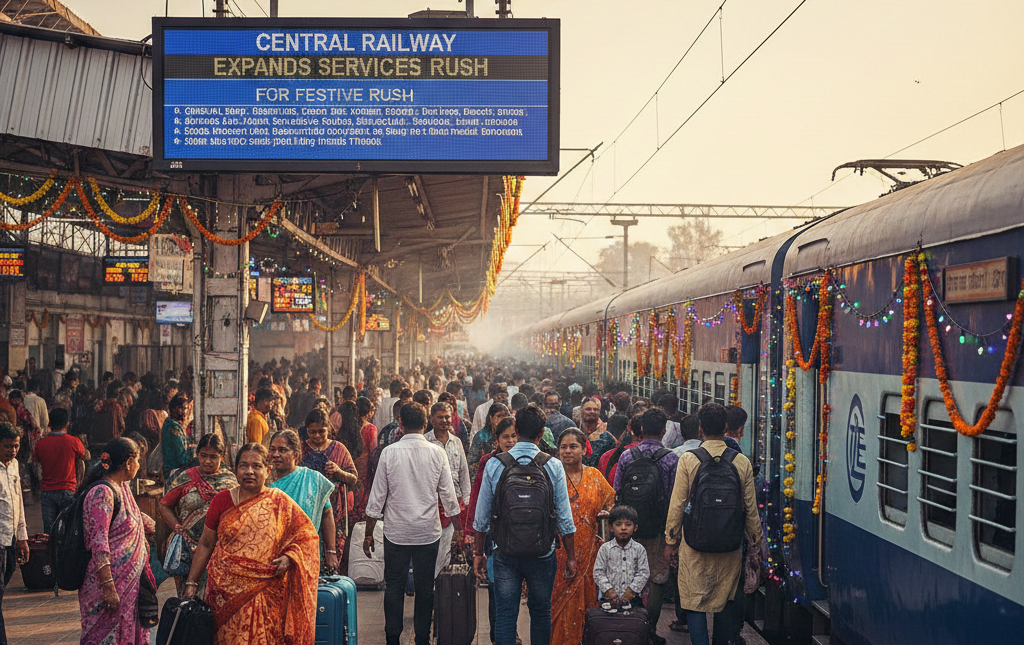
Rail capacity across western and northern India is set to see a significant temporary expansion as Central Railway rolls out an extensive plan to manage peak holiday travel demand. The zonal railway has scheduled 186 special train services linking Mumbai and Pune with major destinations across Maharashtra and North India, a move aimed at easing congestion on long-distance corridors during the upcoming festive and holiday period.
The additional services will operate on some of the busiest intercity and interstate routes originating from Mumbai and Pune, connecting economic hubs and migration-heavy regions such as eastern Uttar Pradesh, Bihar, Vidarbha and the Konkan coast. Railway officials said the temporary augmentation is designed to absorb seasonal surges in passenger volumes that often overwhelm regular timetabled services, particularly during festival-linked travel windows. Key origin points include Chhatrapati Shivaji Maharaj Terminus and Pune Junction, with special trains running to destinations such as Nagpur, Sawantwadi Road, Gorakhpur, Danapur and Hazrat Nizamuddin. The services span daily, weekly and bi-weekly operations, ensuring coverage across different travel patterns, from short-haul regional movement to long-distance inter-zonal journeys.
According to transport planners, such targeted capacity deployment plays a critical role in maintaining the reliability of India’s rail network, especially on corridors that support labour mobility, tourism and regional trade. Mumbai’s rail-linked hinterland includes industrial clusters, agricultural belts and emerging urban centres, making predictable passenger movement essential for economic continuity. Each special service has been configured with a mix of air-conditioned, sleeper and general class coaches, reflecting the diverse socio-economic profile of travellers on these routes. Railway officials noted that this composition is intended to balance affordability with comfort, ensuring that lower-income passengers are not displaced during high-demand periods — a recurring challenge during festival seasons.
Urban mobility experts also highlight the environmental dimension of the move. Long-distance rail travel remains one of the most energy-efficient transport modes available at scale. By increasing train capacity rather than relying on road-based alternatives, the railways help limit emissions growth during peak travel cycles, aligning with broader climate-resilience goals for intercity transport. The expanded timetable is expected to reduce waiting lists and curb overcrowding on regular trains, improving passenger safety and travel experience. For cities like Mumbai and Pune, where rail terminals already operate near saturation, smoothing outbound and inbound flows can also ease station-area congestion and reduce pressure on urban road networks.
Officials indicated that such special operations are increasingly being planned as part of a data-driven response to seasonal demand rather than ad-hoc interventions. As India’s urban population becomes more mobile and festival travel volumes continue to rise, railway authorities may need to institutionalise flexible capacity models to keep pace with changing mobility patterns. The current deployment will be closely monitored, with lessons likely to inform future holiday schedules. For millions of travellers, the additional trains offer not just seats, but greater certainty — a small yet vital factor in making long-distance rail travel more inclusive, reliable and sustainable.
Central Railway Expands Services For Festive Rush