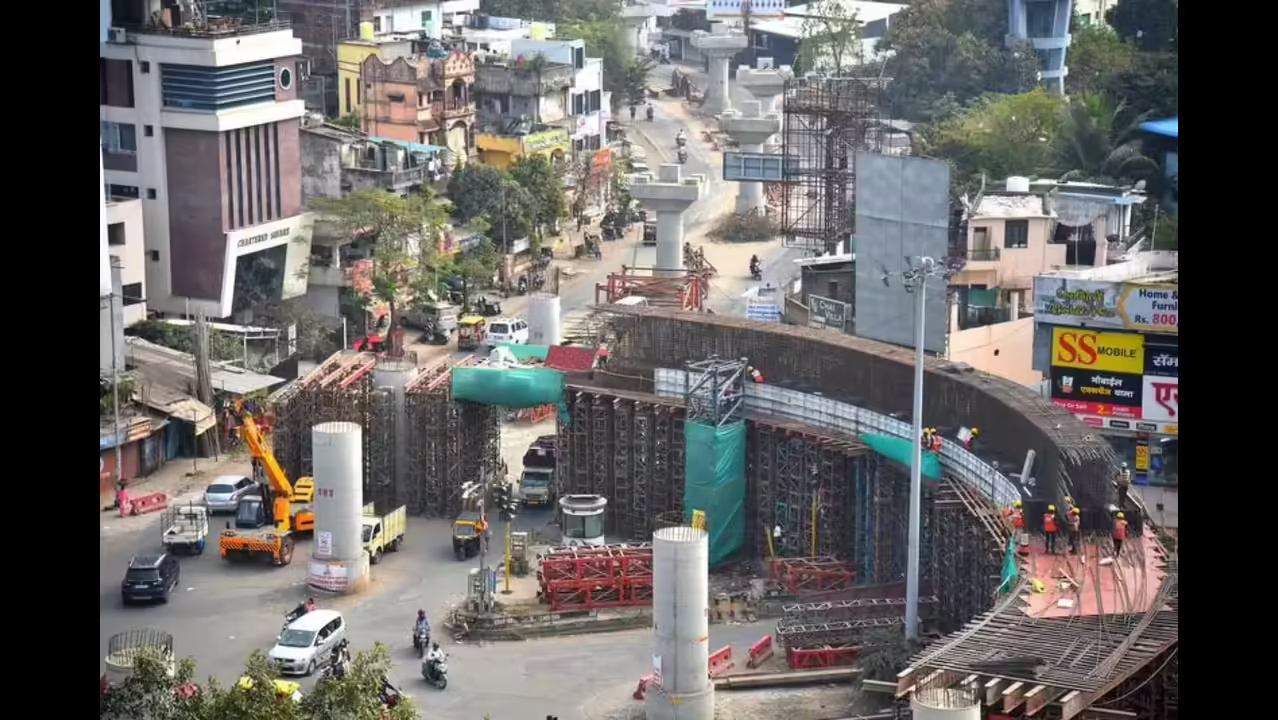
Nagpur — The sprawling Indora–Dighori flyover corridor, one of the region’s most ambitious urban road infrastructure projects, has ignited local backlash and renewed scrutiny of city planning standards after sections of the elevated expressway pass within inches of existing residential and commercial buildings.
What was conceived as a key congestion-relief artery is now prompting questions about safety, community engagement and the fundamentals of inclusive and resilient urban design. Constructed by the National Highways Authority of India (NHAI) with an estimated ₹998 crore investment, the Indora–Dighori project aims to link north and east Nagpur and reduce travel times across a notoriously congested urban grid. Initial sections between Bhande Plot and Dighori are scheduled to open for traffic as early as April 2026, with full completion projected by June. NHAI has highlighted the project’s advanced materials and ecological features, including noise barriers and planned green spaces along interchanges, as part of broader sustainability goals. Yet recent field observations and resident accounts reveal that in several stretches — notably near Agrasen Square, Golibar Square and the Pachpaoli railway crossing — the carriageway encroaches uncomfortably close to built structures, leaving barely a defensive buffer between traffic flows and homes.
Citizen groups argue that such proximity raises practical concerns about noise pollution, vibration exposure, emergency access and long-term structural integrity of adjoining buildings. Urban planners and civic engineers say the controversy reflects a wider challenge in Indian cities where the pace of infrastructure expansion outstrips systematic integration with existing dense urban fabric. “Elevated corridors can deliver significant traffic relief, but without adequate setback distances and safety buffers, they risk compromising livability and community trust,” noted a senior city traffic engineer, speaking on condition of anonymity. Safety assessments and buffer guidelines, they added, must be rigorously enforced at design and approval stages. Critics also highlight that meaningful consultation with affected residents — a cornerstone of equitable urban development — appears to have been minimal as the flyover alignment was finalised.
Beyond local frustrations, the debate touches on economic equity. Small businesses along the corridor report diminished footfall during extended construction phases, and sudden road diversions have constrained access to commercial frontage. These impacts underscore how infrastructure investments, though necessary, can produce asymmetric ripple effects if mitigation strategies aren’t baked into planning from the outset. Municipal authorities are now under pressure to provide transparent technical clarifications and enhanced safety assurances. Among suggested measures are structural reinforcements, expanded crash barriers, audible noise mitigation solutions, and proactive community safety audits — all intended to realign ambitious transport upgrades with the everyday realities of residents living beneath and beside the new flyway.
Nagpur’s experience reflects a broader urban juxtaposition: the imperative to modernise transport networks in rapidly growing cities, while ensuring that expansion doesn’t erode human comfort, equitable access, or public confidence in civic governance. With multiple flyovers already transforming the city’s skyline, officials and planners have an opportunity to catalyse a more participatory, context-sensitive model of infrastructure delivery — one that balances speed with safety, and mobility with meaningful community engagement.